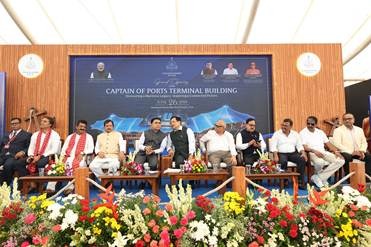
Union Minister Sarbananda Sonowal inaugurated the new Captain of Ports Terminal in Panaji on June 26, 2026. The ₹48.87-crore facility aims to modernize maritime administration. Simultaneously, the Minister announced that the Goa Water Metro project has been fast-tracked to phase-I implementation priority to enhance urban transit and tourism.
Union Minister announces phase-I priority for the transformative Goa Water Metro project, marking a new era in state maritime infrastructure.
PANAJI — Union Minister of Ports, Shipping and Waterways Sarbananda Sonowal inaugurated the new Captain of Ports Terminal Building in Panaji on Friday, June 26, 2026. The ₹48.87-crore waterfront facility is set to serve as the administrative nerve centre for Goa’s maritime operations, marking a significant step in the state's efforts to modernize its port infrastructure and enhance river navigation.
In a major development during the inauguration, the Union Minister announced that the proposed Goa Water Metro project has been moved to "phase-I implementation priority." The project, which was initially envisioned for a later phase, was fast-tracked following a formal request from Goa Chief Minister Dr. Pramod Sawant during a recent visit to New Delhi.
Modernizing Maritime Governance
The new Captain of Ports Terminal Building, developed by the Goa State Infrastructure Development Corporation (GSIDC), is a G+3 structure spanning 4,405 square metres. Inspired by the architectural form of a ship docked along the Mandovi River, the terminal replaces the previous office, which had become insufficient for the department's expanding operational needs.
According to official releases, the facility is equipped with state-of-the-art maritime and hydrographic divisions, navigational control infrastructure, and radio communication centres. Beyond its administrative role, the terminal features public amenities, including a 450-seat rooftop amphitheatre, an indoor restaurant, and an open terrace, aimed at creating a vibrant waterfront hub for both residents and tourists.
Goa Water Metro: A New Connectivity Paradigm
The Goa Water Metro project aims to provide sustainable urban mobility, drawing inspiration from the successful model implemented in Kochi, Kerala. A feasibility study conducted by Kochi Metro Rail Limited (KMRL) previously identified eight viable routes covering a 111-km network, with projections estimating daily ridership to exceed 43,000 passengers.
"I am particularly happy to share that the Goa Water Metro project, which was earlier envisaged in a later phase, has now been brought into phase-I implementation priority," Sarbananda Sonowal stated during the event. He expressed confidence that the project would transform daily transportation in the coastal state while simultaneously boosting the tourism experience.
Official Sources
The Ministry of Ports, Shipping and Waterways (MoPSW) confirmed that the infrastructure project aligns with the Government of India’s Sagarmala Programme and Maritime India Vision 2030. According to government reports, the MoPSW and the state administration are working in tandem to finalize the Maritime Master Plan, which includes the proposed Goa Maritime Board and the Goa Shipbuilding and Ship Repair Policy.
Quote Section
"Today, we are dedicating much more than a building. We are dedicating a symbol of Goa's maritime identity, its commitment to modernisation and its vision for a sustainable and people-centric future," said Union Minister Sarbananda Sonowal.
Goa Chief Minister Dr. Pramod Sawant added, "The state's rivers, which have shaped its history, will drive the next phase of Goa's development by strengthening maritime governance, river traffic management, navigational monitoring and public services."
Why It Matters
The prioritization of the Water Metro and the opening of the new terminal signal a shift toward port-led development that integrates urban transport with the preservation of maritime heritage. For commuters, the water metro offers a reliable alternative to road travel in a geography defined by its interconnected riverine landscape. For the state's economy, these investments—part of a broader ₹2,000 crore maritime push for Goa—are expected to improve logistics efficiency and establish Goa as a hub for maritime education and waterborne tourism.
Key Facts at a Glance
New Terminal Cost: Built at a cost of approximately ₹48.87 crore.
Terminal Specifications: A G+3 facility covering 4,405 square metres, designed to resemble a docked ship.
Water Metro Status: Fast-tracked to phase-I implementation priority at the request of the Goa Chief Minister.
Projected Ridership: Feasibility studies estimate daily ridership for the water metro to be over 43,240 passengers.
National Context: Part of the broader Maritime India Vision 2030 and Sagarmala Programme.
Frequently Asked Questions
What is the primary function of the new Captain of Ports building?
The building serves as the administrative headquarters for the Captain of Ports Department, housing navigational control, marine and hydrographic offices, and public facilities.
Why was the Goa Water Metro priority level changed?
It was advanced to phase-I implementation priority following a direct request from Chief Minister Dr. Pramod Sawant to the Union Ministry of Ports, Shipping and Waterways.
How many routes have been identified for the water metro?
Kochi Metro Rail Limited (KMRL) identified eight feasible routes along a 111-km network in Goa.
What is the total investment in Goa's maritime sector?
The central government is pushing for maritime projects worth approximately ₹2,000 crore in the state to boost infrastructure and connectivity.
Source: Press Information Bureau (PIB), Government of Goa Department of Information & Publicity, ANI News, The Public World