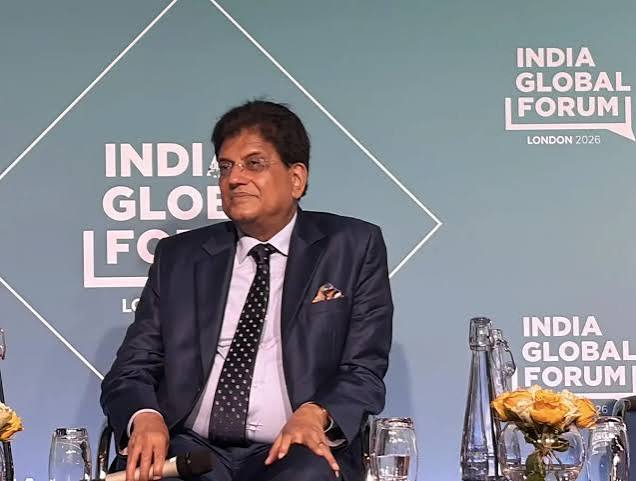
Union Trade Minister Piyush Goyal declared that the 'Made in India' label has become a premier global symbol of trust and quality. Citing the international success of Tamil Nadu's Florence Shoe Company, Goyal stressed that maintaining high manufacturing standards is a crucial national responsibility as India scales up its global trade corridors.
NEW DELHI — India's Union Minister of Commerce and Industry, Piyush Goyal, stated on June 28, 2026, that the 'Made in India' label has evolved far beyond a basic manufacturing marker, establishing itself as a definitive global symbol of trust, quality, and national pride. Addressing a business plenary session during an official trade visit to London, Goyal emphasized that when an entrepreneur applies the 'Made in India' label to any export product, they assume a profound national responsibility to uphold global benchmarks. The development comes as India aggressively expands its international market share and fine-tunes its industrial compliance parameters to integrate with major Western supply chains.
Shifting From Volume to Global Excellence
According to the official ministerial briefing, the Indian domestic manufacturing sector is executing a structural transition away from low-cost, high-volume operations toward high-value, innovation-led manufacturing. This strategic pivot aligns closely with the central government's ongoing push for structural optimization, technical capacity building, and stringent standardization across diversified product groups.
The minister highlighted that international consumer markets are increasingly associating Indian manufacturing origins with high technical durability, ethical sourcing, and operational compliance. Goyal noted that public agencies and private enterprises must collaborate closely to ensure that the domestic ecosystem completely eradicates substandard production lines, protecting the integrity of the collective national trade identity.
The Florence Shoe Case Study: Brand India on Global Display
To illustrate the international reach and prestige of modern Indian craftsmanship, Minister Goyal cited the real-world success of the Tamil Nadu-based Florence Shoe Company. During the London trade session, the minister shared an account regarding the company's founder, Aqeel Ahmed Panaruna, whose manufacturing facilities operate out of the industrial hub of Ambur.
The minister detailed an incident where an international customer discovered a luxury pair of Hugo Boss shoes at the Cairo Airport retail lounge. Upon inspecting the inner stamping, the consumer noted the prominent 'Made in India' label—signaling that premium global fashion houses are structurally dependent on specialized Indian production plants for their top-tier inventories.
The minister emphasized that such examples prove Indian manufacturing has achieved parity with historic European craft hubs. Beyond production quality, the enterprise was lauded for generating large-scale rural employment, introducing zero liquid discharge environmental tech, and advancing women's empowerment within the heavy leather manufacturing sector.
Trade Agreements and Regulatory Interventions
The enforcement of the 'Made in India' label as a symbol of premier quality is backed by comprehensive administrative changes. The Ministry of Commerce and Industry has vastly accelerated the implementation of Quality Control Orders (QCOs), which mandate that domestic and imported goods strictly comply with the Bureau of Indian Standards (BIS).
The strategy has transformed volatile consumer sectors. Prior to regulatory expansion, the domestic market faced heavy influxes of unverified, substandard imports. Following structured QCO applications across sectors like electronics, footwear, and toys, compliant domestic manufacturing grew rapidly, allowing local producers to expand net export metrics across Australia, the Middle East, and Europe.
Official Sources Section
The official policy stances, trade statistics, and corporate anecdotes detailed in this report are sourced from formal releases distributed by the Press Information Bureau (PIB), public social media declarations issued via the Minister’s executive channels, and trade event proceedings documented by the Ministry of Commerce and Industry.
Quote Section
"According to officials from the Ministry of Commerce and Industry, maintaining absolute quality control is no longer an optional corporate benchmark; it is a vital national duty. When you label a product 'Made in India,' you are carrying the reputation of 1.4 billion citizens on global shelves. The government remains fully committed to acting as an industrial facilitator, establishing plug-and-play production infrastructure while ensuring zero compromise on technical standards."
Why It Matters
The evolving prestige of the 'Made in India' label carries tangible economic implications for corporate investors, local small-to-medium enterprises (MSMEs), and the domestic workforce. As India moves toward implementing the comprehensive India-UK Comprehensive Economic and Trade Agreement (CETA), scheduled to take effect on July 15, 2026, a strong reputation for manufacturing quality ensures lower entry barriers into high-premium European retail chains. For consumers worldwide, the label guarantees safe, highly vetted engineering, while domestic workers benefit from sustainable, long-term industrial employment.
Key Facts at a Glance
National Accountability: Minister Piyush Goyal defines the 'Made in India' label as an indicator of national responsibility and global trust.
Premium Brand Acceptance: Major global luxury conglomerates, including fashion house Hugo Boss, rely on manufacturing hubs in regional India for premium consumer lines.
Regulatory Oversight: The Ministry has vastly scaled up Quality Control Orders (QCOs) via the Bureau of Indian Standards to eliminate substandard manufacturing.
Impending Trade Deadlines: The focus on product excellence coincides with the final roll-out phase of the India-UK trade pact starting July 15, 2026.
FAQ Section
What did Minister Piyush Goyal say about the 'Made in India' label?
The minister stated that the 'Made in India' label represents national pride, global trust, and premium quality, noting that manufacturing excellence is a national responsibility for every Indian entrepreneur.
Which company did the minister cite as a success model in London?
He highlighted the Florence Shoe Company based in Ambur, Tamil Nadu, which produces high-end luxury footwear for top global fashion brands like Hugo Boss.
How is the Indian government enforcing quality standards across factories?
The government uses Quality Control Orders (QCOs) monitored by the Bureau of Indian Standards (BIS) to ensure products meet strict safety and durability metrics before entering domestic or international markets.
Source: Press Information Bureau - Ministry of Commerce, Ministry of Commerce and Industry Trade Portals