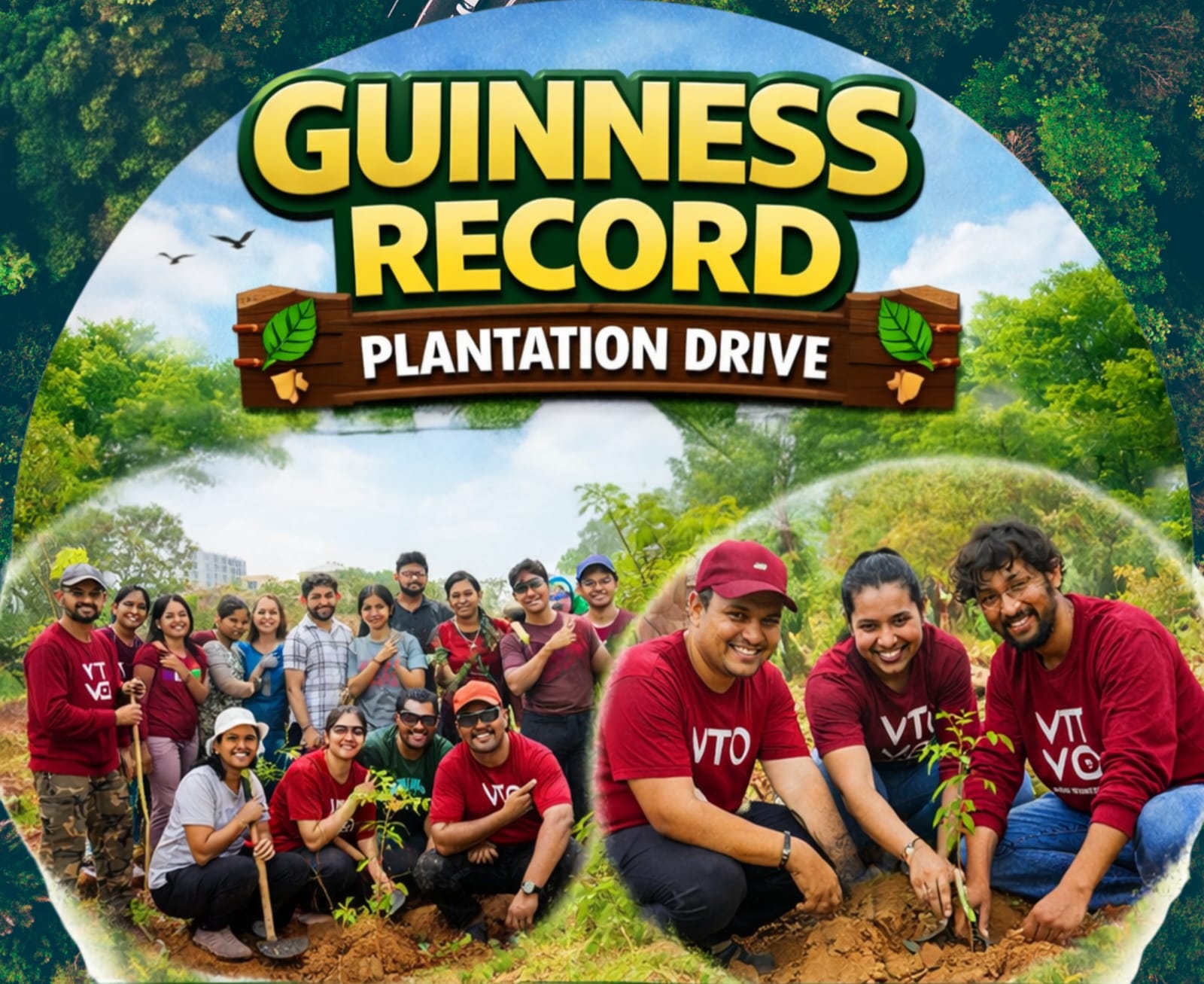
Bengaluru secured a Guinness World Record on June 27, 2026, by planting 1.5 million native saplings within 12 hours. Led by the Bangalore Development Authority and 50,000 volunteers, the massive Miyawaki-style urban forestry project targeted 243 acres to combat urban heat and restore the city's iconic green cover.
BENGALURU, India — In a historic environmental mobilization on June 27, 2026, the Bangalore Development Authority (BDA) successfully entered the Guinness World Records by planting 1.5 million (15 lakh) native saplings across the city within a 12-hour period. The citywide campaign mobilized over 50,000 citizens, students, civic groups, and corporate volunteers, eclipsing the previous single-day planting record of 12.4 million saplings held by Indore. Coinciding with the 517th birth anniversary of Bengaluru's founder, Nadaprabhu Kempegowda, this massive afforestation project aims to fundamentally expand urban green cover and combat the intensifying urban heat island effect across southern India's primary tech corridor.
High-Density Miyawaki Method Drives Massive Scale
The scale of the initiative required a rigorous zone-based execution framework under the broader Green Bengaluru and Bengaluru Urban Ecological Restoration Mission (2026–2030). According to official guidelines released by the Bangalore Development Authority, the afforestation drive targeted roughly 243 to 245 acres of public land. The targeted regions spanned key municipal layouts, including Nadaprabhu Kempegowda Layout, Dr. K. Shivaram Karanth Layout, Banashankari 6th Stage, lake bunds, and civic stormwater drains.
Rather than utilizing traditional linear street-avenue planting, forestry experts deployed a high-density, multi-layered Miyawaki-style method. This dense framework mimics native old-growth dynamics, combining varied structural layers:
Top Canopy Trees (40%): Tall native species like Banyan and Mahogany.
Mid Canopy Trees (40%): Fruit-bearing and shade-providing varieties, including Mango, Jackfruit, Neem, and Wild Mango.
Shrubs and Medicinal Plants (20%): Understory biodiversity like Bilva and Millettia pinnata.
The multi-tiered composition accelerates natural forest growth patterns, generating resilient urban ecosystems capable of growing up to ten times faster than standard commercial tree plantations.
Comprehensive Post-Planting Survival and Tracking Strategy
Recognizing that large-scale environmental drives frequently struggle with long-term survival rates, local regulators established a robust post-planting maintenance mechanism.
"The successful planting of 15 lakh indigenous saplings is one of the most significant environmental conservation programmes undertaken by the BDA," stated BDA Chairman N.A. Haris during a progress briefing. "We are giving a new direction to urban planning by adopting sustainability at every stage of development."
The total financial outlay for land preparation, sapling acquisition, and execution stands at approximately ₹18 crore, with each individual sapling averaging ₹59. To guarantee sustained botanical survival, the BDA has secured a comprehensive corporate social responsibility (CSR) funding structure valued at roughly ₹70 crore. Under this model, partnered non-governmental organizations (NGOs)—including Youth For Seva and Youth For Parivarthan—will take structural responsibility for the newly planted patches for a mandatory three-year period. Maintenance obligations include daily manual watering, protective perimeter fencing, soil mulching, de-weeding, and replacement planting.
Furthermore, every single sapling has been officially geo-tagged. This allows civic observers and forestry departments to track real-time growth progress and evaluate localized canopy density variations through transparent online monitoring portals.
Community-Led Environmental Stewardship
The structural operational blueprint split the 243-acre footprint into 49 dedicated ecological zones managed by distinct ground commanders. Beyond structural conservation, the campaign was intended to catalyze civic action.
Karnataka Chief Minister D.K. Shivakumar, who directly participated by planting saplings alongside school groups, called on educational institutions to help secure the city’s environmental future. The Chief Minister announced that the Greater Bengaluru Authority (GBA) will coordinate municipal competitions encouraging school children to actively adopt and nurture local tree plots, framing environmental stewardship as an ongoing community duty rather than an isolated civic event.
Key Facts at a Glance
Total Saplings Planted: 1.5 million (15 lakh) local and indigenous species.
Timeframe: Completed within a strict 12-hour environmental marathon.
Land Utilization: Distributed across 243 acres, 49 zones, and 314 distinct planting sites.
Civic Turnout: Over 50,000 registered volunteers and civic personnel.
Financial Oversight: ₹18 crore initial project expenditure backed by a ₹70 crore long-term CSR caretaking framework.
Frequently Asked Questions
What species of plants were used in the record attempt?
The plantation drive exclusively featured over 350 variations of native, indigenous, and medicinal plants. Key species included banyan, neem, mango, jackfruit, mahogany, bilva, and various regional flowering variants from the Tabebuia family.
How will the Bangalore Development Authority ensure the trees survive?
The BDA has partnered with prominent local NGOs to manage regular upkeep, watering, and mulching for three years. Additionally, all saplings are geo-tagged, enabling systemic, digital monitoring of survival rates.
Why did the city prioritize the Miyawaki technique over traditional planting?
The Miyawaki technique utilizes dense, layered spacing that allows native species to grow much faster and more compactly. This approach maximizes biodiversity, rapidly establishes self-sustaining urban micro-forests, and creates highly effective barriers against the urban heat island effect.
Source: Official project briefings from the Bangalore Development Authority (BDA), public statements from Karnataka Chief Minister D.K. Shivakumar, and field verification documentation from the Greater Bengaluru Authority (GBA).