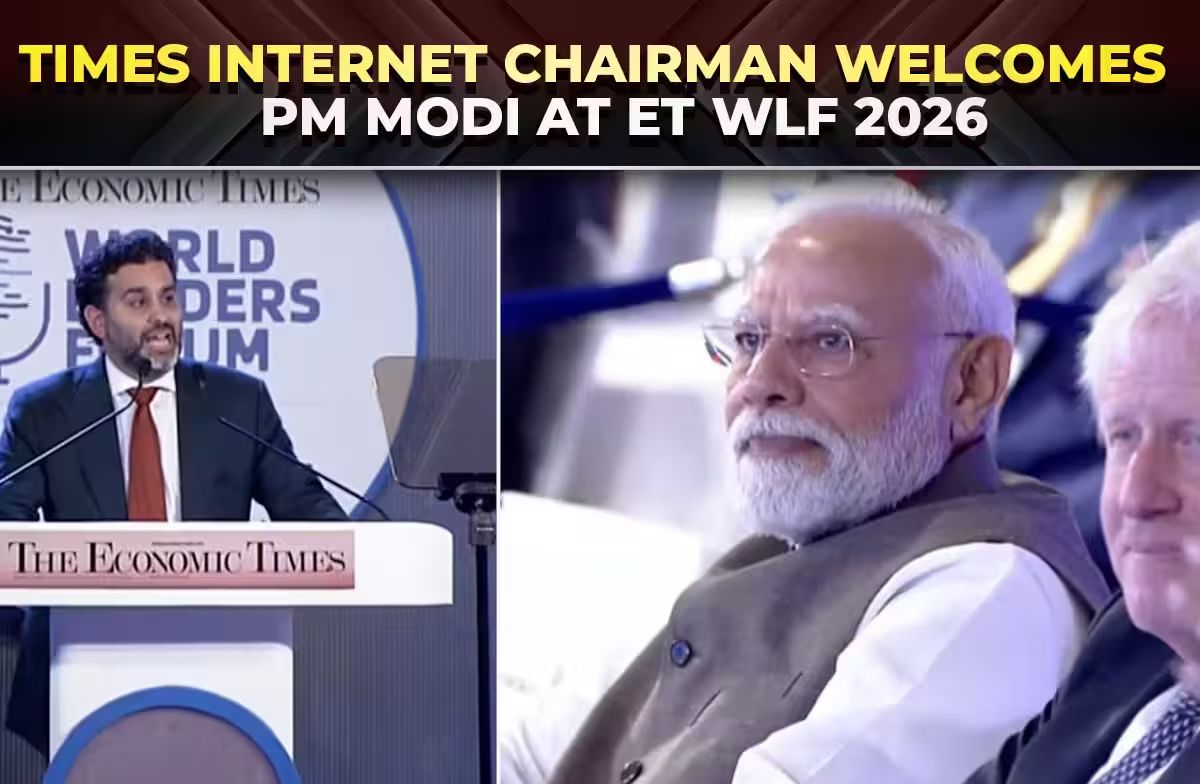
Opening the Economic Times World Leaders Forum 2026 in New Delhi, Times Internet Chairman Satyan Gajwani welcomed Prime Minister Narendra Modi, highlighting his leadership through global crises. PM Modi responded by outlining India's transition from past regulatory bottlenecks to an incentive-driven economic growth model, cementing the nation's global status.
Backed by official summit proceedings in New Delhi, business leaders hailed policy continuity as Prime Minister Narendra Modi outlined India's economic resilience at the Economic Times World Leaders Forum 2026.
High-Level Engagement at the Economic Times World Leaders Forum 2026
The intersection of geopolitical uncertainty and economic transformation took center stage on August 21, 2026, as top policymakers and industry titans gathered in New Delhi for the Economic Times World Leaders Forum 2026. Setting the tone for the high-profile summit, Times Internet Chairman Satyan Gajwani delivered an opening address welcoming Prime Minister Narendra Modi. Gajwani commended the Prime Minister for successfully guiding the nation through an era marked by overlapping global crises, supply chain fractures, and shifting international alliances.
In his introductory remarks, Gajwani emphasized that political and economic stability under Prime Minister Modi’s administration has provided vital predictability for businesses and investors navigating an increasingly turbulent global order. The address set the stage for PM Modi's keynote speech, which focused on structural reforms, regulatory modernization, and India's position as a reliable pillar of international economic growth.
From License Raj to Incentive-Driven Economic Growth
Taking the podium following the opening remarks, Prime Minister Narendra Modi delivered a comprehensive address detailing India's evolving economic philosophy. PM Modi sharply criticized the regulatory constraints of past decades, characterizing the historical license regime as a "Production Linked Punishment" (PLP) model that penalized industrial expansion.
Contrasting past limitations with current policies, the Prime Minister highlighted the success of modern frameworks like Production-Linked Incentive (PLI) schemes and structural tax reforms. Furthermore, PM Modi announced a foundational shift in regulatory governance—moving away from a legacy framework of "prohibited unless permitted" toward a modern standard of "permitted unless prohibited", designed to foster institutional trust between the state and commercial enterprises.
Why It Matters
The discussions and policy shifts unveiled at the Economic Times World Leaders Forum 2026 carry direct implications for global investors, domestic manufacturers, and corporate leaders. By dismantling archaic regulatory hurdles and reinforcing policy continuity, the administration aims to accelerate foreign direct investment, boost industrial self-reliance, and secure India's trajectory toward becoming the world's third-largest economy.
Key Facts at a Glance
Event: Economic Times World Leaders Forum 2026 held in New Delhi.
Key Speakers: Times Internet Chairman Satyan Gajwani and Prime Minister Narendra Modi.
Core Policy Shift: Transitioning from historical "Production Linked Punishment" to modern incentive-based frameworks.
Regulatory Evolution: Shifting administrative philosophy from "prohibited unless permitted" to "permitted unless prohibited".
FAQ Section
What was the primary focus of Satyan Gajwani’s opening address at ET WLF 2026?
Times Internet Chairman Satyan Gajwani praised Prime Minister Modi's leadership in navigating global instability, highlighting how policy continuity has shielded India from international supply chain disruptions and economic volatility.
What did PM Modi mean by the "Production Linked Punishment" model?
PM Modi used the term to describe historical license-era regulations that penalized companies if their output exceeded rigid government-mandated production limits.
How is the government changing its regulatory approach for businesses?
The administration is shifting its bureaucratic framework from "prohibited unless permitted" to "permitted unless prohibited," aiming to reduce red tape and build mutual trust.
Where can readers find complete transcripts of the Economic Times World Leaders Forum 2026?
Full speeches, video highlights, and expert analyses are published regularly through The Times of India and The Economic Times.
Source: The Times of India, The Economic Times