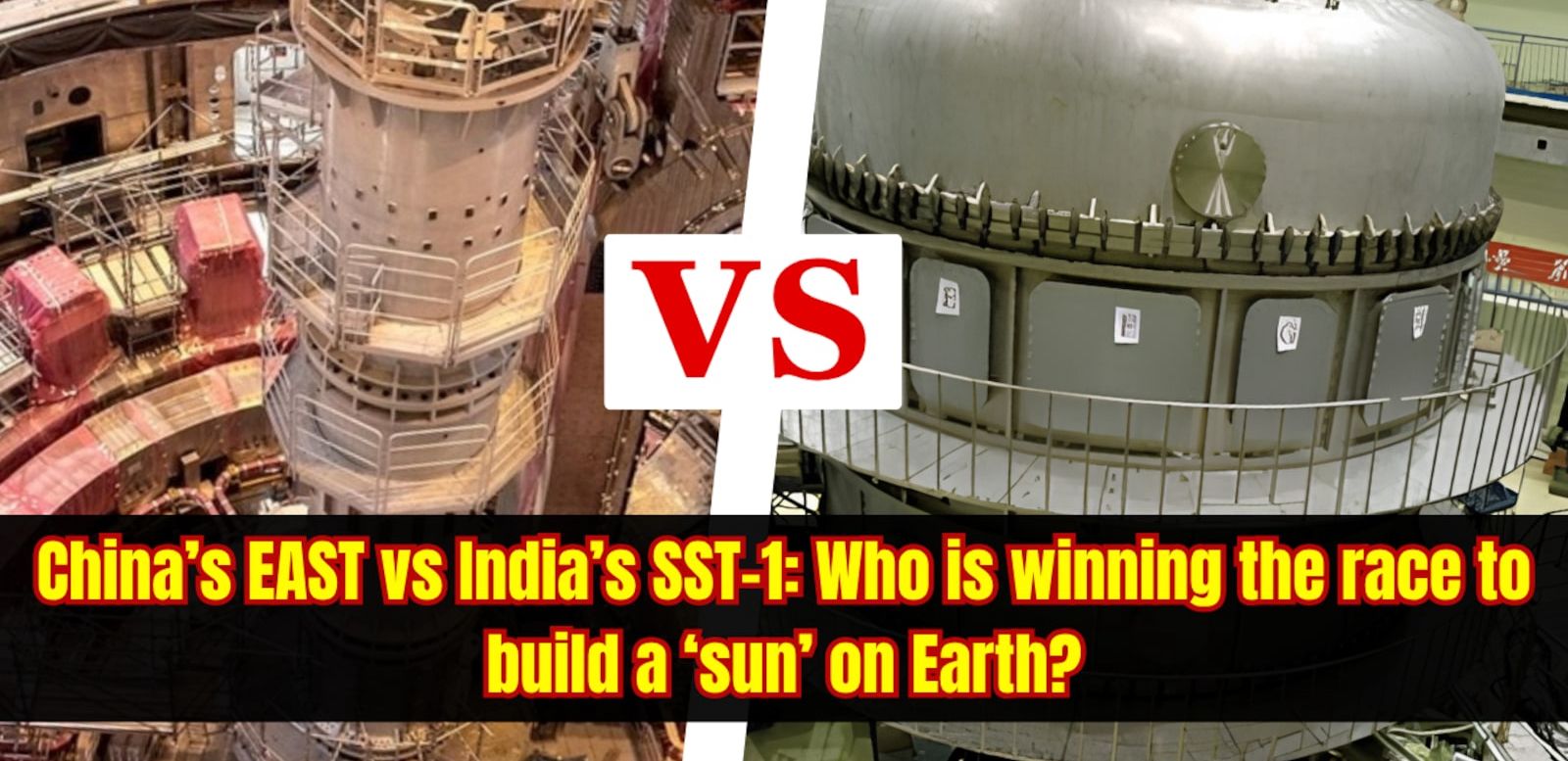
As global powers accelerate efforts to harness clean energy through nuclear fusion, attention has turned to Asia's premier magnetic confinement projects. While China's EAST tokamak has achieved record-breaking plasma durations, India’s SST-1 facility in Gujarat recently integrated advanced gyrotron heating systems, intensifying the scientific race toward commercial fusion.
Propelled by landmark plasma endurance records in Hefei and critical microwave heating upgrades in Gujarat, Asian research facilities are spearheading the global quest to harness nuclear fusion.
As the international scientific community intensifies its search for limitless, carbon-free energy, the technological rivalry between advanced magnetic confinement programs has taken center stage. At the forefront of this movement are two prominent experimental systems: China’s Experimental Advanced Superconducting Tokamak (EAST), operated by the Chinese Academy of Sciences in Hefei, and India’s Steady State Superconducting Tokamak (SST-1), housed at the Institute for Plasma Research (IPR) in Gandhinagar. While both facilities utilize doughnut-shaped tokamak chambers to replicate the core mechanics of the sun, their respective engineering milestones reflect different phases of a complex global race toward sustainable power generation.
Evaluating Tokamak Performance, Plasma Confinement, and Technical Upgrades
Analyzing the operational capabilities of both reactors highlights distinct engineering strategies aimed at solving the primary challenge of nuclear fusion: maintaining stable, ultra-hot plasma over extended periods. According to official institutional releases and scientific disclosures from 2026, the competitive landscape is defined by key technical achievements:
China’s EAST Endurance Records: China’s "artificial sun" has repeatedly pushed operational boundaries, notably sustaining high-confinement steady-state plasma operations for over 1,000 seconds and exploring advanced "density-free" operational regimes.
India’s SST-1 Infrastructure Enhancements: India’s fusion research received a major technical boost with the successful commissioning of an advanced 82.6 GHz, 400 kW gyrotron system on the SST-1 tokamak.
Magnetic Confinement Mechanics: Both devices rely on powerful superconducting magnet systems to suspend plasma heated to tens of millions of degrees Celsius away from physical vessel walls.
Global Collaborative Frameworks: Despite national competition, both China and India participate as core members of the international ITER consortium, sharing foundational data on steady-state plasma physics.
Why It Matters
The practical implications of advancements in tokamak research extend far beyond academic prestige, laying the groundwork for future baseload clean energy grids. For energy-dependent economies like China and India, successful commercial fusion would eliminate long-term reliance on fossil fuels and nuclear fission waste, offering a virtually limitless source of power. For global investors and technology sectors, breakthroughs in superconducting magnets and microwave heating systems drive secondary innovations in materials science and cryogenics.
Key Facts at a Glance
China's Contender: EAST (Experimental Advanced Superconducting Tokamak) located in Hefei.
India's Contender: SST-1 (Steady State Superconducting Tokamak) located in Gandhinagar.
Recent Milestone (EAST): Sustained high-confinement plasma operations exceeding 1,000 seconds.
Recent Milestone (SST-1): Commissioned an upgraded 82.6 GHz, 400 kW gyrotron heating system to enhance plasma stability.
FAQ Section
What is the primary difference between China's EAST and India's SST-1?
While both are superconducting tokamak reactors designed to study magnetic confinement fusion, EAST has achieved longer continuous plasma discharge durations, whereas SST-1 focuses on advancing steady-state 'D'-shaped plasma configurations with recent heating upgrades.
Are either EAST or India's SST-1 currently producing commercial electricity?
No, both facilities are experimental research reactors designed to test plasma physics and engineering principles, serving as testbeds for larger international projects like ITER.
What role does a gyrotron play in nuclear fusion reactors?
A gyrotron is a high-powered microwave device used to inject targeted energy into the tokamak, helping scientists heat and sustain plasma at extreme temperatures.
How do nuclear fusion reactors keep plasma from melting the machine?
Reactors use powerful superconducting magnetic fields to suspend the superheated, ionized gas (plasma) safely in the center of the vacuum vessel without touching the physical walls.
Where can researchers access official technical data on these fusion projects?
Detailed scientific papers, experimental logs, and institutional updates are accessible via the Institute for Plasma Research (IPR) Portal and the Chinese Academy of Sciences Research Platform.
Source: Chinese Academy of Sciences (CAS), Institute for Plasma Research (IPR), India Today, ITER Organization