Key Highlights on Supreme Court’s Stray Dog Directive and Ongoing Legal Developments
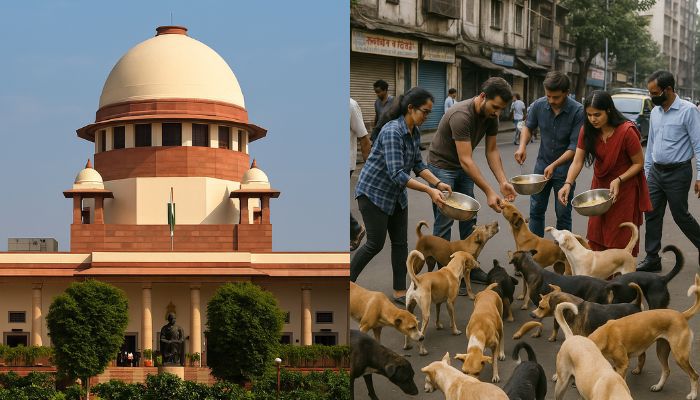
The Supreme Court of India recently directed authorities in Delhi-NCR to capture and permanently house stray dogs within eight weeks, following alarming rabies cases and dog attacks on childr...
Key Highlights on Supreme Court’s Stray Dog Directive and Ongoing Legal Developments
The Supreme Court of India recently directed authorities in Delhi-NCR to capture and permanently house stray dogs within eight weeks, following alarming rabies cases and dog attacks on children.
The order mandates that once picked up, stray dogs must not be released back to public spaces, overriding the traditional Animal Birth Control (ABC) Rules requiring sterilization, vaccination, and release.
Numerous animal welfare activists and NGOs strongly oppose the ruling, calling it inhumane and a potential death sentence for community dogs.
In a recent hearing before Chief Justice of India BR Gavai, an advocate expressed concerns that dogs were already being picked up even though the SC order had not yet been officially uploaded or made publicly available.
The Chief Justice acknowledged the concerns and said he would look into the issue; meanwhile, protests and legal petitions are ongoing.
The Supreme Court bench headed by Justices JB Pardiwala and R Mahadevan underscored an urgent need to curb the stray dog menace to protect public safety, especially young children.
The court issued a strong warning against obstruction, indicating that it would take strict action, including contempt proceedings, against individuals or groups interfering with the dog removal drive.
The court also mandated establishment of a helpline for reporting dog bites and wanted daily records maintained of stray dogs captured and sheltered.
The directive has ignited a nationwide debate balancing public safety concerns with animal rights and welfare regulations.
Background: Why the Supreme Court Took Suo Motu Cognizance
The Supreme Court intervened suo motu in late July 2025 after a series of tragic incidents involving children contracting rabies from stray dogs, culminating in a notable case of a 6-year-old girl’s death. The court described the stray dog situation in Delhi-NCR as "grim" and deemed existing regulatory frameworks ineffective in ensuring community safety.
Traditional ABC protocols—mandating sterilization, vaccination, and release of strays—were ruled inadequate for the current public health crisis. The court ordered an immediate drive to capture all stray dogs, sterilize them, vaccinate against rabies, and house them permanently in shelters. This approach notably challenges established Animal Birth Control Rules and has sparked backlash.
Reactions from Animal Rights Advocates and Authorities
Animal welfare activists, including prominent voices like Gauri Maulekhi and Maneka Gandhi, have criticized the ruling as lacking empathy and scientific basis, highlighting that Delhi has recorded zero human rabies deaths in recent years and warning that mass removals may deprive community dogs of their habitat.
Protests have taken place near India Gate in New Delhi, with some demonstrators detained by police. These groups urge strict implementation of humane ABC measures rather than mass apprehension and permanent detention. Critics stress the lack of adequate shelter infrastructure and question the feasibility of such a massive pick-up operation.
Legal Proceedings and the Current Status
In recent court proceedings, senior advocates have sought clarifications and voiced concerns about the execution and upload of the court's order. During one hearing, an advocate informed Chief Justice BR Gavai that stray dogs were being removed despite the judgment not yet being uploaded on the court’s official website, raising issues about transparency and due process.
The Chief Justice responded by assuring the matter would be considered carefully, signaling possible review or further deliberations. The case has been referred to a three-judge bench for deeper examination, with subsequent hearings expected.
What the Supreme Court Order Entails Practically
Capture of all stray dogs from high-risk areas across Delhi-NCR within eight weeks.
Mandatory sterilization, vaccination, and transfer to designated shelters with CCTV monitoring.
Prohibition of releasing captured dogs back into public or residential areas.
Creation of a dedicated helpline for reporting dog bites with prompt action mandated within four hours.
Vigilant monitoring to prevent any release of dogs, with legal penalties for violations.
Daily records to be maintained by local authorities on dog capture and shelter status.
Broader Implications and Public Safety Concerns
India sees an estimated 5,700 annual human rabies deaths, with over 3.7 million dog bite cases reported in 2024 nationwide, making rabies prevention a critical public health priority. Delhi witnesses thousands of dog bite reports each year, raising alarm among parents and public health officials.
The court’s intervention reflects growing concern over ensuring children’s safety and addressing community fears, albeit at the cost of stirring controversy over animal rights and ethical treatment.
Conclusion: A Complex Crossroads of Safety and Compassion
The Supreme Court’s directive to remove stray dogs across Delhi-NCR, despite opposition and legal challenges, marks a significant moment in India’s management of urban animal populations. Advocates pressing the Chief Justice highlight procedural and humanitarian concerns, while the judiciary emphasizes urgent public safety imperatives.
The forthcoming hearings before a larger bench and ongoing social discourse will likely chart the future course balancing welfare laws, scientific responses, and societal safety.
Sources: New York Times, Down To Earth, India Today