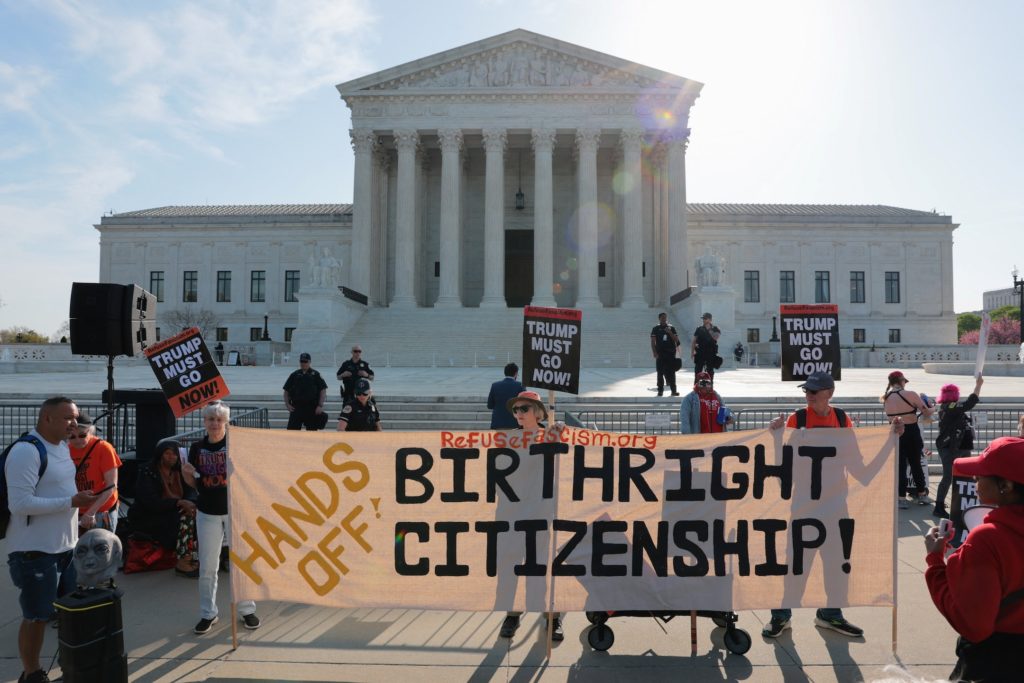
The U.S. Supreme Court has delivered a major defeat to the White House, ruling 6-3 that President Donald Trump’s executive order to end birthright citizenship is unconstitutional. The decision reaffirms that the Fourteenth Amendment guarantees citizenship to individuals born on U.S. soil, regardless of their parents' immigration status.
WASHINGTON — In a historic constitutional decision, the U.S. Supreme Court on Tuesday ruled 6-3 against President Donald Trump’s executive order that sought to end automatic birthright citizenship for children born in the United States to undocumented immigrants or temporary visa holders. The high court affirmed that the citizenship clause of the Fourteenth Amendment explicitly guarantees citizenship to almost all individuals born on American soil, invalidating a cornerstone of the administration's second-term platform before it could take effect.
High Court Reaffirms Constitutional Precedent
The ruling in Trump v. Barbara establishes that executive authority cannot override long-standing constitutional protections. Chief Justice John Roberts authored the majority opinion, which was joined by liberal Justices Sonia Sotomayor, Elena Kagan, and Ketanji Brown Jackson, alongside conservative Justices Brett Kavanaugh and Amy Coney Barrett.
The majority anchored its reasoning in the text of the Fourteenth Amendment and the landmark 1898 precedent United States v. Wong Kim Ark. In his opinion, Chief Justice Roberts systematically rejected the White House's legal theories, noting that history contradicts the administration's revisionist interpretation of federal jurisdiction.
"The trouble is that there is scant evidence for this dramatically revisionist view," Chief Justice Roberts wrote. "The Framers of the Fourteenth Amendment extended that promise to 'every free-born person in this land.' We keep that promise today."
Dissenting from the majority were Justices Clarence Thomas, Samuel Alito, and Neil Gorsuch, who argued that the executive branch held the authority to interpret the parameters of federal jurisdiction regarding foreign nationals.
Broad Impacts Across the United States
The executive action, designated as Executive Order 14160, was signed by President Trump on January 20, 2025. It directed federal agencies to deny passports, Social Security numbers, and citizenship recognition to newborns unless at least one parent was a U.S. citizen or permanent legal resident.
Demographic researchers and civil rights organizations projected that the policy would have reshaped American society. According to data evaluated during the legal proceedings, the order would have denied citizenship to an estimated 250,000 infants born in the U.S. annually, potentially inflating the domestic undocumented population by 25 percent over the next 50 years.
For international businesses, healthcare systems, and state governments, the ruling removes profound operational uncertainty. Hospitals will not be required to verify the immigration status of parents in delivery rooms to process standard birth certificates, a logistical hurdle that had drawn sharp questions from Justice Ketanji Brown Jackson during oral arguments in April.
Official Responses and Legal Reactions
The legal challenge was originally filed in New Hampshire under the pseudonym Barbara on behalf of an asylum-seeker who fled gang violence in Honduras. The lawsuit was supported by a coalition including the American Civil Liberties Union (ACLU), the Legal Defense Fund, and the Asian Law Caucus.
Civil rights advocates praised the decisive nature of the ruling. In an official release, legal representatives emphasized the structural significance of the decision.
"The court's decision reaffirms a fundamental American promise — if you are born here, you are a citizen," stated Cecillia Wang, National Legal Director at the American Civil Liberties Union, who argued the case before the justices. "A president cannot change the Constitution by executive fiat."
Immigration advocacy groups noted the immediate humanitarian relief provided by the permanent injunction.
"The Justices rightly recognized that the U.S. Constitution is clear and unambiguous," said Krish O’Mara Vignarajah, President and CEO of Global Refuge. "Birthright citizenship survived the Chinese Exclusion Act, Jim Crow, and today, it survived an executive order that would have essentially turned the maternity ward into a customs checkpoint."
The White House did not immediately issue a formal statement from the press room, though President Trump indicated via social media that the administration may look toward legislative alternatives.
Why It Matters
The Supreme Court's decision sets a firm boundary on the limits of executive orders regarding settled constitutional law. By striking down the directive, the court has insulated hundreds of thousands of families from immediate legal vulnerability, ensuring equal access to public education, healthcare, and future employment for children born within the United States. For investors and economic analysts, the ruling preserves long-term labor supply projections that rely on standard population growth metrics.
Key Facts at a Glance
The Vote: A 6-3 majority struck down Executive Order 14160, with Chief Justice Roberts and Justices Kavanaugh and Barrett joining the three liberal justices.
The Core Law: The decision explicitly upholds the Fourteenth Amendment, which mandates citizenship for all persons born in the U.S. and "subject to the jurisdiction thereof."
Historical Context: President Trump became the first sitting U.S. president to personally attend oral arguments for this case at the Supreme Court in April 2026.
Potential Impact: Had the order been upheld, an estimated 250,000 children per year would have been denied birthright citizenship.
Frequently Asked Questions
What was the basis of President Trump's executive order?
The administration argued that the Fourteenth Amendment's phrase "subject to the jurisdiction thereof" excluded children born to parents who were in the United States illegally or on temporary visas, asserting that such children owed allegiance to foreign powers.
How did the Supreme Court rule on this argument?
The Supreme Court rejected the argument 6-3, stating that historical evidence and legal precedent since 1898 firmly establish that standard territorial birth automatically confers U.S. citizenship, regardless of parental status.
Does this ruling affect existing citizens?
No. The executive order targeted future births, and the Supreme Court’s ruling permanently preserves the existing system for all individuals born within U.S. borders.
Sources: CBS News, PBS, U.S Department of State, New York City Bar Association, The Washington Post