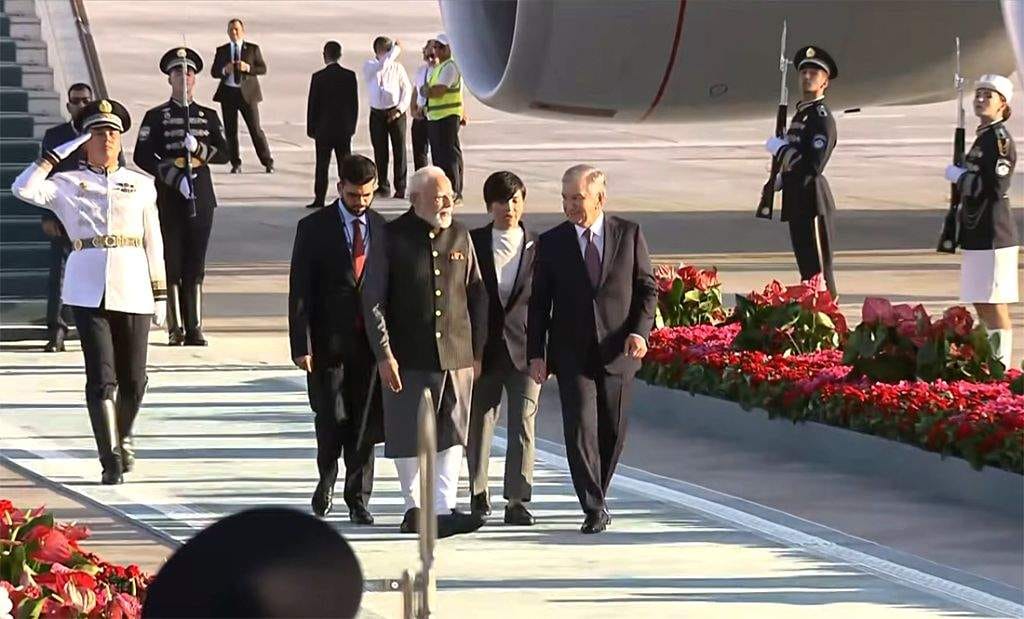
Prime Minister Narendra Modi arrived in Tashkent on August 29, 2026, for a two-day state visit to Uzbekistan. Talks with President Shavkat Mirziyoyev focus on expanding trade, defence, energy, and digital connectivity, alongside alignment with the Viksit Bharat 2047 framework, ahead of the 26th SCO Summit in Bishkek.
TASHKENT — Prime Minister Narendra Modi arrived in Tashkent on Saturday, August 29, 2026, commencing a two-day state visit to Uzbekistan. The trip, undertaken at the invitation of Uzbek President Shavkat Mirziyoyev, marks the Prime Minister's fourth visit to the Central Asian country. The diplomatic leg aims to bolster bilateral strategic partnerships, expand economic cooperation, and align developmental frameworks prior to the Prime Minister’s scheduled attendance at the 26th Shanghai Cooperation Organisation (SCO) Summit in Bishkek, Kyrgyz Republic.
Strategic Agenda and High-Level Delegation Talks
During his stay in Tashkent, Prime Minister Modi will hold comprehensive delegation-level discussions with President Mirziyoyev. According to the Ministry of External Affairs (MEA), bilateral consultations will focus on key economic and security sectors, including digital connectivity, defence cooperation, trade and investment, energy security, education, and health care.
The bilateral dialogue is structured to harmonize national developmental programs, specifically mapping India’s Viksit Bharat 2047 framework against Uzbekistan’s Yangi Uzbekistan (New Uzbekistan) 2030 agenda. Both leaderships intend to review ongoing projects in critical minerals, pharmaceutical manufacturing, and information technology.
Cultural Engagements and Historical Tributes
Beyond economic and security negotiations, the official itinerary includes visits to prominent cultural and historical sites in Tashkent. Prime Minister Modi is scheduled to lay a wreath at the Lal Bahadur Shastri Memorial, commemorating India's second Prime Minister, who passed away in Tashkent in 1966.
The Prime Minister will also visit the Mahatma Gandhi Centre located at the Tashkent State University of Oriental Studies. The center serves as a primary hub for academic exchange and Hindi language instruction in Central Asia.
Official Sources Section
The details and schedule of the state visit were verified through formal briefings and releases issued by official government bodies:
Prime Minister's Office (PMO): Official departure statement outlining strategic focus areas across Central Asia.
Ministry of External Affairs (MEA): Media briefing conducted by Secretary (West) Sibi George detailing bilateral trade figures, SCO participation, and institutional agreements.
Embassy of India, Tashkent: Diplomatic protocol notifications regarding civil society engagements and cultural sites.
Statements from Leadership and Diplomacy
Official statements released prior to the arrival highlighted mutual diplomatic objectives:
"In recent years, the India-Uzbekistan Strategic Partnership has seen significant advancement," Prime Minister Narendra Modi stated in an official release prior to departure. "I look forward to my discussions with President Mirziyoyev on further deepening our cooperation in trade, investment, digital connectivity, defence, and energy."
Ministry of External Affairs Secretary (West) Sibi George confirmed during a media briefing that total bilateral economic engagements between India and Uzbekistan remain near the $1 billion threshold, positioning India among Uzbekistan's top 10 trading partners.
Impact on Trade, Security, and Regional Connectivity
The strategic partnership carries practical implications across multiple sectors:
Commercial & Business Ties: Enhanced frameworks in pharmaceutical export, digital payment integration, and joint venture investments in critical mineral processing.
Regional Logistics: Continued evaluation of trade corridors, including the Chabahar Port transport nexus and the International North-South Transport Corridor (INSTC), designed to streamline Indian cargo flows into Central Asia.
Security Cooperation: Joint counter-terrorism initiatives and expanded military training exchanges under regional stabilization protocols.
Key Facts at a Glance
Dates of Visit: August 29–30, 2026 (Tashkent, Uzbekistan), followed by the SCO Summit in Bishkek (August 31–September 1).
Engagement Count: This marks Prime Minister Modi's fourth official visit to Uzbekistan.
Trade Volume: Bilateral trade and investment between India and Uzbekistan stand near $1 billion.
Key Focus Areas: Defence, digital infrastructure, critical minerals, pharmaceuticals, energy, and educational exchanges.
Next Destination: Bishkek, Kyrgyz Republic, for the 26th Shanghai Cooperation Organisation Summit.
Frequently Asked Questions
What is the primary objective of PM Modi's visit to Uzbekistan?
The visit aims to review and strengthen the India-Uzbekistan Strategic Partnership across trade, energy, defence, digital technology, and critical minerals, while aligning strategic goals under Viksit Bharat 2047 and Uzbekistan-2030.
How many times has Prime Minister Modi visited Uzbekistan?
This state visit marks Prime Minister Modi's fourth visit to Uzbekistan, following trips in 2015, 2016, and 2022.
Where will Prime Minister Modi travel after completing his visit to Tashkent?
Following his bilateral engagements in Tashkent on August 29–30, Prime Minister Modi will travel to Bishkek, Kyrgyz Republic, to attend the 26th SCO Summit scheduled for August 31–September 1, 2026.
Source: Ministry of External Affairs (MEA), Prime Minister's Office (PMO), Reserve Bank of India.