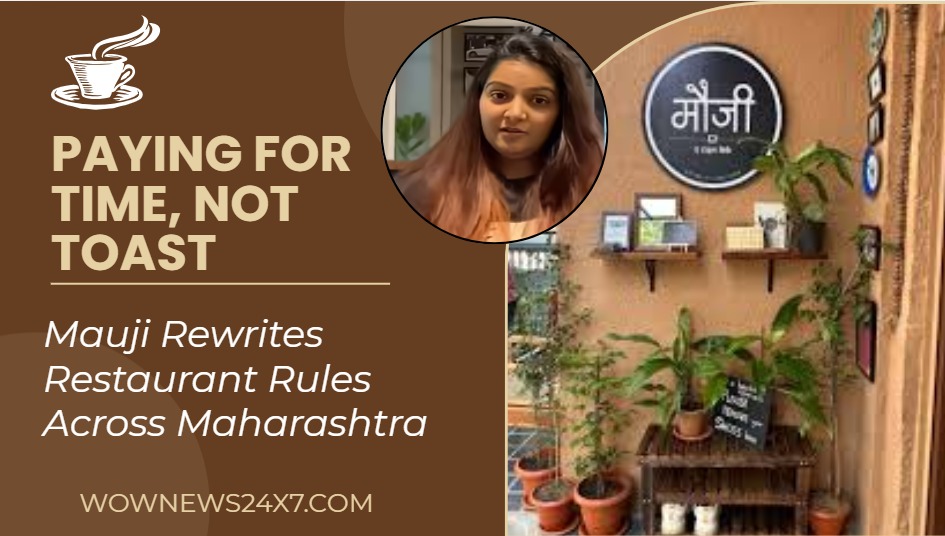
A Maharashtra-based entrepreneur has scaled Mauji, a unique time-based café where customers pay for their duration of stay rather than food. Generating nearly 2 crore rupees in annual revenue, the venture successfully blends co-working, community events, and flexible dining to redefine urban hospitality spaces.
PUNE — Redefining conventional hospitality models, Maharashtra-based entrepreneur Vandita Purohit has turned an unconventional hospitality concept into a thriving commercial enterprise. Mauji, an innovative time-based café operating in Pune and Nagpur, allows customers to pay strictly for the duration of their stay while enjoying complimentary, unlimited beverages. According to recent corporate financial disclosures and enterprise growth reports, the unique community-centric business has scaled rapidly to generate nearly 2 crore rupees in annual revenue. This milestone development is significant today as alternative workspace concepts and experiential third-spaces continue to capture shifting consumer preferences across urban Indian markets.
The Time-Cafe Concept and Operational Model
The operational framework of Mauji breaks away from traditional restaurant economics by treating the physical space itself as the primary commodity. According to company background statements, the idea originated from market observations showing that a majority of café visitors primarily seek spaces to socialize, read, or work remotely rather than consume food.
Pay-By-The-Hour Structure: Customers check in and pay a nominal hourly rate that covers workspace utility, high-speed internet, and unlimited house tea or coffee.
Bring Your Own (BYO) Food: Patrons are permitted to bring external food or order from nearby restaurants, eliminating mandatory menu purchases.
Multipurpose Community Hubs: The expansive properties feature integrated co-working zones, art studios, reading libraries, event lawns, and screening lounges designed to foster creative collaboration.
Economic Growth and Scalability
The steady scaling of the business model highlights the viability of experiential service ventures outside major metropolitan tech corridors. According to enterprise performance metrics, consistent organic footfalls, co-working memberships, and event hosting revenues have propelled annual turnover close to the 2-crore milestone.
Business analysts note that by diversifying revenue streams beyond standard food and beverage margins—incorporating studio rentals, workshops, and retail art displays—time-cafes insulate themselves against traditional restaurant supply chain volatility and food inflation pressures.
Official Sources and Enterprise Statements
Corporate milestones, expansion roadmaps, and business valuations are tracked via official enterprise statements and startup registry disclosures.
"According to company statements and founder disclosures from Mauji management, the enterprise has successfully sustained rapid month-on-month growth by scaling its community-first infrastructure across Maharashtra."
Complete business updates, franchising models, and investor communications can be monitored through official corporate tracking platforms and entrepreneurial networks.
Why It Matters
For urban consumers, freelancers, and small business owners, the time-cafe model offers a flexible, low-cost "third space" that bridges the gap between home and formal offices. For the broader hospitality industry, Mauji's commercial success demonstrates that consumer demand is shifting toward experience-driven, community-centric environments that prioritize comfort and productivity over traditional dining transactions.
Key Facts at a Glance
Founder: Vandita Purohit.
Core Concept: Pay-by-the-hour workspace and time café with unlimited house beverages.
Current Milestone: Annual revenue approaching 2 crore rupees.
Key Locations: Pune and Nagpur, Maharashtra.
Frequently Asked Questions (FAQ)
How does a time-based café operate?
Customers pay for the amount of time they spend at the establishment, which includes access to workspaces, Wi-Fi, and unlimited complimentary tea or coffee, rather than paying for individual food orders.
Can customers bring their own food to Mauji?
Yes, the café operates on a flexible Bring-Your-Own (BYO) model, allowing visitors to bring outside food or order delivery from their preferred restaurants.
What additional facilities are available at these spaces?
Beyond seating zones, the spaces function as multi-utility hubs featuring co-working desks, reading libraries, event spaces, art studios, and screening areas.
Where can official updates regarding the enterprise be accessed?
Official updates, expansion news, and booking details can be found via Mauji’s official corporate channels and business media filings.
Source: Official enterprise disclosures, founder interviews, and hospitality industry reports.