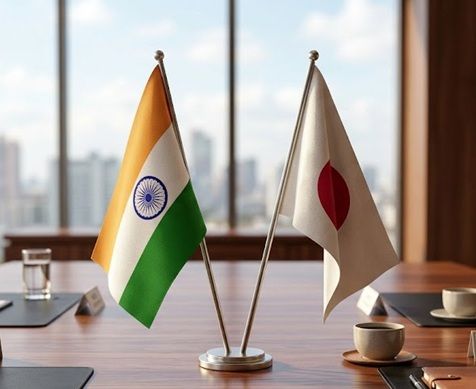
Japan and India’s deepening strategic partnership is rooted in decades of deliberate diplomatic, economic, and cultural alignment. Beginning with post-war peace treaties in 1952 and early ODA loans, Tokyo and New Delhi systematically built a robust "Special Strategic and Global Partnership" to navigate shifting geopolitical landscapes and ensure regional stability.
Backed by historical archives and official Ministry of External Affairs disclosures, the multi-decade evolution of Japan and India’s bilateral partnership reveals a carefully calculated blueprint for regional stability and economic growth.
The robust economic and strategic alignment binding Tokyo and New Delhi did not materialize overnight; rather, it is the product of a deliberate, multi-decade diplomatic strategy. Tracing back to the formal establishment of diplomatic relations through the 1952 peace treaty—one of the earliest signed by post-war Japan—the relationship has steadily matured from cultural affinity into a profound Special Strategic and Global Partnership. According to historical records and diplomatic briefs released by the Ministry of External Affairs (MEA) and Japan’s Ministry of Foreign Affairs (MOFA), key milestones such as the 1958 yen loan agreements, the post-Cold War economic opening of India in 1991, and the 2006 Joint Statement laid an unbreakable foundation for today’s extensive collaboration.
Evaluating Historical Milestones, Economic Assistance, and Strategic Convergence
Analyzing the chronological progression of bilateral ties reveals distinct eras of consolidation that transformed distant acquaintances into vital allies. According to official documentation from Ministry of External Affairs (MEA) Bilateral Briefs and Ministry of Foreign Affairs of Japan (MOFA), core phases of this decades-long strategy include:
Post-War Reconciliation & Early Aid: Following the 1952 peace treaty where India waived reparation claims, Japan initiated its very first global yen loan aid program to India in 1958, cementing early economic cooperation.
Post-Cold War Economic Reset: The dismantling of old bipolar constraints in the 1990s allowed both nations to pursue mutual economic synergies, with Japan expanding Official Development Assistance (ODA) to make India its largest ODA recipient for extended periods.
Institutionalizing Strategic Summits: The formalization of the "Strategic and Global Partnership" in December 2006 during Prime Minister Manmohan Singh’s visit institutionalized annual leader-level dialogues and security frameworks.
The Indo-Pacific Convergence: Under successive administrations, notably catalyzed by former Japanese Prime Minister Shinzo Abe’s 2007 "Confluence of Two Seas" address, both countries aligned India’s Act East Policy with Japan’s Free and Open Indo-Pacific (FOIP) vision.
Why It Matters
The practical implications of this decades-long diplomatic strategy extend far beyond bilateral trade, establishing a reliable anchor for security and economic resilience across the Indo-Pacific. For citizens and businesses, sustained cooperation translates into major infrastructure projects—such as high-speed rail networks and clean energy partnerships—alongside robust supply chain frameworks. For regional stability, the steady institutionalization of trust between Asia's two largest open democracies provides a durable counterbalance to evolving geopolitical uncertainties.
Key Facts at a Glance
Diplomatic Genesis: Official diplomatic relations established on April 28, 1952.
First Yen Loans: Initiated in 1958, marking Japan's earliest government-backed loan aid program globally.
Strategic Elevation: Formalized as a "Special Strategic and Global Partnership" in 2014.
Core Frameworks: Convergence between India’s Act East Policy and Japan’s Free and Open Indo-Pacific Vision.
FAQ Section
When did modern diplomatic relations between India and Japan officially begin?
Formal diplomatic ties were established on April 28, 1952, following the signing of a bilateral peace treaty where India waived all war reparation claims.
What role did Japanese Official Development Assistance (ODA) play in the relationship?
Starting with the first yen loans in 1958, Japan steadily grew its ODA to India, supporting critical infrastructure, power projects, and economic development over multiple decades.
When was the strategic partnership between the two nations formally elevated?
While strategic dialogues intensified after 2006, the partnership was formally updated to a "Special Strategic and Global Partnership" in 2014.
How do India and Japan coordinate their regional security policies?
Both nations align their strategies through the Act East Policy and the Free and Open Indo-Pacific (FOIP) vision, alongside multilateral frameworks like the Quad.
Where can readers review official historical documents on Indo-Japan relations?
Comprehensive historical summaries and treaty texts are accessible through the Ministry of External Affairs (MEA) and the Ministry of Foreign Affairs of Japan (MOFA).
Source: Ministry of External Affairs (MEA) India-Japan Brief, Ministry of Foreign Affairs of Japan (MOFA), Observer Research Foundation Analysis