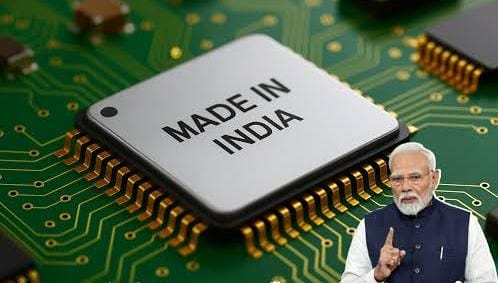
Prime Minister Narendra Modi recently urged top global tech CEOs in New Delhi to supercharge investments in India's semiconductor ecosystem. Highlighting policy predictability, AI integration, and a booming talent pool, Modi's push aims to transform India into a premier global hub for advanced microchip manufacturing and high-tech innovation.
The Race for Silicon Supremacy
We rarely think about the tiny pieces of engineered sand powering our daily lives until they suddenly disappear. From the smartphone in your palm to the vehicle parked outside, semiconductors keep the modern world spinning.
Yet, for decades, the supply lines driving this multi-billion-dollar industry remained dangerously fragile, clustered within a handful of traditional corridors.
Enter Prime Minister Narendra Modi. In a closed-door roundtable at Seva Teerth that caught the attention of global markets, Modi sat face-to-face with the architects of the digital universe—the chief executives steering Micron, AMD, Intel, Applied Materials, and Foxconn. The message was striking in its clarity: India is no longer watching the tech revolution from the sidelines. It wants to anchor it.
Beyond the Grand Vision: The Blueprint for Reality
It is easy for leaders to talk about high-tech futures, but this gathering felt different. Rather than falling back on standard political rhetoric, the dialogue plunged straight into the operational realities of building microchip fabrication plants from scratch.
Modi framed India’s pitch around three distinct advantages: a massive, engineering-heavy talent pipeline, an insatiable domestic appetite for technology, and an infrastructure overhaul moving at breakneck speed. Crucially, the conversation extended past legacy hardware, touching directly on the frontier domains of artificial intelligence and quantum computing.
For international executives hunting for a stable, scalable alternative to traditional manufacturing hubs, the proposition carried undeniable weight.
Cutting Through the Red Tape
Bureaucracy has historically been the silent killer of ambitious industrial projects. Recognizing this, the administration came to the table with a rare promise of agility.
Modi assured global stakeholders that India's regulatory framework would not remain rigid; instead, it is designed to evolve in real-time alongside shifting technological demands. In an unusual display of administrative humility, the government invited executives to hand over direct feedback on streamlining operational hurdles.
When paired with national skilling initiatives designed to train millions of workers in advanced digital fields, the strategy addresses the industry's two greatest fears: regulatory friction and talent shortages.
What the Titans Are Saying
The industry response suggests this pitch is landing where it matters. Representatives from global heavyweights like SEMI, ASML, and Tata Electronics noted the startling speed with which India has built out its semiconductor policy framework under the India Semiconductor Mission (ISM).
When legacy suppliers and emerging domestic powerhouses start singing from the same hymn sheet, global investors tend to listen. The groundwork laid during these discussions is already paving the way for upcoming strategic partnerships and billion-dollar capital allocations.
Official Sources Section
Insights and details for this report are drawn directly from official public announcements and press briefings released by the Press Information Bureau (PIB) and official policy updates from the Prime Minister's Office (PMO).
Quote Section
"Organizers stated that the progress achieved in recent years has created a strong foundation for further industry participation across the semiconductor value chain."
Why It Matters to You
Why should a silicon fabrication plant thousands of miles away matter to an ordinary consumer?
Because supply chain resilience dictates your everyday costs. When manufacturing hubs diversify, the risk of crippling global tech shortages plummets. For consumers, that translates to steadier prices, faster technological leaps, and a more secure digital economy that isn't vulnerable to sudden geopolitical shocks.
Key Facts at a Glance
High-Stakes Dialogue: PM Modi hosted top global tech executives at Seva Teerth to fast-track India's semiconductor ambitions.
Industry Heavyweights: Leadership from Micron, Intel, AMD, ASML, Applied Materials, and Foxconn participated.
Frontier Focus: Discussions zeroed in on scaling the semiconductor value chain, AI integration, and quantum computing.
The Regulatory Promise: The government pledged an adaptable, responsive policy environment tailored to long-term foreign investment.
Frequently Asked Questions
What was the core objective of PM Modi's meeting with tech CEOs?
The meeting aimed to accelerate global partnerships, eliminate administrative bottlenecks, and cement India's status as an indispensable pillar of the global semiconductor supply chain.
Which major companies were represented at the roundtable?
Key players including SEMI, Micron, Intel, AMD, Applied Materials, ASML, and Tata Electronics took part in the high-level talks.
How does India plan to back these massive manufacturing ventures?
Through a mix of flexible policy frameworks, direct industry feedback channels, and sweeping workforce upskilling programs aimed at producing millions of tech-ready professionals.
What does this shift mean for everyday technology?
It promises a more robust global supply chain, reduced risk of electronics shortages, and an accelerated boom in high-tech manufacturing.
Sources: Press Information Bureau (PIB), Prime Minister's Office (PMO), Ministry of Electronics and Information Technology (MeitY).