At the G7 Summit in France, U.S. President Donald Trump strongly praised Prime Minister Narendra Modi, stating India plays a "big role in everything" under his leadership. The leaders held extensive bilateral talks where Modi explicitly secured commitments regarding the safety of Indian seafarers ahead of a pending U.S.-Iran peace deal.
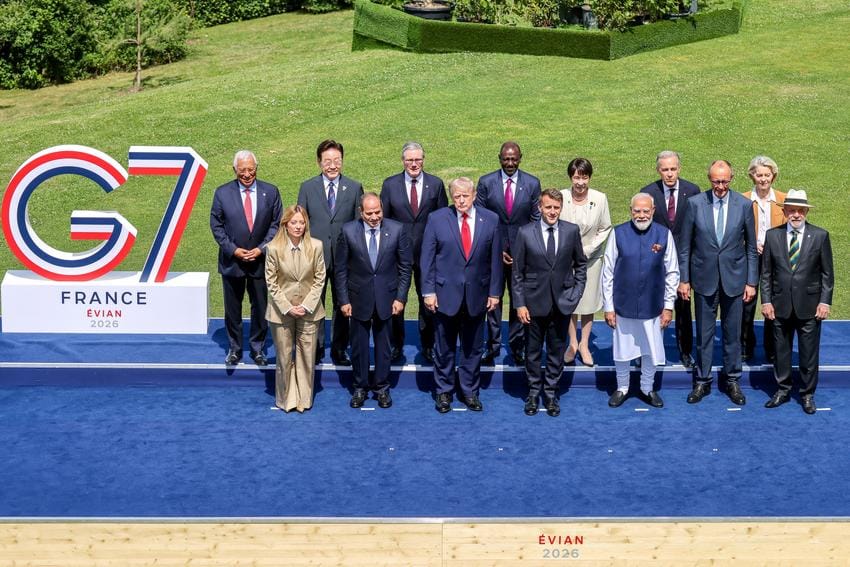
EVIAN-LES-BAINS, France — U.S. President Donald Trump issued a strong endorsement of India’s burgeoning geopolitical influence on Wednesday, asserting that New Delhi plays a "big role in everything" under the leadership of Prime Minister Narendra Modi. Speaking on the sidelines of the 52nd G7 Summit in the French commune of Évian-les-Bains, Trump emphasized that as long as Modi remains in office, India's role on the global stage will continue to expand significantly.
The face-to-face bilateral meeting, the first between the two leaders in 16 months, comes at a critical juncture as Washington finalizes a high-profile peace agreement with Iran. Alongside declarations of diplomatic solidarity, the discussions ventured into delicate terrain, with Prime Minister Modi directly raising acute security concerns regarding the safety of Indian maritime workers in the Middle East.
Geopolitical Alignment and Strong Praise
During a working session on June 17, 2026, President Trump spoke extensively on the strategic convergence between Washington and New Delhi. When questioned by reporters regarding India's prospective involvement in stabilizing West Asia amid unfolding regional diplomatic shifts, Trump underscored his administration's viewpoint.
"I think India plays a big role in everything," Trump stated during the bilateral exchange. "As long as he [PM Narendra Modi] is the leader, India is going to play a big role."
Trump further described the Indian Prime Minister as "calm, cool, and a total killer" in his approach to governance and negotiations, adding that bilateral ties have reached historically unprecedented heights. He recalled his previous state visit to India, referencing joint public addresses, and guaranteed that New Delhi could rely entirely on American support in the event of external security threats.
"We’ve never been closer to India, and India can count on me 100 percent and our country," Trump asserted. "If they ever need help, they know where to call—they call right here."
Modi Raises Critical Seafarers' Safety Issue
While acknowledging the progress made by the U.S. administration toward restoring stability in West Asia, Prime Minister Modi utilized the high-level meeting to address a pressing humanitarian and economic issue affecting Indian citizens.
With the United States and Iran moving closer to a formal memorandum of understanding (MoU), Modi urged Trump to ensure explicit protective provisions for international maritime workers within the text of the peace agreement. The demand comes on the heels of severe maritime disruptions in the region, including an incident last week off the coast of Oman where three Indian nationals were killed during security operations linked to an active maritime blockade.
Addressing President Trump after their closed-door session, Modi highlighted the economic stakes:
"In the world of maritime trade, hundreds of thousands of Indian seafarers are performing their duties across global maritime trade routes, including the Strait of Hormuz, contributing heavily to global progress. Their safety is of the utmost importance to us. I am confident that the issue of seafarers’ safety will receive the highest priority during the implementation of this agreement."
Modi reiterated that keeping the Strait of Hormuz open and safe is fundamentally vital to the stability of the global economy. India contributes roughly 10 percent of the global seafaring workforce, making its workforce particularly exposed to commercial shipping vulnerabilities in geopolitical choke points.
Economic and Strategic Impact
The public display of solidarity and the underlying policy discussions hold substantial implications across several global sectors:
Investors & Markets: The reassurance of defense assistance and the anticipated easing of trade tensions through a proposed bilateral U.S.-India trade deal provide regulatory clarity for multinational firms operating across the Indo-Pacific.
Maritime Trade & Energy Supply: The specific focus on the Strait of Hormuz aims to reassure global oil transport networks and commercial shipping conglomerates, which have faced soaring insurance premiums due to regional vulnerabilities.
Defense Procurement: Trump's explicit pledge of security assistance reinforces ongoing joint defense initiatives, including technology transfers and critical mineral partnerships discussed during the day's expanded sessions.
Official Sources Section
According to official briefings from the G7 Summit Organizers and readouts provided by the Indian Ministry of External Affairs, the broader agenda for the bilateral talks included finalizing structural agreements on bilateral trade, defense technology cooperation, energy security, and joint supply-chain resilience in critical mineral sectors.
Quote Section
Reflecting on the progress of the U.S.-led diplomatic initiatives in the Middle East, Prime Minister Modi stated:
"I commend you for your leadership on the progress that has been made in the efforts to restore peace. Thanks to your efforts, Mr. President, new hope for peace and stability in the region has been rekindled."
Concurrently, French President Emmanuel Macron briefed the press on the final day of the summit, noting that while the G7 leaders broadly welcomed the impending U.S.-Iran diplomatic understanding, collective focus remained fixed on addressing systemic fragmentation across the global trade landscape.
Why It Matters
The diplomatic standard set in Evian indicates that the U.S. administration increasingly views India not merely as a regional counterbalance, but as an indispensable stakeholder in global crisis resolution, spanning from West Asian maritime security to Eastern European peace initiatives. For citizens and commercial enterprises, an explicitly secured shipping corridor translates to stabilized consumer energy prices and safer working conditions for thousands of mariners operating in high-risk zones.
Key Facts at a Glance
Strategic Assurance: President Trump stated that India can count "100 percent" on U.S. support and defense cooperation under Modi's leadership.
Maritime Mandate: Prime Minister Modi formally requested that the upcoming U.S.-Iran peace deal incorporate strict safety guidelines for international seafarers.
Economic Vulnerability: Indian nationals constitute approximately 10 percent of the global seafaring workforce, heavily impacting the country's economic interest in keeping the Strait of Hormuz open.
Summit Context: India attended the 52nd G7 Summit in France as an invited partner nation, marking its 13th participation overall.
FAQ Section
Q1: What did Donald Trump say about PM Modi at the G7 Summit?
A1: President Trump highly praised PM Modi's leadership, stating that India plays a "big role in everything" as long as Modi is at the helm. He affirmed that bilateral ties have never been stronger and pledged full U.S. support if India faces external security challenges.
Q2: What specific issue did PM Modi raise regarding maritime trade?
A2: PM Modi raised the urgent issue of seafarers' safety, particularly within critical trade routes like the Strait of Hormuz. He requested that the upcoming U.S.-Iran diplomatic agreement prioritize protecting maritime workers, following recent regional casualties involving Indian crew members.
Q3: Why is the safety of seafarers significant to India?
A3: India provides roughly 10 percent of the world's seafaring workforce. Disruptions, blockades, or military actions along major Middle Eastern shipping lanes directly threaten the lives of thousands of Indian citizens and disrupt vital global supply chains.
Q4: Where did this bilateral meeting take place?
A4: The meeting took place on June 17, 2026, in Évian-les-Bains, France, on the sidelines of the annual G7 Summit, where India was participating as an invited partner country.
Source: Ministry of External Affairs, Government of India; G7 France Summit Official Press Pool; White House Office of the Press Secretary Transcripts.