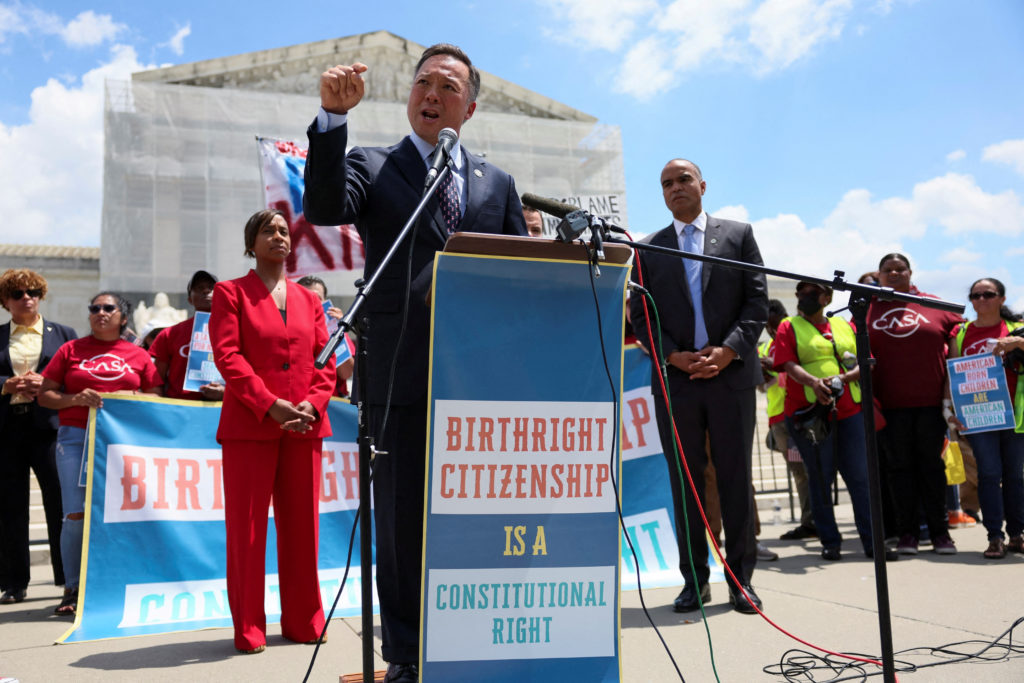
A federal judge in Maryland declined to immediately block President Donald Trump’s revised executive order targeting birthright citizenship. Following a Supreme Court ruling striking down a broader initial order, this procedural decision allows federal agencies to temporarily implement narrower citizenship restrictions while advocacy groups pursue further legal challenges.
GREENBELT, Md. — A U.S. federal judge on Friday, August 28, 2026, declined to immediately halt the implementation of President Donald Trump’s latest executive order limiting the eligibility criteria for automatic birthright citizenship.
U.S. District Judge Deborah Boardman in Greenbelt, Maryland, denied a emergency petition for a temporary restraining order brought by civil rights organizations and immigrant advocates. The ruling marks a major shift in the ongoing legal battle surrounding executive attempts to redefine the Fourteenth Amendment. It allows the White House's newly tailored citizenship restrictions to temporarily remain active while full legal briefs are prepared for substantive litigation.
Background and Court Proceedings
The decision follows an extensive multi-year legal conflict between the administration and immigrant advocacy groups over the scope of the U.S. Constitution's Citizenship Clause.
In January 2025, President Trump signed Executive Order 14160 on his first day back in office, which sought to deny automatic citizenship to U.S.-born children whose parents lacked legal permanent residence or U.S. citizenship. Lower federal courts, including Judge Boardman, issued nationwide injunctions halting that initial policy. That dispute culminated in June 2026, when the U.S. Supreme Court ruled 6-3 in Trump v. Barbara that a broad, sweeping ban on birthright citizenship violated the Fourteenth Amendment.
However, the administration subsequently issued a restructured executive order. The revised directive focuses on specific legal carve-outs, directing the Department of State and the Department of Homeland Security to withhold citizenship documentation from children born to non-citizens under targeted circumstances, such as short-term visitors, individuals on temporary visas, or those engaged in "birth tourism".
Advocacy groups promptly returned to the U.S. District Court in Maryland seeking an immediate emergency stay. Judge Boardman ruled that the revised order’s distinct structure required fuller judicial review before any preliminary injunction could be issued, refusing an immediate temporary restraining order.
Impact on Families, Legal Services, and Public Agencies
The decision creates short-term legal uncertainties for non-citizen families and regulatory agencies:
Immigrant Families: Children born in the United States to non-citizen parents holding temporary or non-immigrant visas face potential delays or formal challenges when applying for Social Security cards, U.S. passports, or federal benefit credentials.
Federal Agencies: The Department of State and the Department of Homeland Security are permitted to continue updating administrative policies and operational directives targeting visa issuance and status determination.
Healthcare Providers and Hospitals: Local medical institutions face operational questions regarding birth registration procedures and local vital statistics filings while the federal directive remains under judicial review.
Official Sources
According to official filings with the U.S. District Court for the District of Maryland, the court declined the plaintiffs' request for immediate injunctive relief.
Statements released by civil rights groups, including the American Civil Liberties Union (ACLU), confirmed that the legal coalition will continue pursuing a formal preliminary injunction and full trial proceedings.
The Department of Justice and federal administration officials asserted in court records that executive agencies possess the constitutional authority to define statutory jurisdiction under immigration and border control statutes.
Official Statements and Commentary
"According to officials from the Department of Justice, the executive order operates within defined statutory boundaries to ensure federal agencies enforce U.S. jurisdiction rules consistently," legal representatives noted in court filings.
Civil rights advocates voiced disappointment following Friday's hearing. Organizers stated that the 14th Amendment establishes explicit protections for anyone born on American soil and expressed confidence that higher courts will ultimate strike down the narrower order, following the precedent set in Trump v. Barbara.
Why It Matters
The immediate effect of the judge’s ruling means the federal government is not restricted by an emergency court order from carrying out agency planning and procedural changes under the new decree.
While the ruling is procedural rather than a final ruling on the merit of the policy, it creates a temporary period in which non-citizens on temporary visas or undocumented status may encounter new documentation burdens for newborns. The case sets up a crucial constitutional test regarding whether the executive branch can carve out exceptions to birthright citizenship based on specific parental visa categories.
Key Facts at a Glance
Court Ruling: U.S. District Judge Deborah Boardman declined an immediate temporary restraining order against the White House's revised birthright citizenship executive order.
Legal History: The ruling follows a June 2026 Supreme Court decision (Trump v. Barbara) that struck down a broader initial attempt to ban birthright citizenship.
Order Scope: The administration's modified directive targets specific visa classes, foreign visitors, and instances categorized as birth tourism.
Next Steps: The policy remains in effect pending full preliminary injunction hearings and further appeals.
Frequently Asked Questions
Has birthright citizenship been officially ended in the United States?
No. The 14th Amendment guarantees citizenship to individuals born on U.S. soil. The Supreme Court upheld this core protection in Trump v. Barbara in June 2026. The current legal challenge involves an executive order attempting to apply specific administrative exceptions.
What did the federal judge decide on August 28, 2026?
Judge Deborah Boardman denied a request for an immediate temporary restraining order, allowing the administration's modified order to remain active while the full case moves through court hearings.
Who is affected by the revised executive order?
The revised directive specifically targets children born to non-citizens holding temporary, short-term, or undocumented status under specialized legal classifications outlined by executive agencies.
Will there be further court rulings on this policy?
Yes. The judge's decision only addressed an emergency restraining order request. The court will hear formal arguments regarding a longer-term preliminary injunction in the coming weeks.
Source: Official court records from the U.S. District Court for the District of Maryland, public filings by the U.S. Department of Justice, official statements from the American Civil Liberties Union, and court filings from Trump v. Barbara.