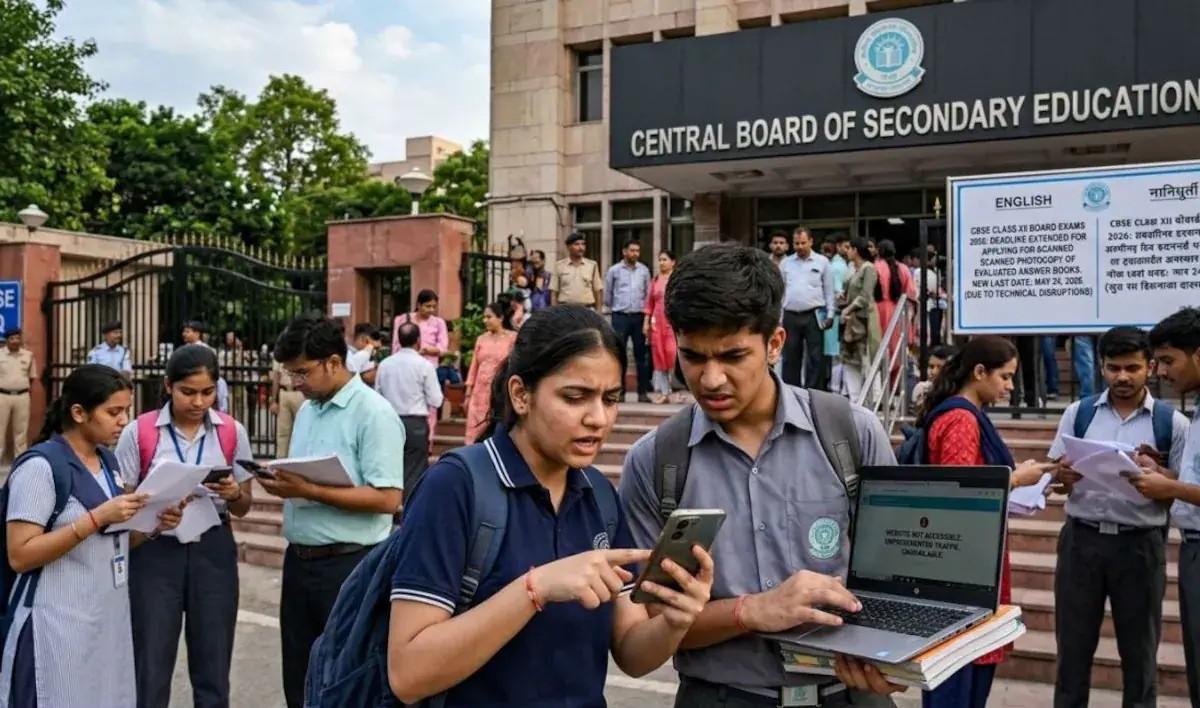
The education board of India is in troubled waters as students of Class 12 complain of getting wrong, incomplete or blurry answer sheets under its recently introduced On-Screen Marking (OSM) system. From handwriting errors to portal crashes, the controversy has left many questions unanswered regarding transparency, digital preparedness, and the credibility of the CBSE's re-evaluation process.
The Trigger No One Expected
It began on social media and quickly turned into an institutional crisis. Two class 12 students, Vedant and Sanjana, publicly claimed that the scanned answer sheets uploaded against their roll numbers were not in their handwriting. Their posts went viral and hundreds of other students came forward with similar complaints, creating a trust deficit because of a technical glitch.
How The OSM System Works — And Where It Cracked
This year, CBSE for the first time implemented the On-Screen Marking system for class 12, in which physical answer sheets are scanned into PDFs for digital marking by teachers. The logic was simple: quicker processing, less human error, and increased transparency in re-evaluation. But the grievances started to mount — the images were fuzzy, with broken pixels, some pages were missing, some answer sheets were mismatched, and some were failing to pay for the portal. CBSE later acknowledged that a technical error had resulted in an incorrect scanned copy being uploaded with one student's roll number.
The Numbers Behind The Noise
CBSE manually checked nearly 13,000 answer sheets out of a total of 9.8 million evaluated answer sheets as discrepancies were found. According to the update dated 26th May, students have demanded 11,31,961 scanned answer books, out of which 8,98,214 have been distributed digitally. The board also said it would provide pending copies by May 27, and would lower the fee for scanned copies to make them more accessible.
The game is played in a similar manner to the original, but the board is under fire and on the backfoot.
A teenager was further embarrassed the CBSE when he claimed to have hacked its portal, but the board denied any security breach. The technical issues with the portal were then discussed with the help of IIT experts and public sector banks. The CBSE evaluators have been asked to reconsider objections and re-evaluate marks by May 29.
Student Transparency Insights
- At least some students had their scanned copies uploaded under incorrect roll numbers.
- Allegedly, pages were replaced or lost when answer sheets were scanned and tagged
- Evaluators were unsure of the accuracy of the answers due to the blurriness and low resolution of the scans.
- Many applicants were unable to access scanned copies due to payment failures and crashes of the portal.
- 1 in 4 students of Class 12 asked for their scanned answer books after the results were announced.
- CBSE admitted the disparity in the official e-mail and assured revision of the marks.
The Road Ahead
The CBSE OSM controversy is not just a glitch in the system, but a warning sign that mass deployments of technology in high-stakes education require careful quality audits prior to implementation. Students who had been working for months are now having to deal with a system that doubts their own work. The need for an independent review of the scanning and evaluation mechanism is becoming louder as the board works to course correct.
Sources: Business Standard, India Today, Deccan Herald, Hindustan Times, Times of India, The Telegraph India, ABP Live