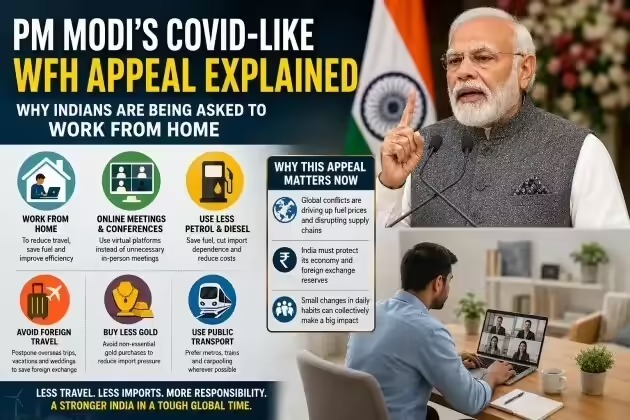
Prime Minister Narendra Modi has urged Indians to revive work from home and virtual meetings, tying this directly to India’s energy security and the global fuel crisis. In recent speeches, he has framed remote work not as a Covid-era compulsion, but as a conscious “nationally responsible” lifestyle choice to cut fuel use, traffic and economic stress.
Addressing public events in Hyderabad and Secunderabad, Modi said that systems built during the pandemic – remote work, online meetings and video conferences – should be brought back “in the national interest.” He linked this appeal to rising crude oil prices and uncertainty caused by tensions in West Asia and the Strait of Hormuz, which threaten fuel supplies and India’s import bill.
Energy Security And Fuel Savings
The core reason behind the work from home push is to reduce India’s dependence on imported petroleum products. Modi has specifically asked citizens to limit petrol and diesel consumption, avoid unnecessary foreign travel and large physical events, and use options such as remote work, metro rail and carpooling wherever possible. He argued that even small changes – fewer commutes, more virtual meetings – can cumulatively lower fuel demand and help protect the economy during a volatile global energy cycle.
Beyond Crisis Management - Traffic, Pollution And Well Being
Commentary around the Prime Minister’s remarks has also highlighted secondary benefits - less traffic congestion, lower urban air pollution and reduced daily stress for workers stuck in long commutes. A widely shared response from a tech professional argued that India “loses hours daily in traffic” and that hybrid or remote work could meaningfully improve both productivity and quality of life. Modi’s earlier speeches have also framed flexible work, including work from home, as part of the “future of work” that can boost women’s labour force participation.
Work From Home Appeal Highlights
- PM Modi has asked institutions and citizens to revive work from home and online meetings where feasible, recalling Covid-era arrangements.
- The appeal is linked to global oil price spikes and supply risks from conflicts in West Asia, not to a new health emergency.
- He has urged people to cut unnecessary fuel use, foreign travel and large in person events to conserve foreign exchange and strengthen energy security.
- Remote work is framed as a “national interest” measure that can reduce fuel consumption, traffic and overall economic pressure.
- Supporters point to added benefits – lower congestion, better air quality and improved work life balance for urban workers.
- Modi has previously described flexible workplaces and work from home ecosystems as the “future,” especially for increasing women’s workforce participation.
Sources: The Hindu, Hindustan Times, Times of India, Economic Times, Business Standard, India Today, PM speeches coverage and explainer pieces on the WFH appeal