Top Searches
- • Walk For Awareness: AIIMS Delhi Hosts Parkinson’s Walkathon To Bridge Care Gap 4 hours ago
- • CSK And KKR Clash At Chepauk: A Battle Of Tradition And Turnarounds 4 hours ago
- • Physics Wallah And Microsoft Unite To Power India’s AI Learning Revolution 4 hours ago
- • Pune Airport Spreads Its Wings With 15 New Flights From May 2026 4 hours ago
- • Walk The Talk: Pune Metro Chief Urges Citizens To Step Beyond Two-Wheelers 4 hours ago
- • India Pharma 2026 Showcases Policy Reforms And Innovation Powering Sectoral Transformation 4 hours ago
- • Why Bengaluru Beckons: Internet Explains NCR Exodus With Pay, Air And Lifestyle 4 hours ago
- • For India To Decide: US Envoy Highlights New Delhi’s Role In West Asia Peace 4 hours ago
WOW STORY OF THE DAY: Grandfather's 1968 Mithai Shop Met the Pandemic. Two Brothers Built a Brand That PUMA and Christian Louboutin Collaborated With.
A 55-Year Legacy, a Cloud Kitchen, and a Vision No One Saw Coming
• Harshit and Tanay Agrawal grew up in the world of Janta Dairy, the beloved mithai shop their grandfather founded in 1968 in Mumbai and passed down to their father Narottam. It was a neighbourhood institution, known for its quality, its warmth, and the smiling man always at the counter.
• When the pandemic shut the business down in 2021, Harshit and Tanay felt the weight of what that meant. They were not halwais. Harshit was a mass media graduate turned film producer, working on advertisements and feature films. Tanay was a literature graduate. Neither had a background in food entrepreneurship.
• But the recipes had been passed down through generations. And the gap they spotted in the Indian mithai market was undeniable: an enormous, beloved category with no real brand voice, no compelling design language, and no product format designed for modern, everyday consumption.
• “I noticed a significant absence of a distinct brand voice in the mithai industry. You see brands with strong identities in sneakers or clothing, but the mithai industry seemed to lack that voice. Our decision to venture into mithai was not primarily driven by business prospects but rather an emotional one," Harshit says.
• Pistabarfi launched in September 2021 as a cloud kitchen from Mumbai.
Gond Art, Muslin Cloth, and Packaging That Tells a Story
• The most defining decision Harshit and Tanay made was to treat Pistabarfi not as a food product but as a cultural artefact.
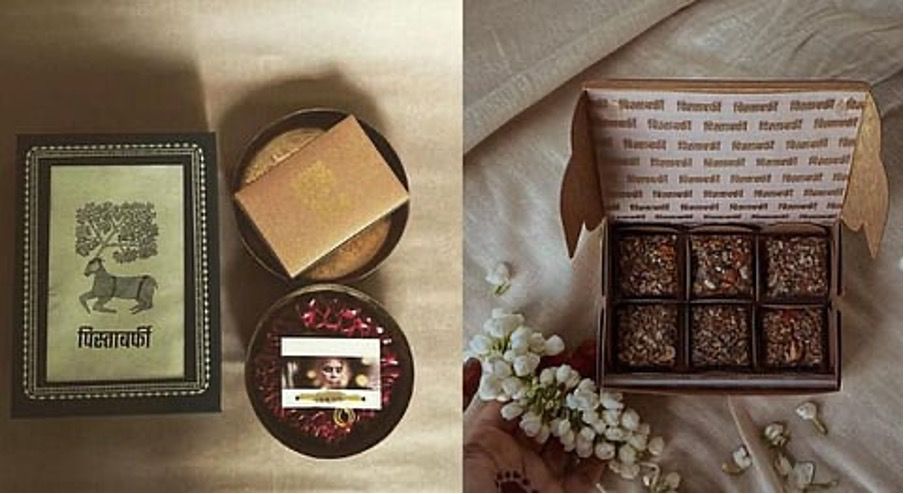
• The packaging features original Gond art by Bhajju Shyam, a Padma Shri-awarded artist from the Gond-Pardhaan community of Madhya Pradesh. Harshit first encountered Gond art in 2015 while assisting filmmaker Devashish Makhija on a short film. A gifted book, The Night Life of Trees, opened that world to him. When designing Pistabarfi's packaging, he licensed the artwork from Tara Books to appear on each box: a deer with a tree growing from its horns, stunning, contemporary, and distinctly Indian.
• The boxes are wrapped in muslin cloth, an idea drawn from childhood train journeys back from their grandmother's house in Dhanbad, Jharkhand, where sweets were always packed in cloth. The colour palette uses greens and pink, a deliberate departure from the gold, white, and red that dominate traditional mithai packaging. "The imagery is not exciting," Harshit says of conventional mithai design. "Even brands with good packaging do not tell a story through it. There's no voice."
• Pistabarfi built that voice. And the world's biggest brands noticed.
• PUMA reached out to collaborate for the launch of its Palermo sneakers. Pistabarfi created bespoke mithai boxes matching the sneaker colourways: Mysore Pak in cobalt blue, Aam Papdi in teal. The Puma logo was rendered in Devanagari script. IKEA, Christian Louboutin, and Indo followed. Vogue featured the brand. Each collaboration reinforced the same truth: that Indian mithai, given the right design language and cultural confidence, belongs in every global conversation about premium gifting and lifestyle.
The Shark Tank Moment and What Happened Next
• Pistabarfi appeared on Shark Tank India Season 5, asking for ₹30 lakh for 5% equity at a ₹6 crore valuation. The Sharks tasted the product. Anupam Mittal, whose own daughter's birth he had announced by sending Pistabarfi to friends and family, called the brand a goldmine. The product quality and packaging left the panel genuinely impressed.
• The Sharks ultimately passed, citing limited sales momentum and asking whether Harshit, who was simultaneously serving as an executive producer on the film All We Imagine As Light, which won the Grand Prix at Cannes in 2024, would commit to Pistabarfi full-time. He was honest that he was managing both.
• Vineeta Singh's words carried particular weight: "Once you figure out how to grow this, please come to me. I will definitely be interested in investing in this business."
• Post-telecast, Pistabarfi saw a significant jump in brand visibility and sales, precisely the outcome that makes Shark Tank India valuable well beyond the deal itself.
When Heritage Meets Design, the World Comes to You
• The sharpest lesson from Pistabarfi's journey is this: in a world of commoditised products, cultural storytelling is the most underutilised competitive advantage.
• Every mithai shop in India carries a legacy. Almost none of them have found a way to make that legacy visible, wearable, giftable, and globally relevant. Harshit and Tanay did, by bringing a filmmaker's eye, a designer's instinct, and a grandson's love to every box they shipped.
• PUMA came to them. Vogue covered them. Anupam Mittal sent their sweets at his daughter's birth. That is brand power built from the inside out, from memory, craft, and the courage to give traditional things the design treatment they always deserved.
• Their grandfather made sweets with simple ingredients. His grandsons made those sweets into art.
Sources: The Better India, Indian Express, Blur The Border, LinkedIn, Platform Magazine, Filmibeat
Stay Ahead – Explore Now! Regulation Reset: Meity Clarifies IT Rules Intent