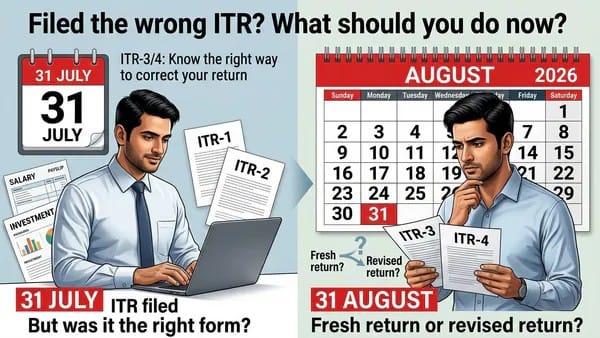
Taxpayers who e-verified an incorrect form (like ITR-1) by July 31 despite having business or F&O income must file a revised return under Section 139(5) using Form ITR-3. Unverified returns can be discarded online to submit a fresh original return, ensuring losses are carried forward without penalty.
Taxpayers who filed an incorrect Income Tax Return (ITR) form—such as submitting an ITR-1 or ITR-2 despite having business, freelancing, or Futures and Options (F&O) trading income—must rectify the error to avoid statutory penalties. While the original deadline for non-audit business cases and complex returns (ITR-3) is set for August 31, taxpayers who e-verified a wrong return filed by July 31 should not submit a fresh original return. Instead, they must file a revised return under Section 139(5) of the Income-tax Act.
Understanding Why Wrong Form Selection Occurs
Many salaried individuals rush to submit tax returns ahead of the July 31 deadline using simplified forms like ITR-1 (Sahaj) or ITR-2. However, secondary or overlooked revenue streams automatically disqualify individuals from using these forms:
Business and Professional Income: Income earned through freelancing, independent consulting, brokerage, or partnership firms.
Equity and Derivative Trades: Intraday equity trading or Futures and Options (F&O) transactions—which are classified under law as business/speculative income—mandatorily require ITR-3.
Presumptive Business Income: Taxpayers opting for presumptive taxation under Sections 44AD or 44ADA must use ITR-4, whereas non-presumptive trade losses require ITR-3.
Filing an incorrect form causes a structural mismatch between the reported return and data logged on the Annual Information Statement (AIS) and Form 26AS, triggering a Defective Return notice under Section 139(9).
Fresh Original vs. Revised Return: Legal Rules Explained
Tax experts and regulatory guidelines clarify that once an original return is e-verified, the Income Tax e-Filing portal treats the submission as complete. Submitting another original return leads to duplicate filing rejections.
1. The Discard Option (For Unverified Returns Only)
If a taxpayer filed an incorrect form prior to July 31 but has not e-verified the return (and has not mailed the physical ITR-V to CPC Bengaluru), they can log into the e-filing portal and select the "Discard" option. Discarding permanently deletes the unverified filing, allowing the user to submit a fresh, original ITR-3 before the applicable deadline.
2. The Revised Return Protocol (For Verified Returns)
If the incorrect return has already been e-verified, the taxpayer must file a Revised Return under Section 139(5). The revised filing completely supersedes the original submission. The online utility allows users to change their ITR form from ITR-1/ITR-2 to ITR-3 seamlessly during the revision process.
Log In: Access the official Income Tax e-Filing portal using PAN credentials.
Initiate Filing: Go to e-File > Income Tax Returns > File Income Tax Return. Select the relevant Assessment Year and mode of filing.
Select Section 139(5): Choose Revised Return u/s 139(5) as the filing type. Input the 15-digit Acknowledgement Number and filing date of the original July 31 return.
Choose Correct Form: Select ITR-3 from the dropdown menu.
Reconcile Financial Data: Import data from Form 26AS, AIS, bank statements, and broker P&L reports. Ensure F&O turnover, intraday gains/losses, and freelancing receipts are fully disclosed.
Pay Tax & E-Verify: Clear any additional self-assessment tax liabilities along with applicable interest under Sections 234B and 234C. Submit and e-verify the revised return within 30 days.
Official Sources
Procedural rules governing return corrections and form updates are administered under official statutory frameworks:
Regulatory Directives and Expert Commentary
Tax practitioners advise taxpayers not to panic if an incorrect form was submitted, as tax laws contain provisions specifically designed to allow rectifications.
"If a taxpayer has already e-verified an incorrect ITR-1 or ITR-2, they should not attempt to submit a fresh original return," stated tax advisory professionals in published operational guidance. "Taxpayers must choose Section 139(5) for a revised return, select ITR-3, cite the original acknowledgement details, and report their complete income package rather than just the omitted amounts."
Officials emphasize that revising the return promptly protects the taxpayer's right to carry forward business or F&O losses to future financial years.
Why It Matters: Financial Implications of Timely Revision
Loss Carry-Forward Protection: Business and capital losses (such as F&O trading losses) can only be carried forward to offset future profits if reported in a valid, timely ITR-3.
Avoiding Penalty Notices: Ignoring an invalid form selection triggers a Section 139(9) defective return notice. Failure to respond within 15 days renders the return null and void, treating the taxpayer as a non-filer.
Eliminating Scrutiny Risks: Aligning ITR-3 disclosures with AIS and Form 26AS broker entries prevents automated tax demand notices and artificial tax adjustments during processing.
Key Facts at a Glance
Correct Mechanism: E-verified incorrect returns must be fixed using a Revised Return u/s 139(5), not a fresh original return.
Discard Utility: Taxpayers can discard unverified returns on the portal to re-file a fresh original ITR-3.
Mandatory Disclosures: F&O trading, freelancing, intraday trades, and partnership income strictly require ITR-3 or ITR-4.
Time Limit: A revised return can be submitted up to December 31 of the assessment year or prior to completion of assessment.
Frequently Asked Questions
Can I switch from ITR-1 to ITR-3 while filing a revised return?
Yes. The e-filing system permits taxpayers to change their ITR form when filing a revised return under Section 139(5) to ensure accurate reporting of income sources.
What happens if I filed the wrong form and do nothing?
The Income Tax Department will flag the inconsistency against your AIS data and issue a Defective Return notice under Section 139(9). If unresolved, your return will be treated as invalid.
Do I need to pay a late fee for filing a revised return?
No. If your original return was filed before the July 31 due date, filing a revised return under Section 139(5) does not attract late filing fees under Section 234F.
What should I do if my unverified return had errors?
You can use the "Discard" option under the pending actions tab on the e-filing portal. This allows you to file a fresh original ITR-3 as if the earlier submission never occurred.
Sources: Income Tax Department e-Filing Portal, Central Board of Direct Taxes Press Releases, Income Tax TRACES Systems