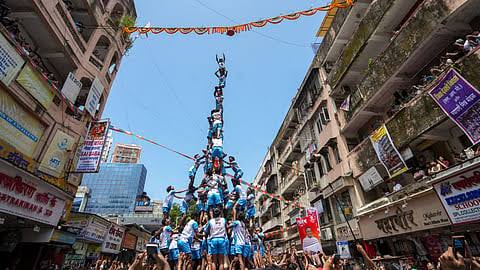
Twenty-two govindas sustained injuries during Dahi Handi celebrations in Mumbai on Saturday following human pyramid collapses. The Brihanmumbai Municipal Corporation confirmed that 21 individuals were discharged after receiving outpatient treatment, while one remains hospitalized in a stable condition amid widespread police deployments and civic hospital readiness.
MUMBAI — At least 22 revellers, commonly referred to as "govindas," sustained injuries while erecting multi-tiered human pyramids during Dahi Handi celebrations in Mumbai on Saturday, civic emergency authorities confirmed. The Brihanmumbai Municipal Corporation (BMC) Disaster Management Cell reported that the incidents occurred across the island city and suburban zones as hundreds of mandals took to the streets to commemorate the birth of Lord Krishna. The annual festival involves teams attempting to shatter clay pots suspended high above public intersections, a practice that carries persistent structural risks. By Saturday afternoon, 21 participants had been discharged after outpatient care, with one individual remaining hospitalized under medical observation.
Hospital Admissions and Regional Casualties Breakdown
According to the medical casualty register compiled by the BMC Disaster Management Department, initial admissions began during morning pyramid attempts. Twenty injured participants sought urgent treatment at municipal healthcare facilities in the island city district. Following diagnostic evaluations and primary trauma management, all 20 were discharged with non-life-threatening lacerations, soft-tissue strains, and minor contusions.
In the eastern suburbs, one govinda received first aid and primary treatment at a civic hospital before being cleared to return home. Meanwhile, in the western suburbs, a single participant remains hospitalized under observation for musculoskeletal trauma sustained during an elevated pyramid collapse. Emergency staff reported that the individual's condition is stable and non-critical.
The geographic distribution of incidents reflects the intensity of regional competitions, which draw hundreds of competing troupes across Dadar, Parel, Lalbaug, Ghatkopar, and Borivali.
Civic Medical Preparedness and Hospital Mobilization
Anticipating potential fall injuries from high-altitude formations, municipal health authorities deployed specialized trauma preparedness protocols ahead of the celebrations. The civic administration instructed sixteen suburban peripheral hospitals and major tertiary care facilities to remain on high alert.
More than 100 hospital beds were reserved across key medical centers, including:
King Edward Memorial (KEM) Hospital in Parel
Lokmanya Tilak Municipal General Hospital in Sion
BYL Nair Charitable Hospital in Mumbai Central
Specialized surgical teams, orthopedic specialists, neuro-trauma consultants, and medical imaging personnel were rostered in continuous shifts to manage sudden surges in casualty admissions. Civic ambulances equipped with emergency stabilization kits were stationed along designated traffic corridors near high-profile handi locations.
Municipal Safety Regulations and Legal Frameworks
The injuries revive scrutiny over safety protocols mandated for Dahi Handi celebrations in Mumbai. Over the past decade, directives issued by the Bombay High Court and the Maharashtra Home Department have sought to mitigate risk during human pyramid formations.
State safety frameworks mandate that organizers install industrial-grade safety nets, shock-absorbing crash mats, and harness ropes at handi venues exceeding four tiers. Troupes are legally required to provide participants with protective headgear, knee guards, and chest protectors, while barring minors under the age of 14 from participating in the upper tiers of the pyramid.
Furthermore, state policy requires local dahi handi coordination committees to maintain comprehensive health and accidental death insurance coverage for registered participants. Civic inspectors and police teams were deployed across arterial junctions to enforce crowd controls, regulate sound limiters, and monitor organizer compliance with statutory safety parameters.
Impact on Commuters, Businesses, and Public Safety
The daytime festivities and subsequent medical logistics affected civic routines across the metropolitan region:
Commuter Traffic: Heavy congestion and lane diversions were enforced around major intersections in Dadar, Lower Parel, Thane, and Chembur to accommodate crowds and allow emergency ambulance corridors.
Civic Infrastructure: Public transport operators, including the Brihanmumbai Electric Supply and Transport (BEST), rerouted multiple bus lines away from narrow residential roads hosting prominent dahi handis.
Commercial Establishments: Retail storefronts along primary procession routes curtailed street operations or adjusted commercial hours amid high-volume foot traffic.
Emergency Response: Municipal rapid-action vehicles maintained clear passage through arterial bottlenecks, limiting delays for emergency hospital transfers.
Official Sources
According to bulletins issued by the Brihanmumbai Municipal Corporation (BMC) Disaster Management Cell and advisories released by the Mumbai Police, emergency services responded rapidly to all reported falls. Operational oversight of hospital admissions is managed by the Public Health Department of the civic administration in accordance with statutory guidelines outlined by the Government of Maharashtra.
Official Statements
"According to officials from the BMC Disaster Management Department, all municipal hospitals were placed on active standby with dedicated beds and trauma specialists, ensuring that injured govindas received rapid medical attention without overwhelming regular casualty wards."
"Organizers stated that mandatory safety equipment, foam padding, and safety netting were deployed across major competition venues, and troupes followed protocols to withdraw injured participants immediately from active pyramid tiers."
Why It Matters
Public Health Readiness: Highlights the capacity of Mumbai's public hospital network to absorb festival-related trauma cases through pre-planned resource allocation and dedicated beds.
Regulatory Compliance: Tests the enforcement of court-ordered safety gear, child protection rules, and insurance coverage across grassroots mandals.
Urban Risk Management: Demonstrates the ongoing operational balance between preserving cultural traditions and minimizing civic hazards in densely populated urban corridors.
Key Facts at a Glance
Total Injuries Reported: 22 govindas sustained injuries during citywide celebrations up to noon.
Discharges and Hospitalizations: 21 participants discharged after outpatient medical treatment; 1 remains admitted in a western suburban hospital.
Healthcare Mobilization: Over 100 reserved beds active across KEM, Sion, Nair, and 16 suburban civic hospitals.
Security & Law Enforcement: Comprehensive police bandobast and traffic diversions deployed across all sensitive hubs in Mumbai.
Frequently Asked Questions
How many participants were injured during the celebrations in Mumbai?
A total of 22 govindas were treated for injuries across civic hospitals during Dahi Handi festivities on Saturday.
What is the medical status of the injured govindas?
Twenty-one individuals were discharged following primary medical care, while one govinda remains under treatment at a western suburban municipal hospital.
Which hospitals reserved beds for festival emergency cases?
Major tertiary facilities including KEM Hospital in Parel, Sion Hospital, and Nair Hospital, alongside 16 civic suburban hospitals, allocated more than 100 dedicated beds for event-related injuries.
Are organizers legally mandated to provide safety gear during Dahi Handi?
Yes. Organizers and troupes are required by municipal and state directives to use safety harnesses, protective headgear, ground crash mats, and provide valid accident insurance for all participants.
Source: Disaster Management Department, Brihanmumbai Municipal Corporation (BMC); Traffic and Law Enforcement Bulletins, Mumbai Police; Department of Medical Education and Drugs, Government of Maharashtra.