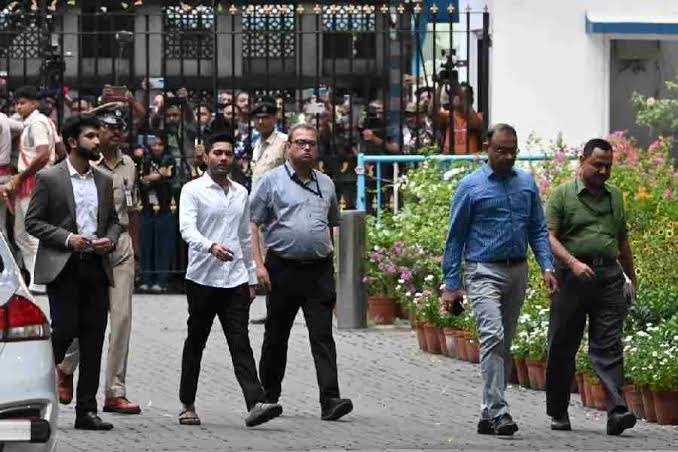
Trinamool Congress leader Abhishek Banerjee underwent 5.5 hours of intense CID questioning regarding a legislative signature forgery case. Following the session, he held an emergency meeting with Mamata Banerjee, as investigators issued a fresh summons for further interrogation this Sunday.
Trinamool's national general secretary meets Mamata Banerjee following a intense session before receiving a fresh weekend summon.
KOLKATA — In an intense escalation of political and legal scrutiny in West Bengal, Trinamool Congress (TMC) National General Secretary Abhishek Banerjee was subjected to a rigorous 5.5-hour interrogation by the State Crime Investigation Department (CID). The questioning, conducted at the agency’s Bhawani Bhawan headquarters, focuses on an ongoing legislative signature forgery investigation. Immediately after exiting the grueling session, the Diamond Harbour Member of Parliament (MP) proceeded directly to the Kalighat residence of TMC Chairperson Mamata Banerjee to hold an emergency strategy meeting. This high-profile interaction comes as the CID issued a fresh follow-up summons commanding the leader to appear again this upcoming Sunday.
Detailed Grilling Over Legislative Resolution Forgery Case
The multi-hour questioning session represents a critical juncture in the signature row probe that has gripped Bengal's political landscape. Investigators are focusing heavily on a disputed legislative party resolution book dated May 6. According to administrative briefs, the case hinges on allegations that the signatures of multiple TMC Members of the Legislative Assembly (MLAs) were systematically forged without their informed consent on documents submitted regarding legislative party leadership structures.
During the 5.5-hour sequence, a specialized team of investigators presented the parliamentarian with video-recorded statements from at least 13 state lawmakers—including Baharul Islam and Arup Roy—who have reportedly disavowed their signatures on the official filing. Sources tracking the investigation indicate that the questioning aimed to map out the physical chain of custody of the resolution records, specifically determining who collected the signatures at the party office and who authorized the final submission to legislative authorities.
High-Level Political Huddle in Kalighat Follows Interrogation
Following his departure from Bhawani Bhawan, Abhishek Banerjee drove directly to Mamata Banerjee’s Kalighat residence. The subsequent closed-door huddle lasted over an hour, drawing senior legal advisors and key cabinet ministers into the discussion. The sudden convergence of top-tier party leadership reflects growing concern within the ruling state party regarding the aggressive speed of the CID investigation, which had previously faced delays due to the MP's health issues and external official engagements in New Delhi.
The political dimensions of the probe are sharpening. Opposition leaders have alleged that the internal handling of the signature log points to unresolved administrative fractions within the state's ruling apparatus. Conversely, TMC spokespersons have rejected these claims, terming the hyper-accelerated pace of the state agency's summons as an administrative technicality that the party is fully prepared to challenge through transparent constitutional and legal pathways.
Legal Strategies and the Upcoming Sunday Summons
The legal teams representing the TMC National General Secretary are actively assessing options ahead of the mandatory Sunday morning return window. The CID’s decision to issue an immediate 48-hour follow-up notice indicates that investigators require further operational clarification regarding the physical location of the original resolution book. In previous written communications to the agency, Banerjee's legal counsel had indicated that the original ledger was not within his personal possession.
The fast-moving sequence has prompted considerations to approach the Calcutta High Court for an emergency review of the summoning schedule. Attorneys have argued that the continuous, compressed timing of the notices allows insufficient time to gather necessary records or consult appropriately with senior advocates. Investigators counter that the rigorous timelines are essential given the statutory weights tied to documents officially submitted before legislative oversight bodies.
Institutional Background of the Probe
The operational momentum behind this case underscores the strict functional boundaries of legislative integrity. Under standard procedures managed by the West Bengal Legislative Assembly and monitored broadly via standard protocols established by the Election Commission of India (ECI), all intra-party appointments, resolutions, and leadership declarations must carry completely verified, uncoerced authorizations from elected members. Any documented discrepancy involving state lawmakers triggers independent, non-bailable criminal review under standard provisions governing forgery, fraudulent presentation of public documents, and criminal conspiracy.
Statement from Investigation Officials
"According to officials attached to the Crime Investigation Department tracking the signature row, the multi-hour interrogation provided crucial foundational data lines regarding the assembly of the disputed documents. Investigators stated that while the parliamentarian provided extensive verbal responses, a subsequent session is required this Sunday to reconcile his statements with the physical forensic handwriting analysis performed on the legislative resolution registry."
Why It Matters
For citizens and political observers, the case carries substantial constitutional weight. It tests the mechanisms used to verify the absolute authenticity of decisions made within legislative parties. A prolonged legal dispute involving the second-highest official in the ruling party could delay regional policy discussions and alter intermediate organizational frameworks ahead of upcoming local administrative distributions.
Key Facts at a Glance
Session Duration: TMC National General Secretary Abhishek Banerjee underwent 5.5 hours of continuous CID interrogation.
Core Accusation: The state agency is probing alleged signature forgery within a legislative party resolution book.
Witness Baseline: Video statements from 13 distinct state MLAs have been processed by case investigators.
Immediate Strategy: The MP met with TMC Chairperson Mamata Banerjee immediately after the session ended.
Next Milestone: A fresh, mandatory follow-up summons requires his appearance before investigators this Sunday.
FAQ Section
What exactly is the signature forgery case involving Abhishek Banerjee?
The case involves allegations that the signatures of multiple Trinamool Congress MLAs were forged without their direct knowledge on an internal party resolution book dated May 6. The document was intended to finalize critical leadership decisions within the West Bengal state assembly framework.
Why did the CID issue a fresh summons for Sunday so quickly?
According to legal and agency sources, the CID requires a follow-up session to resolve discrepancies between the oral answers given during the 5.5-hour interrogation and the physical handwriting samples gathered from the affected legislators.
Can the MP legally decline to appear for the Sunday interrogation?
While individuals can request extensions based on health or official duty, the CID holds the legal authority to reject delays if they believe the request is stalling the probe. Continued non-appearance can prompt the agency to seek strict legal remedies through the courts.
Source: Official investigation updates from the West Bengal Crime Investigation Department (CID), judicial listings from the Calcutta High Court, and press statements released via the Trinamool Congress (TMC) Media Wing.