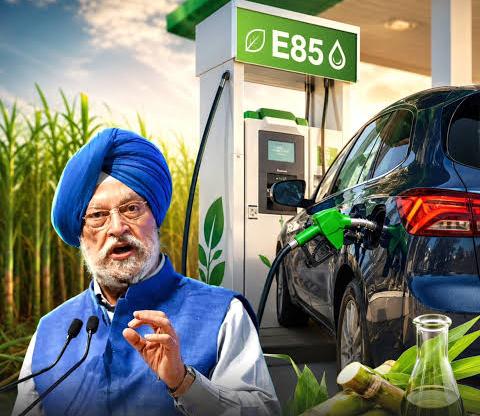
The Union Minister for Petroleum and Natural Gas has announced that flex fuel will be priced ₹20 per litre cheaper than standard E20 petrol in India. The strategic pricing move is engineered to cushion consumer transport budgets, reduce the country's dependence on foreign crude oil imports, and foster a robust local market for flexible-fuel vehicles.
NEW DELHI — India’s Union Minister for Petroleum and Natural Gas announced on June 5, 2026, that flex fuel will be priced approximately ₹20 per litre cheaper than standard E20 petrol at retail outlets. The government's strategic pricing intervention aims to immediately lower transition costs for commuters, curb crude oil import bills, and incentivize automobile owners to adopt flexible-fuel vehicles (FFVs). This economic mandate comes at a critical time as the nation accelerates its localized bio-mobility goals and works to provide visible financial relief to inflationary household budgets.
Government Anchors Price Incentive for Biofuel Transition
The Ministry of Petroleum and Natural Gas confirmed that the retail pricing framework for flex fuel has been intentionally structured to maintain a definitive economic advantage over conventional fossil fuels. By ensuring that flex fuel is priced significantly lower than E20 petrol—which contains an 20 percent ethanol blend—the central government expects to establish a stable consumer demand base for high-blend ethanol variations, including E85 and localized anhydrous bio-ethanol products.
According to ministerial statements, the baseline production costs of domestically manufactured ethanol, sourced primarily from sugarcane residue, corn, and agricultural surplus, allow for a flexible retail cushion. Public sector oil marketing companies (OMCs) will coordinate distribution frameworks to pass these systemic savings directly down to retail vehicle operators.
Strategic Infrastructure Alignment
The pricing policy is designed to move in parallel with the phased rollout of specialized fueling infrastructure across major industrial corridors. The Ministry of Petroleum and Natural Gas is working closely with state-owned logistics desks to establish dedicated dispensing units at existing retail pumps, ensuring that the targeted cost advantage is accessible to consumers without logistical constraints.
Technical Specifications and Financial Impact
The economic mechanics of the new fuel policy address both consumer operational expenses and macroeconomic trade balances. While ethanol exhibits a slightly lower energy density compared to unblended fossil fuels, the ₹20 per litre price differential is calculated to fully offset any marginal variations in vehicle mileage performance.
For automotive manufacturers and heavy investors, this clear statutory pricing indicator provides a reliable pathway to scale assembly lines for flexible-fuel vehicles. Indian automakers have previously expressed a need for long-term fuel pricing visibility before committing substantial capital to alternative powertrain engineering. For everyday citizens and commercial fleet operators, the cost gap offers an immediate avenue to lower monthly transport and courier overheads.
Official Sources Section
The pricing details and alternative fuel benchmarks were formalized during an official ministerial brief organized by the central government in New Delhi. Structural directives regarding refinery allocations and ethanol procurement pricing mechanisms are managed via the Ministry of Petroleum and Natural Gas corporate portal. Public market tracking and statutory compliance data are routinely filed through the exchange networks of BSE Limited and the National Stock Exchange of India Limited by state-aligned energy conglomerates.
Quote Section
Evaluating the regulatory rollout, administrative heads highlighted the economic logic underpinning the domestic ethanol network.
"According to officials from the administrative energy desk, the mandate to position flex fuel at a lower price point is a deliberate fiscal instrument to transition price-sensitive consumers away from imported fossil inputs," the oil minister stated. "Organizers stated that domestic agricultural supply chains are now robust enough to support continuous ethanol blending targets without compromising national food security frameworks."
Why It Matters
The practical implications of keeping flex fuel cheaper than E20 petrol extend far beyond individual pump transactions. For India's macroeconomic balance sheet, every percentage increase in domestic ethanol consumption directly lowers the sovereign foreign exchange outflow allocated to crude oil imports from the Middle East and global trade blocks. Furthermore, the policy converts rural agricultural waste into a high-value industrial commodity, establishing a predictable secondary revenue stream for domestic farming communities.
Key Facts at a Glance
Direct Savings: Flex fuel retail pricing is confirmed to sit approximately ₹20 per litre lower than standard E20 petrol options.
Macro Impact: Designed to significantly reduce India's multi-billion dollar dependence on foreign crude oil imports.
Industrial Support: Provides a clear fiscal incentive for automakers to accelerate the local manufacture of flexible-fuel engines.
Supply Sourcing: Utilizes domestic agricultural surplus and advanced bio-refining infrastructure to keep production costs insulated from global crude shocks.
FAQ Section
What is the primary difference between E20 petrol and flex fuel?
E20 petrol consists of an 20 percent ethanol blend suitable for standard modern engines. Flex fuel refers to much higher ethanol blends, such as E85, which require specialized flexible-fuel vehicles designed to run on variable fuel mixtures.
Will using flex fuel lower my vehicle's overall mileage?
Ethanol has a lower energy density than pure petrol, which can result in a minor reduction in mileage. However, the government’s discount ensures that the consumer's net cost per kilometer remains highly economical.
When will this discounted flex fuel be widely available at local stations?
The retail rollout is being conducted in a phased manner by state oil marketing companies, prioritizing major metropolitan zones and agricultural states with existing high ethanol production capacities.
Source: Official Declarations from the Ministry of Petroleum and Natural Gas, National Stock Exchange of India Limited, BSE India.