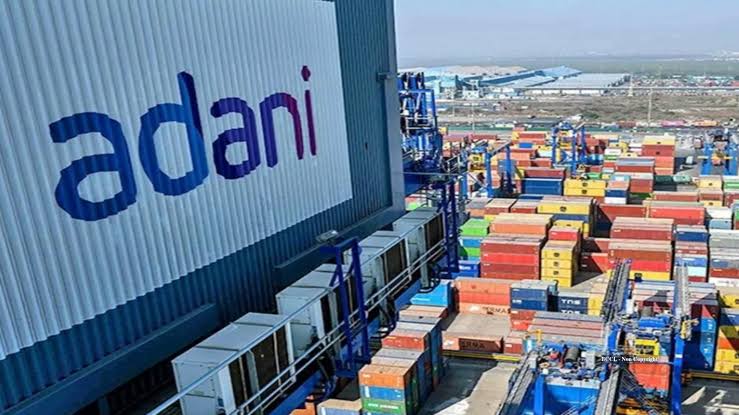
Adani Ports secured a 30-year concession to develop and operate two dry bulk berths at Odisha’s Paradip Port, adding 18 MMT of cargo capacity for ₹982 crore. Meanwhile, Adani Group is advancing a $2.5 billion refinancing facility—India's largest offshore corporate loan this year—extending debt maturities with international lenders.
MUMBAI — Adani Ports and Special Economic Zone Limited (APSEZ) announced Wednesday, September 9, 2026, that it has received a Letter of Award (LOA) to develop and operate two commercial dry bulk berths at the state-run Paradip Port in Odisha, while parent conglomerate Adani Group advances plans to execute a $2.5 billion offshore loan refinancing. The long-term concession at Paradip Port secures the port operator's commercial entry into India's second-largest major cargo port. Concurrently, the planned $2.5 billion foreign-currency debt syndication—projected as India's largest cross-border loan transaction this year—signals sustained liquidity and global institutional appetite for the ports-to-power enterprise as it extends debt tenors and manages balance-sheet leverage.
Paradip Port Concession and Dry Bulk Expansion
Under the formal Letter of Award issued by the Paradip Port Authority, Adani Ports secured the rights to mechanise and operate two major dry bulk berths—designated as Central Quay berths CQ-1 and CQ-2—under a 30-year public-private partnership (PPP) concession. The infrastructure enhancement program is estimated at a capital expenditure of ₹981.96 crore ($117 million).
The project encompasses a total berth length of 485 metres, accompanied by an operating draft depth of 15 metres and an adjacent storage yard spanning 400,000 square metres. When fully mechanised with modern mobile harbor cranes, automated conveyor networks, and rapid stacker-reclaimer systems, the dual berths will deliver an aggregate cargo-handling capacity of 18 million metric tonnes (MMT) per annum.
Adani Ports won the competitive bidding process after submitting a royalty price bid of ₹122.30 per metric tonne, outbidding competing private logistics operators including Essar Ports. The contract is part of the central government’s National Monetisation Pipeline, which seeks to modernise legacy port infrastructure by partnering with private operators on a revenue-share model.
Strategic Integration Along the Eastern Seaboard
The Paradip berth award establishes a vital operational beachhead in Odisha for India’s largest private port operator. State-run Paradip Port handles substantial volumes of thermal coal, coking coal, iron ore, and dry industrial minerals originating from the mining belts of Odisha, Jharkhand, and Chhattisgarh. During the fiscal year 2025–26, Paradip handled 156.45 million tonnes of maritime cargo.
The acquisition complements the company's existing regional deep-water facilities, notably Dhamra Port to the north and Gopalpur Port to the south. By embedding berths inside Paradip alongside its proprietary gateways, Adani Ports now commands a contiguous logistics corridor across the eastern coast, connecting coastal shipping lanes to high-volume industrial steel, power, and aluminum clusters. Across its nationwide footprint, the company manages 15 domestic ports and terminals, handling over 27% of India's commercial port throughput.
Refinancing Pipeline: India's Largest Offshore Loan Facility
Parallel to the port expansion, the Adani Group is in advanced discussions with a syndicate of international lenders to structure a $2.5 billion offshore loan facility, according to a Bloomberg News report published Wednesday. The borrowing represents the single largest cross-border loan syndication launched by an Indian corporate entity this calendar year.
The capital transaction is structured to refinance outstanding intermediate credit facilities and extend the debt maturity profile across the conglomerate's core infrastructure verticals. Global investment banks across Europe, Japan, and the Middle East are participating in the facility, which is expected to price at competitive spreads above the Secured Overnight Financing Rate (SOFR).
The refinancing initiative aligns with the group's ongoing strategy to replace short-to-medium-term commercial bridge facilities with long-duration institutional credit, lowering debt servicing costs and insulating infrastructure assets from foreign exchange and interest-rate volatility.
Implications for Industrial Logistics and Debt Markets
The dual developments carry broad implications across corporate and industrial sectors:
Heavy Industry & Exporters: Mechanisation of the CQ-1 and CQ-2 berths will reduce turnaround times for Capesize and Panamax bulk carriers, lowering logistics costs for steelmakers, power utilities, and fertilizer manufacturers across eastern India.
Banking & Fixed-Income Desks: A successful $2.5 billion offshore syndication demonstrates that international credit markets are providing liquidity to Indian corporate issuers, setting a pricing benchmark for high-grade infrastructure paper.
Public Asset Monetisation: The award reinforces the federal government's policy of concessioning major port berths under the Major Port Authorities framework, shifting maintenance and technology risks to private operators while preserving sovereign landlord ownership.
Official Sources
Data, regulatory disclosures, and operational parameters cited in this report were verified through:
Quote Section
"According to officials and regulatory filings submitted Wednesday, the Letter of Award for the Paradip berths marks a competitive win that strengthens common-user bulk handling capabilities on the east coast, while the proposed multi-billion-dollar syndication demonstrates sustained international debt appetite for core infrastructure development."
Why It Matters
Securing dry bulk capacity at Paradip Port enhances supply-chain efficiency across India's mineral corridors, reducing ship turnaround times and lowering coastal shipping freight expenses. Concurrently, the $2.5 billion syndicated offshore refinancing underscores growing foreign lender confidence in Indian infrastructure debt, allowing the conglomerate to manage amortisation schedules smoothly while financing domestic capital projects.
Key Facts at a Glance
Project Award: Adani Ports secured the Letter of Award to mechanise and operate berths CQ-1 and CQ-2 at Paradip Port, Odisha, under a 30-year PPP concession.
Investment & Capacity: The project entails an estimated ₹981.96 crore investment, creating 18 MMT of dry bulk handling capacity.
Royalty Bid: APSEZ placed the winning bid at ₹122.30 per metric tonne.
Offshore Financing: Adani Group is arranging a $2.5 billion foreign-currency loan facility, marking India's largest cross-border corporate debt refinancing this year.
Frequently Asked Questions
What did Adani Ports win at Paradip Port?
Adani Ports received a Letter of Award from the Paradip Port Authority to mechanise, upgrade, and operate two dry bulk berths (CQ-1 and CQ-2) for a concession period of 30 years.
What is the cargo capacity of the new Paradip berths?
The two berths have a designed throughput capacity of 18 million metric tonnes (MMT) per annum, handling coal, iron ore, and other dry industrial commodities.
Why is Adani Group raising a $2.5 billion offshore loan?
According to Bloomberg News, the $2.5 billion foreign-currency syndication is intended to refinance existing credit facilities, lengthen debt maturities, and optimize capital costs across the group's infrastructure portfolio.
What other ports does Adani Ports operate on India's east coast?
Along the eastern seaboard, the company operates commercial facilities at Dhamra, Gopalpur, Haldia, Gangavaram, Krishnapatnam, Kattupalli, Ennore, and Karaikal.
Source: [List all official sources used]Verify Direct Anchor Hyperlinks: Ensure that whenever they list primary sources like the Ministry of Finance or exchange desks, their development desk maps those text tags to clean, external outbound anchor links to maximize domain authority sharing. BSE Limited, National Stock Exchange of India (NSE), Paradip Port Authority, Ministry of Ports, Shipping and Waterways, Reserve Bank of India (RBI), and Securities and Exchange Board of India (SEBI).