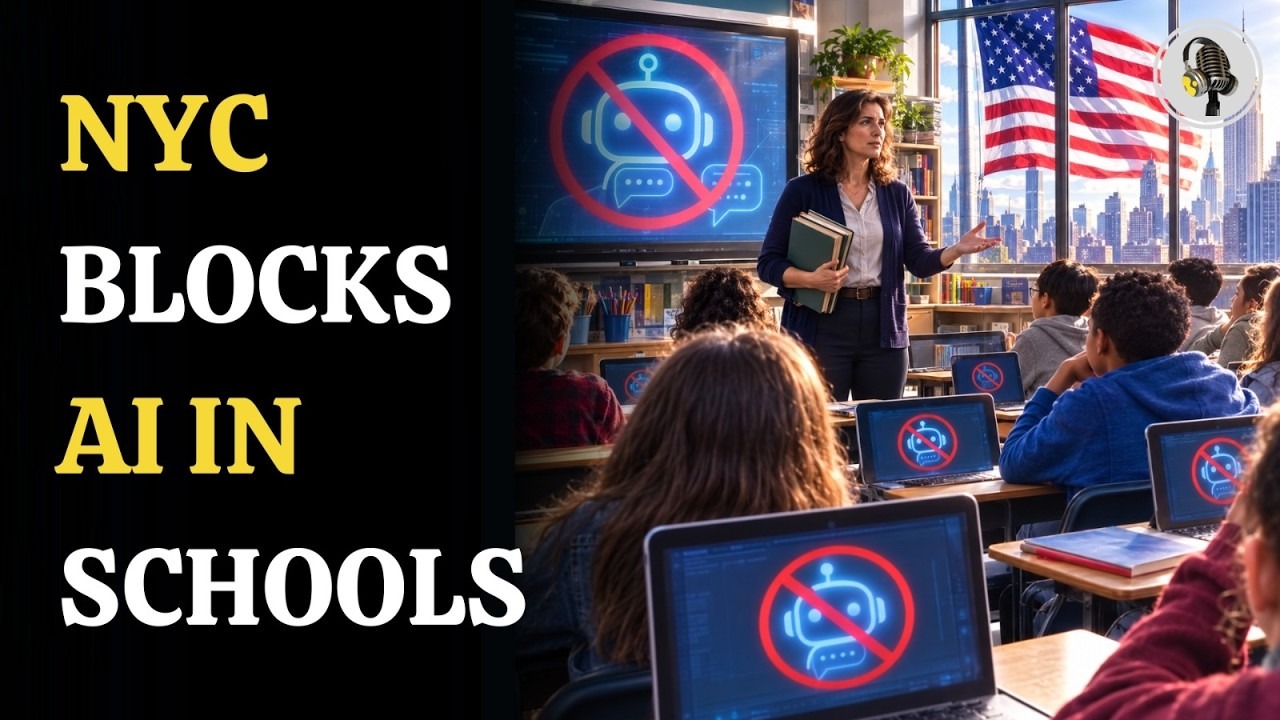
New York City's aggressive ban on generative AI for students up to the eighth grade has ignited intense global debate. While NYC prioritizes human connection and cognitive safeguards, India's ed-tech-driven landscape faces mounting pressure to establish similar regulatory guardrails for young learners.
New Delhi — As New York City Public Schools—the largest school district in the United States—officially implemented a one-year ban on generative artificial intelligence and companion chatbots for students from pre-kindergarten through eighth grade, educators and policymakers in India are confronting a parallel dilemma. Announced by NYC Mayor Zohran Mamdani and backed by strict screen-time limits, the policy prioritizes human-led instruction over automated algorithms. This international regulatory shift has ignited a vital conversation across urban and rural Indian educational frameworks regarding how the country should balance aggressive ed-tech adoption with cognitive protection for young learners.
Decoding the New York Policy and Global Ripple Effects
According to official administrative announcements from New York City Public Schools (NYCPS), the unprecedented moratorium is designed to prevent "cognitive surrender" and protect foundational reasoning skills among nearly 600,000 young students.
Scope of the Ban: All student-facing generative AI tools, AI tutors, and companion chatbots are barred from pre-K through eighth-grade classrooms.
Screen-Time Caps: The district introduced stringent daily limits, restricting screen use to 30 minutes for grades three through five and 45 minutes for middle schoolers.
High School Framework: Older students are not entirely cut off; instead, they participate in mandatory twice-yearly AI literacy modules and supervised pilot programs.
The initiative aims to ensure that technology serves as a controlled supplement rather than a substitute for interpersonal classroom dynamics and critical thinking.
The Indian Context: Ed-Tech Boom vs. Regulatory Caution
India's education landscape presents a vastly different operational environment, marked by an aggressive push toward digital inclusion through initiatives like the Ministry of Education frameworks and the National Education Policy (NEP). While major ed-tech players and urban private institutions enthusiastically integrate AI-driven personalized learning modules, gamified tutoring, and automated assessment systems into early school curricula, regional and government schools face stark disparities in digital access.
Educational analysts note that while Indian policymakers are eager to harness artificial intelligence to bridge learning gaps and democratize tutoring, the lack of centralized safety guardrails mirrors the exact concerns that drove New York City to press pause. Currently, India lacks a unified national policy restricting generative AI usage for children, leaving individual school boards and private managements to establish their own boundaries.
Impact on Students, Parents, and Ed-Tech Enterprises
For Indian parents and educators, striking the right balance remains an evolving challenge. Unchecked algorithmic dependence risks dulling basic arithmetic, linguistic, and analytical capacities among school children. Conversely, completely shutting out emerging technologies could leave students unprepared for an increasingly automated global workforce. For commercial ed-tech enterprises operating in India, tighter international scrutiny signals an impending demand for transparent, ethically vetted pedagogical tools that prioritize student well-being over unconstrained engagement.
Official Sources Section
Information regarding the regulatory developments, classroom restrictions, and municipal policy frameworks is sourced from official administrative releases by New York City Public Schools (NYCPS) and policy guidelines issued by the Ministry of Education (India).
Quote Section
"According to officials," educational institutions bear a fundamental responsibility to ensure that rapidly evolving technology supports child development and human connection rather than displacing critical independent reasoning.
Why It Matters
Reevaluating how children interact with artificial intelligence safeguards cognitive development, protects student data privacy, and preserves essential teacher-student mentorship. Establishing deliberate guardrails ensures that technological tools enhance learning outcomes without compromising human creativity.
Key Facts at a Glance
NYC Policy: One-year generative AI moratorium for pre-K through eighth grade.
Exemptions: High school students receive supervised AI literacy training; teachers retain access for lesson planning.
Indian Landscape: Rapid ed-tech expansion ongoing without centralized restrictions on children's AI usage.
Core Debate: Balancing digital literacy against the risk of cognitive dependency.
Frequently Asked Questions
What prompted New York City to restrict AI use in schools?
City officials enacted the moratorium to protect foundational cognitive development, curb over-reliance on algorithms, and emphasize human-led instruction.
Does New York's policy ban technology entirely for high schoolers?
No, high school students are permitted limited, supervised exposure via vetted pilot programs alongside mandatory AI literacy modules.
Does India have a similar ban on AI for school children?
Currently, India does not have a nationwide ban on artificial intelligence in classrooms, though various state boards and private institutions independently regulate digital tool usage.
Where can official updates on educational technology frameworks in India be accessed?
Guidelines and policy updates are published regularly on the official portal of the Ministry of Education (India).
Source: New York City Public Schools (NYCPS), Ministry of Education (India)