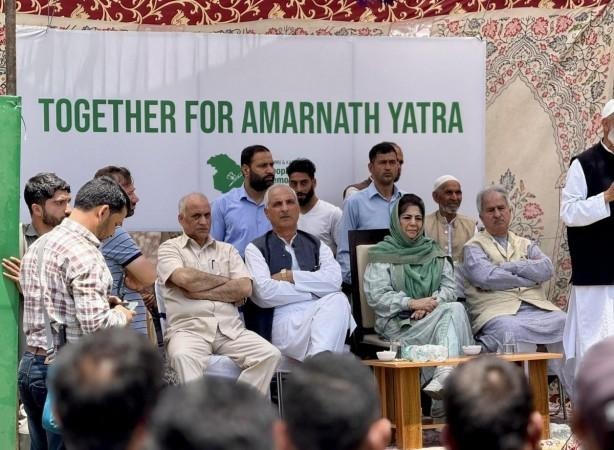
PDP president Mehbooba Mufti has urged the people of Kashmir to leverage the upcoming Amarnath Yatra, starting July 3, 2026, as an opportunity to counter hatred and polarization across India. Speaking in Pahalgam, she emphasized that local hospitality can dismantle negative narratives and foster lasting cross-community harmony.
Addressing stakeholders from the local hospitality sector, traders, and community organizers in the south Kashmir base camp, Mehbooba Mufti stressed that the cultural tradition of the pilgrimage is a cornerstone of Kashmiriyat—the historical ethos of communal harmony and religious syncretism in the Valley.
According to official briefings from party coordinators in Srinagar, the PDP chief argued that direct human interaction during the event serves as the most potent instrument to challenge systemic prejudice. Millions of pilgrims traveling from diverse states across India are expected to visit the 3,880-metre-high cave shrine nestled in the south Kashmir Himalayas.
The public appeals align with broader political efforts to ease local administrative tensions and restore trust ahead of the seasonal influx. The pilgrimage has traditionally seen local Kashmiri Muslims acting as primary service providers, guiding pilgrims, managing logistical supply lines, and running transit camps across challenging mountain terrains.
Collective Social Ownership vs. Security Bureaucracy
A primary focus of the policy address centered on moving the operational philosophy of the pilgrimage away from purely militarized frameworks toward community-led stewardship. While multi-tiered security apparatuses—comprising the Jammu and Kashmir Police, Central Armed Police Forces (CAPF), and the Indian Army—consistently oversee the transit routes, the former Chief Minister advocated for a "locally protected, locally supported, and locally owned" model.
The administrative emphasis highlights the distinct economic and social impact the annual event exerts on regional business networks:
Logistical Integration: Thousands of local porters, horse owners, and tent operators depend on the 57-day operational window for their primary annual income.
Countering Misinformation: Returning pilgrims act as cultural ambassadors, projecting firsthand testimonies of communal safety that counter media-driven biases against the regional population.
Cross-Community Alliances: The shared economic space reinforces multi-faith reliance, temporarily lowering political friction indexes between the Union Territory and neighboring states.
The administrative push for community integration also coincides with recent security coordination reviews led by the Inspector General of Police (IGP) Kashmir, ensuring that localized public participation works in tandem with state protective arrangements along both the Pahalgam and Baltal transit corridors.
Leadership Declarations
"According to officials and public representatives accompanying the party delegation, safeguarding the annual pilgrimage must be approached as a deep-rooted social obligation belonging to the people of Kashmir, rather than a task delegated solely to armed checkpoints."
"Organizers stated that every visiting pilgrim functions as an essential ambassador who carries the true reality of local warmth and hospitality back to their home communities, effectively dismantling false narratives built around the region."
Why It Matters
The peaceful execution of the Amarnath Yatra carries immediate socioeconomic and political implications across the country:
For Devotees and Travelers: Direct community-level cooperation ensures physical safety, fair pricing, and reliable support while navigating high-altitude health hazards.
For Local Businesses: A smooth, incident-free pilgrimage season secures the economic livelihoods of thousands of transport workers, artisans, and hospitality micro-enterprises.
For the National Fabric: Fostering direct, compassionate interaction between diverse communities bridges regional divides, creating a practical template for peace and coexistence across India.
Key Facts at a Glance
Pilgrimage Parameters: The 57-day annual journey to the 3,880-metre-high cave shrine is officially slated to begin on July 3, 2026.
Core Policy Statement: Former Chief Minister Mehbooba Mufti labels the event a prime opportunity to end hate and polarization across India.
Operational Philosophy: Calls for a transition toward a locally protected, locally supported, and locally owned pilgrimage framework.
Economic Impact Footprint: Directly influences seasonal income models for regional porters, transit camp traders, and horse-cart operators.
Frequently Asked Questions
When does the annual Amarnath Yatra commence for the 2026 season?
According to active institutional schedules published by the shrine administration, the multi-week Himalayan pilgrimage is set to officially begin on July 3, 2026.
Why does PDP Chief Mehbooba Mufti emphasize local community involvement over security forces?
She maintains that while security check-posts provide physical monitoring, genuine peace and the elimination of communal mistrust can only be accomplished through direct, hospitable human interactions between local citizens and visiting pilgrims.
What are the primary routes utilized by pilgrims to reach the cave shrine?
The pilgrimage traditionally operates through two distinct mountain tracks: the traditional, longer route starting from Pahalgam in southern Kashmir and the steeper, shorter route via Baltal in central Kashmir's Ganderbal district.
Sources: