Agrarian mountain villages in Ladakh are utilizing vertical, gravity-fed artificial ice pyramids to mitigate severe climate-induced spring water shortages. Designed to minimize solar melting, these automated reservoirs freeze winter stream runoff, providing millions of liters of vital irrigation water during the critical early agricultural season.
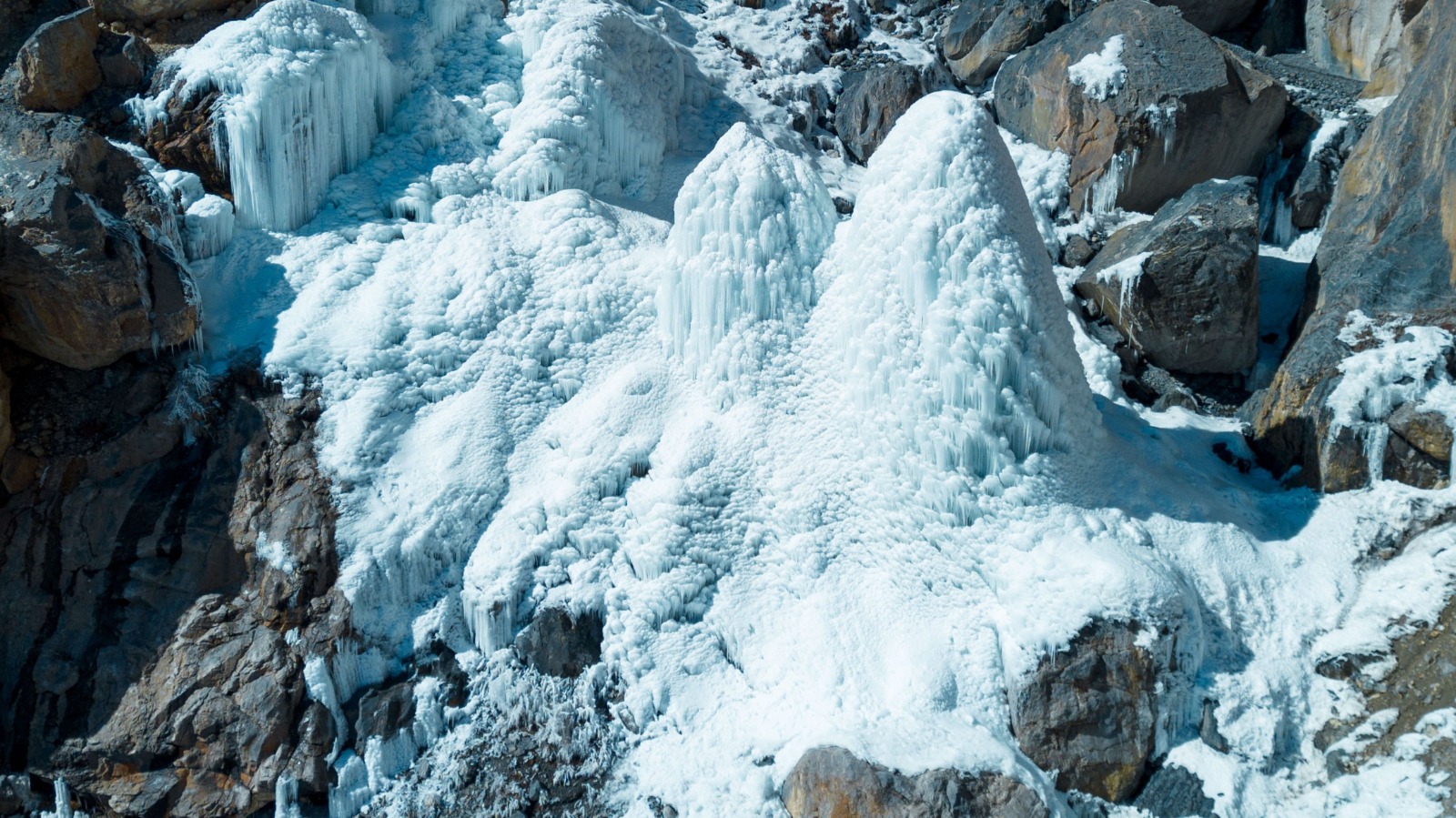
LEH, LADAKH — High-altitude agricultural communities across the trans-Himalayan region of Ladakh are successfully neutralizing critical early-season droughts through the scaled deployment of vertical artificial ice pyramids. These engineered structures, colloquially known as "ice stupas," freeze unutilized winter runoff into massive conical ice mounds that melt gradually to provide crucial water supplies during the spring planting window.
The development is increasingly critical as human-induced climate change accelerates the retreat of natural Himalayan glaciers, disrupting centuries-old water cycles. In Ladakh's cold desert where villages receive less than 50mm of annual rainfall and rely exclusively on glacial melt the delayed arrival of natural runoff has threatened the survival of primary sustenance crops like barley and peas. To address the immediate threat to regional food security, local communities working alongside engineering consortia have established over a dozen automated ice reservoirs, storing millions of liters of water directly above vulnerable farming settlements.
The Physics and Biomimicry of Ice Stupas
Pioneered by Ladakhi engineer Sonam Wangchuk and developed alongside the Students' Educational and Cultural Movement of Ladakh (SECMOL), the artificial ice pyramids rely on a precise geometry designed to delay melting. Traditional horizontal artificial glaciers developed in the 1990s required heavy shading and were restricted to high, north-facing slopes. By contrast, the modern ice stupa uses a vertical, inverted cone structure. This design minimizes the total surface area exposed to direct sunlight while maximizing the interior volume of frozen water, allowing the structures to persist lower down in valleys where temperatures frequently exceed 20 degrees by late spring.
The construction process requires no electricity or mechanical pumps. Water is channeled from high-altitude streams through subterranean pipelines buried below the frost line. Driven entirely by gravitational pressure, the water is forced upward through a vertical terminal pipe at the valley site, creating a continuous fountain.
Implementation, Automation, and Scalability
To optimize these structures against increasingly volatile winter temperatures, the Himalayan Institute of Alternatives, Ladakh (HIAL) has introduced smart automation frameworks. Historically, sub-zero pipe freezing and variable stream flows required intensive, hazardous manual monitoring by village volunteers in severe winter conditions.
Newly integrated telemetry systems track local weather patterns, atmospheric pressure, and real-time water levels. Automated valves dynamically modulate the fountain flow, ensuring optimal misting density for maximum ice accumulation while preventing internal pipe blockages. Data from water-conservation groups indicates that in the 2024/2025 winter season alone, partner organizations successfully stored more than 18.8 million liters of water across 12 distinct mountain villages in the Leh district.
Official Sources Section
The expansion of artificial ice pyramids is documented through multi-institutional data and official research briefs:
The GlacierAlive Foundation: Conducts international tracking and scientific documentation of alternative ice reservoir technologies deployed globally.
Himalayan Institute of Alternatives, Ladakh (HIAL): Coordinates local community implementation and oversees technical research into smart water distribution metrics.
Rolex Awards for Enterprise: Provided formal operational funding and foundational verification data for the scale-up of the initial ice stupa designs.
Executive Quotes
"We ran an international crowdfunding campaign that drew a lot of interest from people around the world. It really was like the whole world coming together to build these stupas which used to be built to stop calamities from coming but now it was to check climate change effects like glacier meltwater shortage."
— Sonam Wangchuk, Founder of SECMOL and Inventor of the Ice Stupa
"According to officials at HIAL, integrating automation into traditional indigenous wisdom provides a sustainable solution to water scarcity, reducing local dependency on dwindling natural water sources and promoting climate resilience across fragile mountain ecosystems."
— HIAL Operational Briefing
Why It Matters
For the citizens and agrarian families of the high Himalayas, the structural stability of these artificial ice pyramids represents the difference between economic survival and climate-driven migration. By slowly discharging up to 5,000 liters of meltwater daily during April and May, the pyramids provide reliable, localized irrigation exactly when natural streams run dry.
Beyond local food security, the low-cost, gravity-fed adaptation method is attracting substantial interest from environmental economists and water-tech investors evaluating decentralized climate adaptation strategies. The successful deployment of Ladakhi ice-grafting techniques has already prompted international pilot programs in highly glaciated, water-stressed mountainous regions globally, including the Swiss Alps.
Key Facts at a Glance
Volume Stored: Over 18.8 million liters of vital freshwater were successfully preserved during recent winter cycles to combat early-season agricultural drought.
Thermal Endurance: The cone-shaped geometry minimizes solar exposure, allowing the ice pyramids to remain intact and provide irrigation into late June.
Zero-Emission Operation: The system uses zero electricity, relying exclusively on gravitational pressure and ambient sub-zero temperatures to form the ice structures.
Technological Integration: Automated electronic valves and localized real-time data tracking have mitigated pipe-freezing issues and enhanced scaling capacity.
FAQ Section
Q: What exactly is an ice stupa?
A: An ice stupa is a type of artificial glacier built by piping unutilized winter stream water down into valleys. Forced through a vertical nozzle, the water sprays upward, freezes in the sub-zero air, and builds a cone-shaped mound of ice.
Q: Why are these structures built in a pyramid or cone shape?
A: A conical or pyramidal shape minimizes the surface area exposed to direct sunlight while maximizing the volume of ice inside. This mathematical equilibrium slows down the melting process significantly compared to flat ice sheets.
Q: How do mountain villages benefit practically from these structures?
A: In early spring, natural glacial meltwater is delayed due to high-altitude freezing, causing severe shortages during the critical sowing season. Ice stupas melt at lower elevations during this exact window, providing steady water for village fields.
Sources: