ISRO has successfully test-fired its 175-tonne semi-cryogenic engine power head, a major milestone in developing India’s next-generation launch vehicle propulsion. This cleaner, more powerful engine, using kerosene and liquid oxygen, will upgrade the LVM3 rocket, significantly enhancing India's capacity for heavy-lift commercial and deep-space missions.
The Indian Space Research Organisation has successfully test-fired its next-generation engine at 175-tonne thrust, a critical step toward upgrading India’s heavy-lift launch capabilities.
A Major Leap for Indigenous Space Propulsion
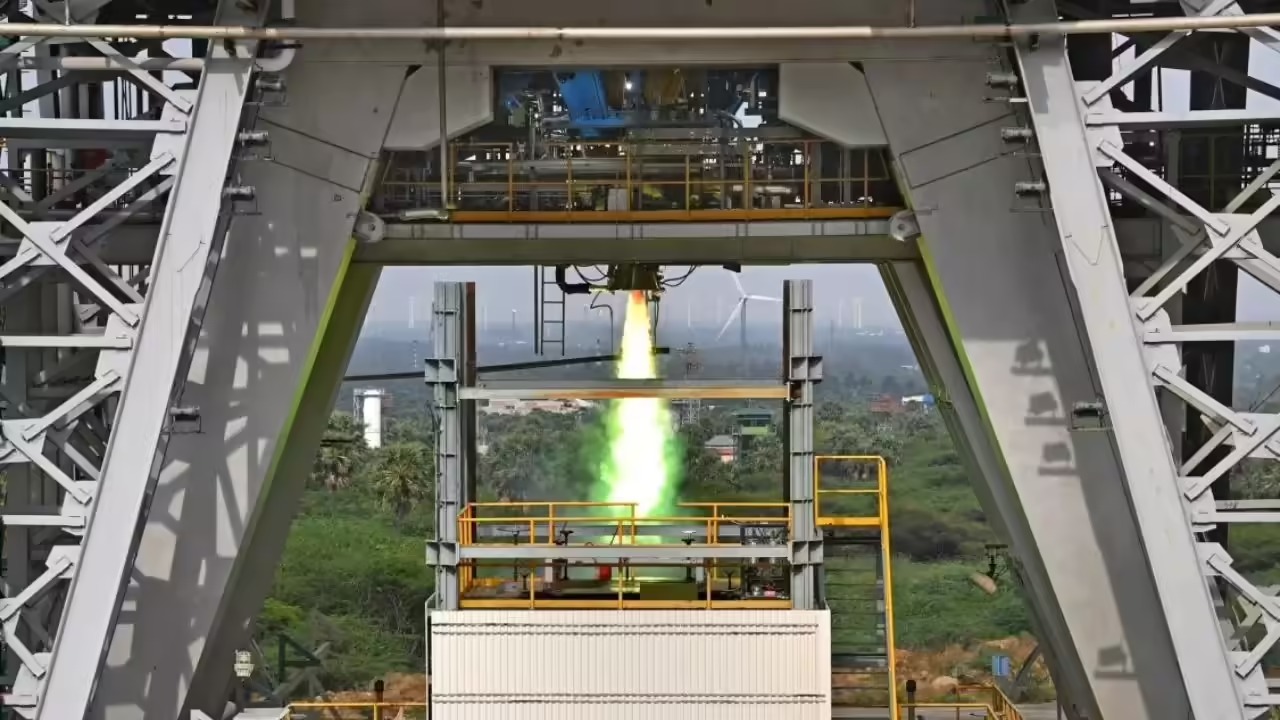
The Indian Space Research Organisation (ISRO) has successfully conducted a hot test of its Semi-Cryogenic Engine Power Head Test Article (PHTA) at a thrust level of 175 tonnes. The test, held on June 24, 2026, at the ISRO Propulsion Complex (IPRC) in Mahendragiri, Tamil Nadu, marks a decisive milestone in the development of India's next-generation propulsion technology.
This trial represents the eighth in a series of hot tests for the engine’s power head, which encompasses all critical systems—including gas generators, turbopumps, and control mechanisms—excluding the thrust chamber. By operating at 175 tonnes of thrust, ISRO successfully demonstrated 88% of the engine's full rated capacity, proving the system’s stability and performance during high-load operations.
Technical Progress and Strategic Impact
The development of the 2,000-kilonewton-class SE2000 engine is central to ISRO's long-term modernization roadmap. The semi-cryogenic propulsion system uses environmentally cleaner, non-toxic propellants: Liquid Oxygen (LOX) and purified kerosene, often referred to as "Isrosene."
Enhancing Launch Vehicle Mark-3 (LVM3)
According to official releases, the Semi-Cryogenic Propulsion Stage (SC120) is being developed to replace the existing L110 liquid core stage of the LVM3, India’s heaviest operational launch vehicle. The upgrade is expected to provide several strategic advantages:
Increased Payload Capacity: Substantially boosting the rocket's ability to carry heavier satellites into orbit.
Operational Efficiency: Utilizing a more cost-effective and efficient propellant combination compared to traditional stages.
Mission Versatility: Strengthening India’s capabilities for high-capacity satellite deployments, deep-space exploration, and the ongoing human spaceflight programme.
The Road to Full-Scale Flight
ISRO Chairman V. Narayanan hailed the test as a "major achievement and milestone" in the space agency's propulsion program. Speaking on the successful outcome, officials noted that the engine's main turbopumps delivered outlet pressures of 400 and 500 bar as predicted, with all parameters remaining within expected ranges.
The data gathered from this 175-tonne trial provides the technical confidence necessary to proceed to the final qualification phase: a full-scale hot test at the engine’s maximum rated thrust of 200 tonnes. Once fully qualified, the engine will not only modernize the LVM3 but also serve as a foundational propulsion system for ISRO’s future Next Generation Launch Vehicle (NGLV).
Why It Matters
This advancement is pivotal for India’s stature as a leading global space power. By achieving indigenous mastery over high-thrust semi-cryogenic technology, India reduces its reliance on foreign launch vehicle subsystems. The transition to more powerful, cleaner-burning engines ensures that ISRO can continue to reduce launch costs while meeting the growing demands of both commercial satellite markets and ambitious national missions, including the roadmap for future lunar and deep-space exploration.
Official Sources
Key Facts at a Glance
Thrust Milestone: Successful hot test conducted at 175 tonnes (88% of rated capacity).
Propellant Type: Uses Liquid Oxygen (LOX) and purified Kerosene (Isrosene).
Core Purpose: To replace the L110 liquid stage in the LVM3 launch vehicle.
Test Location: ISRO Propulsion Complex (IPRC), Mahendragiri, Tamil Nadu.
Next Phase: Qualification test at 200 tonnes of full rated thrust.
FAQ
1. What is a "semi-cryogenic" engine?
A semi-cryogenic engine uses refined kerosene (Isrosene) as fuel and liquid oxygen as an oxidizer. It offers higher efficiency and lower operational costs compared to conventional liquid propulsion stages.
2. Why is this test important for the LVM3 rocket?
The new engine will replace the current core stage of the LVM3, significantly increasing its payload-carrying capacity and efficiency for future missions.
3. What does "Power Head Test Article" (PHTA) mean?
The PHTA is a partial engine assembly that includes all critical components—such as turbopumps and pre-burners—except for the main thrust chamber. It allows engineers to test the core systems before integrating the full engine.
4. How does this affect the Gaganyaan mission?
While the engine upgrade is primarily for the LVM3's general payload capacity, the advancements contribute to the overall technological robustness required for India's human spaceflight program.
Source: ISRO, Economic Times, ANI