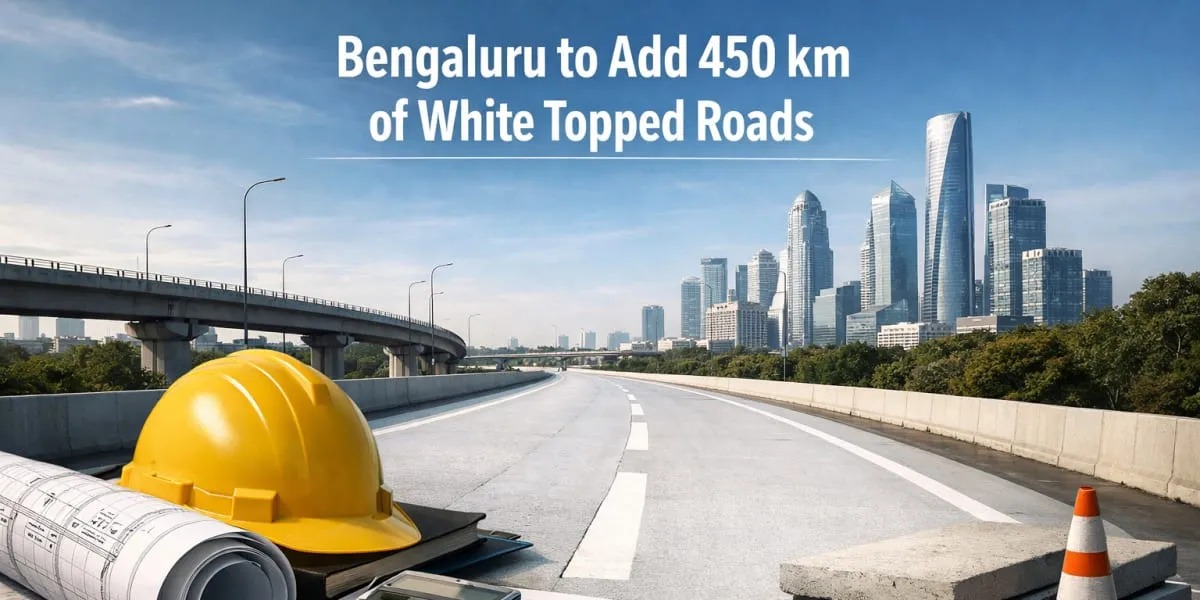
The Karnataka government has launched a ₹3,000 crore plan to white-top 450 km of Bengaluru’s arterial roads. Aimed at replacing short-lived asphalt with durable concrete, the three-year project seeks to reduce pothole formation, lower long-term maintenance costs, and provide a permanent solution to the city's recurring infrastructure degradation.
BENGALURU — The Karnataka government is set to significantly expand its infrastructure footprint with a new project to white-top 450 kilometres of arterial roads across Bengaluru. The project, estimated to cost ₹3,000 crore, is being spearheaded by the Bengaluru Smart Infrastructure Limited (B-SMILE) and aims to provide a long-term, pothole-free solution to the city’s recurring road maintenance challenges.
The initiative was confirmed during a review meeting led by Greater Bengaluru Development Minister Krishna Byre Gowda. Officials noted that while traditional bituminous (asphalt) roads require frequent repairs—especially during monsoon seasons—concrete white-topped roads offer a lifespan of 20 to 30 years.
A Long-Term Solution for Traffic Congestion
The move comes as the city continues to grapple with extreme traffic congestion and poor road conditions. According to the minister, the government is prioritizing durability to offset high initial capital expenditures. While a kilometre of asphalt road costs approximately ₹4 crore, white-topping involves an investment of roughly ₹10 crore per kilometre. However, the government argues that the reduction in recurring maintenance costs and repair cycles makes the concrete-based approach more economical over the lifecycle of the infrastructure.
"Concrete roads offer a longer-lasting solution," Minister Gowda stated during the review. He emphasized that the project is not just about the surface but also about redesigning road efficiency. He specifically directed officials to stop "wasting money" on white-topping stretches already earmarked for proposed flyovers, urging better coordination between various infrastructure projects to avoid redundant spending.
Project Scope and Implementation
B-SMILE is currently finalizing the detailed project reports (DPRs) and cost planning for the 450-km expansion. The work is planned to be executed over a three-year window, with clear instructions from the ministry to accelerate existing phase-three projects.
Current Progress: Approximately 196 km of white-topping has been completed in previous phases.
Active Projects: Another 126 km is currently under construction, with 58 km already finished.
Expedited Timeline: Officials have been instructed to complete all pending phase-three works within the next six months.
Beyond the main carriageways, the project mandate includes the construction of improved footpaths and better integration of drainage systems to prevent waterlogging, a major contributor to road degradation in Bengaluru.
Integration with Other Infrastructure
The road upgrade is part of a multi-pronged strategy to decongest Bengaluru. The government is concurrently advancing plans for tunnel roads, elevated corridors, and the expansion of the Namma Metro network. Minister Gowda clarified that the government is focusing on a comprehensive approach where elevated corridors and tunnel projects are synchronized with surface-level road upgrades to prevent bottlenecks at entry and exit points.
Why It Matters
For Bengaluru’s commuters, the commitment to white-topping represents a potential end to the annual cycle of road digging and pothole filling. For the city’s logistics and daily workforce, the project promises more reliable transit times. However, the construction phase—which involves closing off sections of major roads—is expected to cause significant temporary traffic disruptions. Authorities have mandated that contractors work in shifts, including at night, to meet the strict 11-month construction timelines for specific packages.
Key Facts at a Glance
Project Scale: 450 km of additional white-topped roads planned.
Estimated Budget: ₹3,000 crore.
Target Lifespan: 20 to 30 years per road stretch.
Project Oversight: Managed by Bengaluru Smart Infrastructure Limited (B-SMILE).
Key Mandate: Improved footpaths and integrated drainage for every upgraded road.
FAQ
What is white-topping?
White-topping is a process of laying a cement concrete overlay on existing bituminous (asphalt) roads to provide a durable, weather-resistant, and high-strength surface.
Why is the government opting for white-topping despite the higher initial cost?
The government states that although initial costs are higher, the long lifespan (20-30 years) and minimal maintenance requirements make it cheaper in the long run compared to frequent asphalt repairs.
Will this project cause more traffic jams?
The construction process will likely cause temporary congestion. The government has ordered contractors to work in three shifts, including nighttime, to minimize impact.
Are there other road projects planned for the city?
Yes, the government is concurrently planning a network of tunnel roads and elevated corridors to address North-South and East-West congestion alongside this white-topping programme.
Source: Bengaluru Smart Infrastructure Limited (B-SMILE) Review Meeting, Karnataka Infrastructure Department