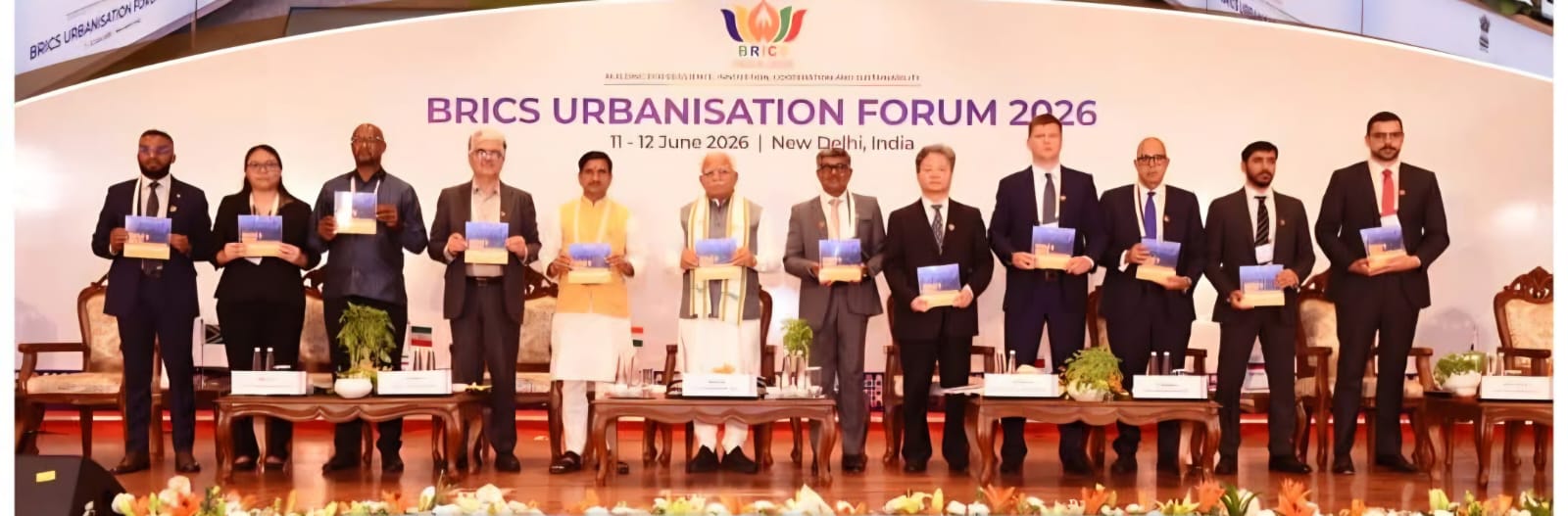
The 13th BRICS Urbanisation Forum in New Delhi concluded with member states approving an India-proposed "BRICS Urban Research and Knowledge Network." Operating via a flexible virtual model led by the rotating chair country, the network joins ten nations to share applied research, upgrade infrastructure resilience, and accelerate sustainable civic governance.
NEW DELHI — In a major geopolitical breakthrough for global municipal development, member countries of the BRICS bloc have officially approved an Indian-proposed multilateral knowledge-sharing framework focused entirely on rapid urbanization. The agreement was reached at the conclusion of the 13th BRICS Urbanisation Forum, held from June 11 to June 12, 2026, under India’s current BRICS Chairship.
The newly approved initiative, named the BRICS Urban Research and Knowledge Network, establishes an institutional platform designed to address critical, shared municipal challenges across the expanded ten-nation alliance. Government delegations from Brazil, Russia, India, China, South Africa, Egypt, Ethiopia, Iran, Indonesia, and the United Arab Emirates formally endorsed the proposal inside the final Ministerial Declaration. This joint mechanism aims to accelerate city-level data-sharing, applied research, and peer-to-peer policy translation to improve urban living conditions for over 40% of the world's population.
Establishing the BRICS Urban Research and Knowledge Network
The framework operates as a low-cost, flexible, and virtually connected cooperative tool. According to official guidelines released by the host ministry, the network will be driven by a rotating format where the nodal organization of the prevailing BRICS Chair country coordinates the platform's outputs annually before transitioning responsibilities to the subsequent host nation.
The Ministry of Housing and Urban Affairs specified that the primary mandate of the program is to narrow the systemic gap between high-level municipal policy and field-level execution. Member states plan to deploy the network to dissect operational lessons, city-level experiments, and technical solutions spanning affordable housing, public transit grids, and digitized civic services.
Sustainable Development and Structural Reform Priorities
The two-day forum in New Delhi focused extensively on long-term structural issues driven by rapid geographic expansion and demographic shifts within developing economies. Key technical panels reviewed resource optimization strategies designed to lower municipal consumption footprints while boosting economic output.
Senior urban practitioners evaluated structural frameworks including:
Climate Adaptation and Disaster Preparedness: Retrofitting aging civil infrastructure to withstand extreme weather anomalies.
Equitable Access Protocols: Guaranteeing essential services, water security, and waste treatment facilities for lower-income and marginalized suburban populations.
Municipal Finance Adjustments: Helping localized governments optimize debt instruments, coinciding with financial transformations like the
Ministry of Financeencouraging local bodies to access debt markets for sustainable development.
Official Sources Section
The ratification of the knowledge network was formally announced by India’s Union Minister of Housing and Urban Affairs, Manohar Lal, during a press briefing at the conclusion of the summit at the Sushma Swaraj Bhavan. Documentation confirming the platform's operating protocols was cross-verified through official government notifications issued by the Press Information Bureau (PIB). Strategic sub-deliberations regarding institutional capacity building were also documented in parallel bilateral minutes signed by India's Ministry of Housing and Urban Affairs and the Ministry of Construction, Housing and Utilities of the Russian Federation.
Ministerial Statement
"The BRICS member nations have accepted a proposal by India to establish a knowledge-sharing forum on urbanization. This network—the BRICS Urban Research and Knowledge Network—will be a chair-led, institutionally connected knowledge mechanism for research and collaboration between member nations. There will be one nodal organization from each member country as a part of this network."
— Manohar Lal, Union Minister of Housing and Urban Affairs
Why It Matters: Practical Impact on Citizens and Infrastructure
For everyday citizens living within the expanding metropolitan boundaries of the BRICS nations, this agreement signals an imminent upgrade to civic utility management. Rather than testing urban solutions in isolation, municipal corporations in cities like Mumbai, Shanghai, or Johannesburg can directly adopt pre-vetted, data-driven frameworks from their peer countries.
For instance, Indian municipal bodies planning waste management programs or slum-upgrading initiatives can import localized operational blue-prints directly from Brazil or China through the network's virtual link. This structural efficiency reduces the time and public capital required to launch massive civil transit projects, expand continuous drinking water access, and upgrade emergency services against flooding or seismic events.
Key Facts at a Glance
New Institution: The initiative is officially named the BRICS Urban Research and Knowledge Network.
Ten Countries Involved: The framework unites municipal institutions across Brazil, Russia, India, China, South Africa, Egypt, Ethiopia, Iran, Indonesia, and the UAE.
Operational Format: Utilizes a flexible, low-cost virtual design managed dynamically by the rotating annual BRICS Chair country.
Core Policy Anchor: Focuses explicitly on applied urban research, climate-resilient infrastructure, digital civic governance, and low-cost housing implementation.
Frequently Asked Questions
What is the primary objective of the BRICS urbanization knowledge-sharing network?
The platform provides a practical, sustained mechanism to exchange city-level experiences, share applied research, and bridge the operational gap between state-level planning and local implementation across member countries.
Which countries are participating in this new urban alliance?
The network includes the host nation India, along with Brazil, Russia, China, South Africa, Egypt, Ethiopia, Iran, Indonesia, and the United Arab Emirates.
How will this platform affect regular city residents?
By allowing local administrations to access proven blueprints for municipal public transport, solid waste management, and water security systems, urban development projects can be deployed faster with lower capital waste.
How will the network be managed structurally?
It operates through a decentralized, virtual model coordinated by a designated lead institution within the annual BRICS Chair country, ensuring zero long-term bureaucratic overhead.
Source: Ministry of Housing and Urban Affairs / Press Information Bureau (PIB), Official Ministerial Briefing, Sushma Swaraj Bhavan, New Delhi.