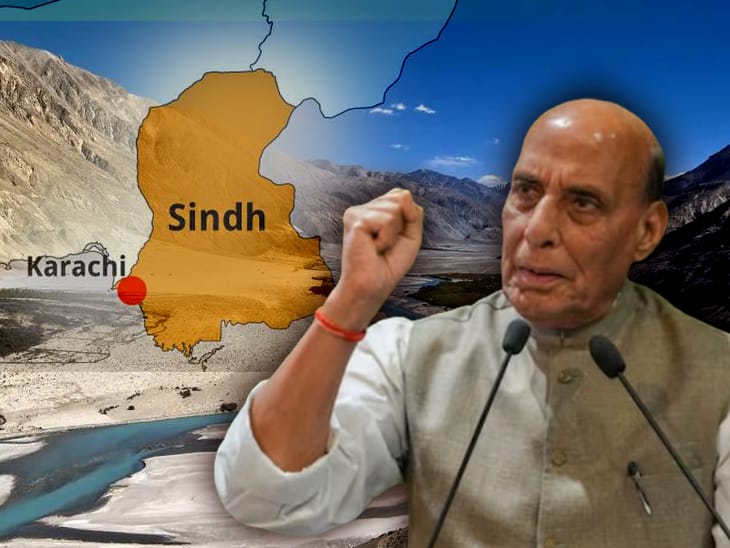
Speaking in Hyderabad, Defence Minister Rajnath Singh warned that India will block the Sindhu (Indus) river waters from reaching patrons of terrorism. Following the suspension of the Indus Waters Treaty post-Pahalgam, Singh underscored a zero-tolerance policy, leveraging hydro-diplomatic assets alongside rising domestic defense capabilities to enforce absolute border security.
HYDERABAD — In a major escalation of regional policy, India has declared it will completely prevent the waters of the Sindhu (Indus) River system from entering Pakistan if neighboring networks continue to sponsor cross-border militancy. Defence Minister Rajnath Singh announced the directive on Friday, June 12, 2026, solidifying New Delhi’s strategy of leveraging hydro-diplomatic resources as an active instrument of counter-terrorism.
Speaking before a high-profile "Intellectuals Meet" organized by the Telangana Bharatiya Janata Party (BJP) in Hyderabad, Singh reinforced the National Democratic Alliance (NDA) government's uncompromising national security posture. The policy shift directly follows India’s formal suspension of the decades-old Indus Waters Treaty (IWT) in response to the Pahalgam terror attack, marking a total departure from decades of strategic restraint.
The Hydro-Diplomatic Front: Cutting Grain and Water
The Union Government has explicitly tied downstream river access directly to regional stability. Minister Singh emphasized that standard diplomatic communication remains frozen, establishing a strict prerequisite that cross-border hostility must permanently cease before any environmental or resource treaties can be renegotiated.
According to statements issued by the Ministry of Defence, India's infrastructure planning along the western rivers of the Indus basin—the Indus, Jhelum, and Chenab—is being structurally modified. The state intends to maximize its legally permissible water storage, run-of-the-river power generation, and diversion capacities to redirect flows back into domestic agricultural and industrial sectors, heavily minimizing the downstream output traditionally channeled into Pakistan.
Contextualizing Operation Sindoor and Evolving Military Doctrine
The hardening hydro-stance directly mirrors recent military developments. During his address, the Defence Minister pointed to the success of "Operation Sindoor"—a highly coordinated counter-terror operation launched by the Indian Armed Forces to neutralize cross-border launchpads following the Pahalgam incident.
Singh noted that the operation successfully disrupted several designated training structures with highly localized precision, demonstrating India’s modern operational capability to penalize hostile staging areas without inflicting major collateral damage on civilian areas. The Minister further stated that the domestic defence industrial complex has grown to an unprecedented valuation of ₹1.50 lakh crore, and is on track to touch ₹1.70 lakh crore within a month, backed by a defense budget allocation that has scaled to ₹8 lakh crore.
Official Sources Section
The defense policy directives were officially detailed during public proceedings documented by state administrative units. The framework regarding resource restrictions and border security alignments has been cross-verified through official government briefings archived by the Press Information Bureau (PIB). Parallel strategic statements regarding India's strict "no terror, no talks" baseline remain synchronized across security briefs maintained by the Ministry of External Affairs.
Quote Section
"After the Pahalgam terror attack, by suspending the Indus Waters Treaty, we said that those whose tears have dried up should not expect water from us. We will not let the waters of the Sindhu reach the patrons of terrorists and enemies of humanity. The government has made it clear that countries supporting terror should not expect either grain or water from India."
— Rajnath Singh, Union Defence Minister
Why It Matters: Strategic Realities for Consumers and Agriculture
The decision to structurally restrict downstream flows heavily impacts regional economics, water management, and agricultural sectors. For domestic farmers in Jammu & Kashmir and Punjab, the accelerated construction of storage reservoirs means upgraded access to irrigation networks, stabilizing crop yields throughout fluctuating monsoon cycles.
Conversely, for regional stakeholders and international observers, the weaponization of water resources introduces a severe variable into South Asian energy and agricultural security. By completely shutting off resource treaties during national security emergencies, New Delhi is actively forcing international entities and neighboring states to calculate the immense economic and ecological penalties of failing to curb localized militant organizations.
Key Facts at a Glance
Policy Threshold: India will explicitly withhold the waters of the Sindhu (Indus) River basin from states sponsoring proxy warfare.
Treaty Status: The long-standing Indus Waters Treaty (IWT) remains suspended following the lethal Pahalgam terror attack.
Military Upgrades: India’s defense production has surged to ₹1.50 lakh crore, supported by an expanded annual defense budget of ₹8 lakh crore.
Strategic Doctrine: The Union Government maintains an absolute "zero-tolerance" framework, stating that grain and water resource access is directly contingent on peace.
Frequently Asked Questions
Why is India threatening to block the Sindhu (Indus) waters?
The directive serves as a hydro-diplomatic counter-measure to cross-border terrorism, penalizing state-sponsored militancy by withholding vital downstream resources.
What led to the suspension of the Indus Waters Treaty?
The treaty was formally suspended by New Delhi after a major militant strike in Pahalgam, fundamentally linking resource-sharing agreements directly to national security and border stability.
What was Operation Sindoor?
It was a precise, high-impact counter-terrorism operation executed by the Indian military to dismantle hostile command centers and launchpads near the border.
How does this policy affect domestic infrastructure inside India?
It accelerates the construction of specialized storage reservoirs, dams, and run-of-the-river power projects across Jammu & Kashmir and Punjab to utilize the water domestically.
Source: Ministry of Defence / Press Information Bureau (PIB), Official Address, Telangana BJP Intellectuals Meet, Hyderabad.