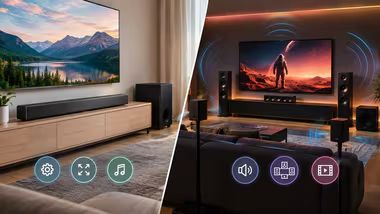
Deciding between a 3.1 and 5.1 soundbar for an Indian living room depends heavily on room size and viewing habits. While 3.1 excels in dialogue clarity and space efficiency, 5.1 systems offer superior cinematic immersion for movie lovers willing to manage extra surround channels.
Choosing the right audio configuration requires balancing room acoustics, spatial preferences, and everyday media habits across urban homes.
NEW DELHI — Upgrading home entertainment systems often brings consumers face-to-face with a confusing array of audio specifications, with the debate between 3.1 channel and 5.1 channel soundbar configurations taking center stage. According to recent consumer technology reviews and audio gear market assessments released in September 2026, urban homeowners frequently struggle to determine whether the addition of rear surround channels justifies the extra cost and layout complexity. As living room dimensions and modern apartment layouts evolve across major metropolitan cities, selecting the optimal audio setup depends heavily on whether buyers prioritize crystal-clear dialogue or full-scale cinematic immersion.
Breaking Down Channel Configurations and Acoustic Realities
Understanding the fundamental differences between these audio systems helps buyers align their hardware purchases with actual daily usage patterns.
Speaker Layout Architecture: A 3.1 system incorporates three front channels (left, right, and center) alongside a dedicated subwoofer, whereas a 5.1 system expands upon this by adding two rear or side surround channels.
Dialogue Clarity Focus: The inclusion of a dedicated center channel in both setups ensures that spoken words, news broadcasts, and television dramas remain distinct and intelligible without requiring constant volume adjustments.
Spatial Immersion Dynamics: A 5.1 configuration leverages extra surround channels or advanced psychoacoustic processing to distribute audio cues around the listener, enhancing movie nights and gaming sessions.
Living Room Spatial Limits: Compact Indian living spaces often lack optimal rear-wall placement or physical clearance for satellite speakers, making front-focused 3.1 bars a more practical fit.
Consumer Impact and Practical Home Integration
For everyday consumers, movie enthusiasts, and multi-generational households sharing a common living room, the choice directly dictates daily convenience. Audio engineers note that while 5.1 systems deliver a broader soundstage for blockbuster films, they require careful room planning to avoid cable clutter and awkward speaker positioning. Conversely, a high-quality 3.1 soundbar offers a streamlined footprint, making it an efficient solution for apartment complexes where wall space is at a premium and late-night listening requires balanced, low-distortion dialogue output.
Why It Matters
Selecting the correct soundbar configuration prevents wasted expenditure on unused features and ensures that home audio gear matches the physical realities of modern living spaces. Matching hardware capabilities to actual room dimensions guarantees optimal acoustic performance and everyday viewing satisfaction.
Key Facts at a Glance
3.1 Setup: Features left, right, and center speakers plus a subwoofer; ideal for dialogue-heavy TV shows and compact spaces.
5.1 Setup: Adds two surround channels; delivers enhanced spatial depth for movies and gaming.
Primary Benefit: Both systems feature dedicated center channels to eliminate muffled speech.
Space Consideration: Room layout and rear speaker placement dictate the feasibility of a 5.1 system.
Frequently Asked Questions
What is the main difference between a 3.1 and 5.1 soundbar?
A 3.1 soundbar features three front-facing audio channels and a subwoofer, whereas a 5.1 soundbar adds two additional surround channels for enhanced directional sound.
Which setup is better for watching standard TV shows and news?
A 3.1 channel setup is usually sufficient for everyday television viewing, news, and dialogue-driven dramas.
Do 5.1 soundbars require physical rear speakers?
While traditional 5.1 configurations use physical rear satellite speakers, many modern soundbars simulate surround effects using acoustic wall reflections or wireless satellite modules.
How do I choose the right option for an apartment living room?
Consider your room size, available wall space for satellite speakers, and whether you primarily watch casual TV or high-octane action movies.
Source: Hindustan Times, MakeUseOf, Ultimea Audio Guide, Burton Acoustix