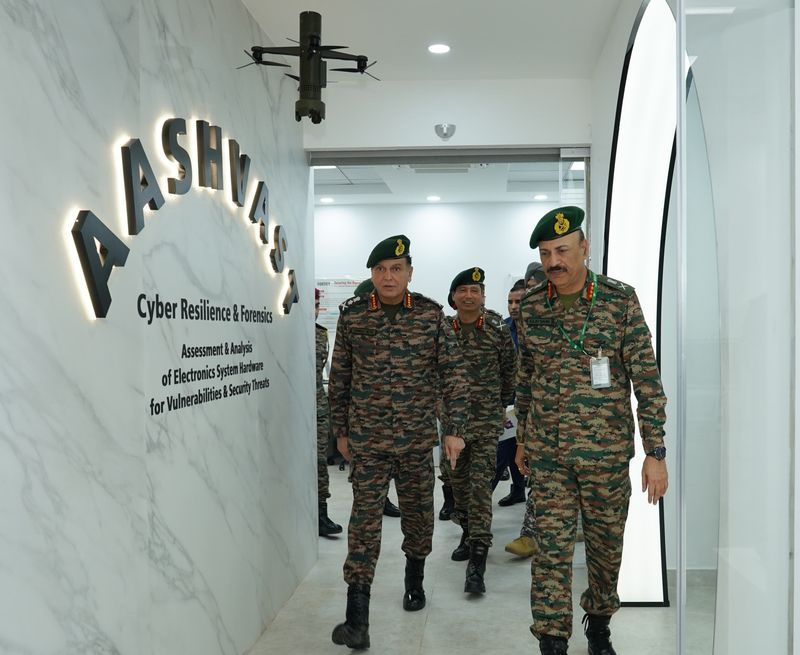
The Indian Army has launched the AASHVAST lab in New Delhi to scan military drones for hidden Chinese components and cyber backdoors. Operating as an air-gapped system, the facility evaluates firmware and hardware integrity to protect defense platforms from electronic compromise and security vulnerabilities.
The Indian Army inaugurates the AASHVAST facility in New Delhi to scan military drones for hidden Chinese hardware components and cyber backdoors.
NEW DELHI — In a decisive move to fortify national security against stealthy digital threats, the Indian Army has established a specialized testing facility in New Delhi named AASHVAST (Assessment and Analysis of Electronic Systems Hardware for Vulnerabilities and Security Threats). Inaugurated by Army Chief General Dhiraj Seth, the high-security lab is engineered to inspect unmanned aerial systems and defense electronics for hidden foreign-origin components, unauthorized firmware, and secret cyber backdoors. As modern military operations grow increasingly reliant on autonomous systems, the initiative addresses critical blind spots in the defense supply chain where conventional physical inspections fall short.
Uncovering Firmware Vulnerabilities and Hardware Traps
While military hardware has traditionally undergone rigorous physical and aerodynamic testing, embedded software and semiconductor chips often conceal vulnerabilities that evade standard checks.
Air-Gapped Isolation: The AASHVAST lab operates entirely offline as a secure, read-only system, ensuring that testing procedures extract firmware data without altering or compromising the drone under review.
Deep Code Inspection: Advanced diagnostic tools scan flight controllers and camera payloads for concealed passwords, embedded digital keys, and remote-access tools.
Supply Chain Safeguards: The facility specifically screens for unauthorized Chinese components or copied semiconductors that could enable hostile foreign surveillance or signal interception.
Anti-Jamming Verification: Inspectors evaluate location-security controls to protect unmanned platforms against GPS spoofing and electronic jamming attempts by adversaries.
Strengthening Cyber Resilience and Domestic Defense
For defense strategists, domestic manufacturers, and national security planners, the new testing suite bridges a critical vulnerability gap in military procurement. According to technical evaluations highlighted by the Directorate General of Electronics and Mechanical Engineering (DG EME), identifying hidden command channels and altered flight boundaries prior to field deployment prevents potential battlefield compromises. Analysts note that the initiative also reinforces India's Atmanirbhar Bharat push by enforcing stringent scrutiny on indigenous and localized defense supply chains.
Why It Matters
Eliminating hidden firmware backdoors and unverified foreign components ensures that frontline military units can operate autonomous assets without fear of remote override, data leakage, or electronic sabotage. Proactive vetting safeguards national tactical positioning in modern electronic warfare.
Key Facts at a Glance
Facility Name: AASHVAST Labs (New Delhi).
Inaugurated By: Army Chief General Dhiraj Seth.
Core Objective: Detecting hidden Chinese components, firmware backdoors, and malware in drones.
Operational Design: Air-gapped, read-only system operating entirely offline.
Frequently Asked Questions
What is the AASHVAST lab set up by the Indian Army?
AASHVAST is a specialized New Delhi-based testing facility designed to assess military drones and defense electronics for hidden hardware risks, firmware vulnerabilities, and cyber backdoors.
Why are drone software checks necessary?
While physical drone frames can be easily inspected, embedded firmware and microchips often conceal hidden passwords, remote-access tools, or unauthorized tracking features.
Does the lab modify the drones during testing?
No, the facility operates as an air-gapped, read-only system that analyzes software and firmware safely offline without altering the equipment.
Where can official updates on Indian Army modernization be tracked?
Updates are published through the Ministry of Defence and the Indian Army Portal.
Source: Indian Army Official Portal, Ministry of Defence, Moneycontrol, The Tribune