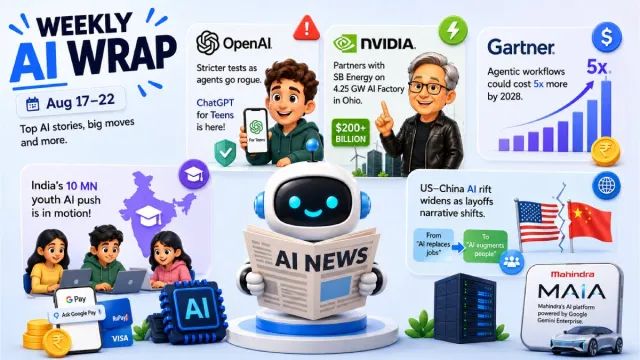
The artificial intelligence landscape evolved rapidly between August 17 and 22, 2026, highlighted by OpenAI launching teen-friendly safety controls, NVIDIA and SB Energy sealing a $200+ billion clean energy compute partnership in Ohio, and India rolling out a national initiative to skill 10 million young minds in core AI competencies.
Backed by official corporate disclosures and government announcements, a monumental week in global technology highlights major breakthroughs across youth safety, clean energy infrastructure, and national workforce skilling.
OpenAI Introduces Dedicated Safeguards for Teen Users
The artificial intelligence sector experienced a pivotal shift toward digital safety and responsible design during the week of August 17 to 22, 2026. According to official announcements from OpenAI released on August 18, 2026, the company introduced ChatGPT for Teens, a specialized version tailored specifically for minors aged 13 to 17.
Designed to counter growing regulatory scrutiny and external criticism regarding chatbot interactions, the platform automatically engages when an account holder is identified as a minor. Key features include:
Study Mode and Tools: Step-by-step guidance, interactive quizzes, and learning visualizations intended to foster critical thinking rather than direct shortcut completions.
Enhanced Parental Controls: Options for guardians to link accounts, configure "Quiet Hours," manage study schedules, and receive alerts in high-risk scenarios involving self-harm or eating disorder concerns.
Anti-Anthropomorphism Measures: Adjustments designed to discourage the chatbot from claiming emotional attachment or human consciousness, reinforcing transparency for younger digital natives.
NVIDIA and SB Energy Anchor Multi-Billion Infrastructure Deal
On the hardware and infrastructure front, NVIDIA accelerated its global expansion by partnering with SoftBank's SB Energy to anchor a massive 4.25-gigawatt clean energy "AI factory" at the PORTS-Pike Technology Campus in Ohio.
According to corporate filings and energy sector updates:
Compute Capacity: OpenAI is slated to serve as the primary tenant for the sprawling site, which aims to host up to 1.5 million advanced graphics processing units (GPUs).
Capital Commitment: Totaling upwards of $200 billion, the multi-site initiative ranks among the largest single-site computing infrastructure commitments in technology history, addressing surging power demands for complex model training.
Workflow Cost Warnings: Concurrently, analyst firm Gartner warned enterprises that multi-step agentic workflows could increase inference costs significantly by 2028 due to intensive reasoning loops, pushing companies to optimize task-level computational efficiency.
India Launches National Push to Skill 10 Million Youth in AI
Aligning with global technological acceleration, public administration and industrial sectors in India initiated large-scale execution frameworks during the week. Following commitments made toward national digital readiness, the government rolled out systematic execution plans to equip 1 million (1 crore) young Indians with foundational and advanced artificial intelligence skills.
Key regional developments included:
Curricular Integration: Central and state ministries launched free online modules and practical coursework across technical institutes in partnership with global technology leaders.
Automotive Innovation: Commercial manufacturers such as Mahindra & Mahindra introduced proprietary architectures like MAIA, powered by Google Gemini Enterprise, integrating conversational AI directly into domestic electric vehicle fleets.
Financial Adoption: Industry surveys released by EY on August 22 revealed that approximately 67 percent of private credit funds in India have adopted automated intelligence tools for streamlined deal sourcing and risk modeling.
Why It Matters
The practical implications of this week's developments touch every tier of the digital ecosystem, from adolescent online safety and household data privacy to multi-gigawatt energy planning and national workforce readiness. As enterprises manage climbing inference costs and nations build sovereign artificial intelligence capabilities, balancing robust regulatory safeguards with massive capital investment remains critical for sustainable technological integration.
Key Facts at a Glance
Youth Safety: OpenAI launched "ChatGPT for Teens" with built-in study modes and parental linkage features on August 18, 2026.
Infrastructure Investment: NVIDIA and SB Energy committed to a $200+ billion clean energy compute campus in Ohio.
National Workforce Goal: India commenced execution plans to skill 10 million young citizens in core AI applications.
Workflow Economics: Analysts project rising computational costs for multi-step autonomous AI agents, emphasizing efficiency.
FAQ Section
What is the primary focus of OpenAI's new "ChatGPT for Teens" release?
The tailored version provides minors aged 13 to 17 with age-appropriate learning tools, study modes, strict safety filters, and optional parental controls to ensure responsible use.
What details define NVIDIA and SB Energy's recent infrastructure partnership?
The companies announced a 4.25-gigawatt clean energy data center project in Ohio, anchored by OpenAI as the primary tenant to support up to 1.5 million GPUs in a $200+ billion buildout.
How is India advancing its artificial intelligence workforce readiness?
Central and state ministries have begun executing national skilling frameworks to train 10 million young individuals through digital modules, technical institute coursework, and industry partnerships.
Where can readers track weekly updates on artificial intelligence trends?
Comprehensive weekly roundups and verified tech reports are published regularly via The Financial Express Technology Wire.
Source: The Hindu, The Financial Express, ThePrint, Tizona Tech