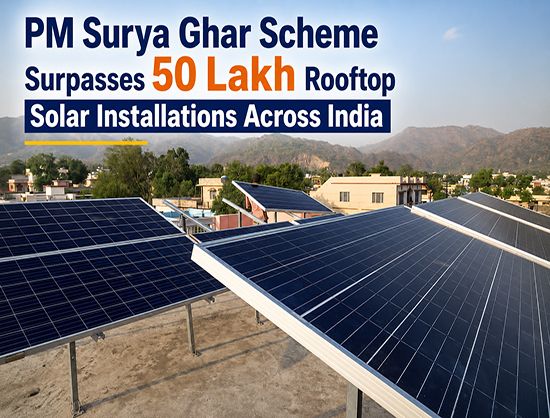
The PM Surya Ghar: Muft Bijli Yojana has crossed 50.06 lakh rooftop solar installations across India. Driven by direct benefit transfers and concessional financing, the flagship Ministry of New and Renewable Energy scheme has helped nearly 19 lakh households achieve zero electricity bills while accelerating the nation's green transition.
Backed by direct benefit transfers and accelerated adoption rates, India’s flagship residential solar initiative achieves a landmark clean energy milestone.
Marking a historic acceleration in the country's renewable energy transition, the Ministry of New and Renewable Energy (MNRE) announced on August 4, 2026, that the PM Surya Ghar: Muft Bijli Yojana has successfully crossed 50.06 lakh rooftop solar installations nationwide. Reached just over two years after its official launch, the milestone represents a dramatic surge compared to the 7.94 lakh installations recorded across the entire previous decade. Disclosed via official government statements and administrative updates in New Delhi, the flagship initiative has positioned itself as the world’s largest rooftop solar program, transforming residential rooftops into decentralized power generators.
Acceleration Metrics and Financial Architecture
The rapid scaling of the program is underscored by a sharp rise in daily adoption velocities. According to official performance data released by the government, the implementation rate scaled 3.2 times over a nine-month window, climbing from 5,038 installations per day in October 2025 to nearly 16,328 daily installations by July 2026. July 2026 alone recorded a record 5.06 lakh residential installations.
Key structural pillars driving this momentum include:
Direct Benefit Transfer (DBT): The Centre has successfully disbursed ₹28,024 crore directly into beneficiaries' bank accounts as capital subsidies.
Concessional Financing: Accessible credit lines at a 5.75% interest rate (Repo rate plus 50 basis points) have been sanctioned for over 21.87 lakh applicants via the Jan Samarth portal.
Utility-Led Aggregation: Specialized frameworks have enabled nearly 1.6 lakh installations for PMAY, Below Poverty Line (BPL), and SC/ST households across participating states.
Government Building Solarization: Over 1.06 lakh government buildings have been successfully equipped with solar rooftop systems to lead by example.
Impact on Citizens, Consumers, and the National Economy
For everyday consumers, the tangible benefits of the scheme are reflected in slashed household expenditures. Official evaluations indicate that nearly 19 lakh households are now reporting zero electricity bills. Furthermore, participating families collectively earned ₹421 crore during FY25 by exporting surplus electricity back to local distribution grids, generating an average secondary income of approximately ₹3,500 per year per household. For commercial enterprises, equipment vendors, and over 2.32 lakh trained solar photovoltaic technicians, the program has fostered a thriving green employment ecosystem.
Why It Matters
Reaching over 50 lakh households with rooftop solar infrastructure alters the fundamental dynamics of domestic energy consumption. By combining direct financial subsidies with revenue-generating surplus power exports, the initiative reduces the nation's reliance on fossil fuels while directly shielding families from rising utility costs.
Key Facts at a Glance
Total Installations: Over 50.06 lakh households successfully covered.
Cumulative Capacity: 14.8 GW of clean energy generation capacity commissioned.
Financial Outlay: ₹75,021 crore allocated under the national scheme.
Zero-Bill Households: Nearly 19 lakh families reporting zero electricity expenses.
Surplus Earnings: Over 12 lakh households earning extra income by exporting power back to utility grids.
FAQ Section
What is the primary milestone achieved by the PM Surya Ghar scheme?
The program has officially surpassed 50.06 lakh residential rooftop solar installations across India.
How does the Direct Benefit Transfer (DBT) work under the scheme?
The central government disburses capital subsidies directly into the bank accounts of verified beneficiaries, totaling over ₹28,024 crore to date.
Can households earn money from excess solar energy?
Yes. Participating families can export surplus electricity generated by their rooftop systems back to local power grids, earning supplementary income.
Where can eligible citizens register for rooftop solar installations?
Applications and technical guidelines are accessible through the official PM Surya Ghar National Portal.
Source: Press Information Bureau (PIB), News On AIR, India Brand Equity Foundation (IBEF), PM Surya Ghar Portal