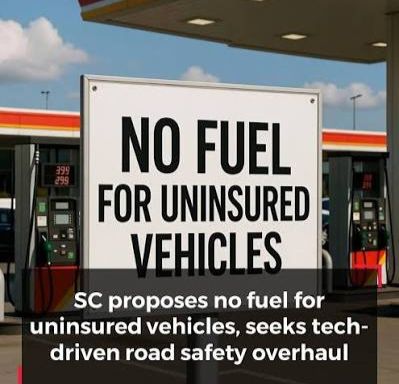
The Supreme Court has directed the Centre and IRDAI to develop a pilot project denying fuel at petrol pumps to vehicles lacking valid third-party insurance. Highlighting that 56% of Indian vehicles are uninsured, the bench emphasized that the measure will enforce statutory compliance and protect road accident victims from prolonged compensation litigation.
Flagging that over 16 crore vehicles ply without mandatory coverage, the top court directs authorities to explore tech-driven fuel station restrictions.
In a significant judicial step toward bolstering road safety and protecting accident victims, the Supreme Court of India directed the central government and regulatory bodies on August 4, 2026, to formulate a pilot project that would deny fuel at retail outlets to vehicles lacking valid third-party insurance. Hearing a motor accident compensation case in New Delhi, a Bench comprising Justice Sanjay Karol and Justice Prashant Kumar Mishra expressed deep concern that roughly 56% of vehicles operating on Indian roads—amounting to 16.54 crore out of 30.48 crore registered automobiles—remain uninsured. The court emphasized that this compliance gap severely undermines statutory safeguards, leaving families of accident victims stranded in prolonged legal battles for compensation.
Crafting a Multi-Tiered Compliance Mechanism
To address widespread default under Section 146 of the Motor Vehicles Act (MVA), the bench outlined a comprehensive technology-driven enforcement framework. According to official court directives, the proposed measures aim to bridge ground-level enforcement deficits by integrating live databases with everyday transit infrastructure.
Key structural elements of the judicial directive include:
Fuel Supply Linkage: The Insurance Regulatory and Development Authority of India (IRDAI), in consultation with the Ministry of Road Transport and Highways (MoRTH), must evaluate a pilot project linking fuel dispensation directly to a vehicle's active insurance status. The Ministry of Petroleum and Natural Gas has indicated it has "in principle, no objection" to the proposal.
ANPR Camera Integration: Automatic Number Plate Recognition (ANPR) cameras deployed on highways and city corridors will be synchronized with the Insurance Information Bureau database and the VAHAN portal to automatically issue e-challans.
Real-Time Police Verification: State police departments are directed to equip field personnel with handheld devices or mobile applications linked directly to central insurance repositories for spot checks.
Extended Mandates for New Vehicles: To secure longer coverage horizons, the court ordered that mandatory third-party insurance for new private cars be increased from three to four years, and for new two-wheelers from five to six years.
Impact on Citizens, Consumers, and Vehicle Owners
For law-abiding vehicle owners and transport operators, the proposed system underscores the importance of maintaining up-to-date statutory documentation. Legal experts and safety advocates note that when uninsured motorists cause collisions, victims frequently face years of litigation before securing financial relief. By enforcing compliance at fuel pumps and through automated cameras, the framework seeks to ensure that compensation mechanisms function as intended by Parliament, while curbing the financial risks associated with uninsured road traffic.
Why It Matters
Driving without mandatory insurance shifts an unfair financial and emotional burden onto innocent accident victims and their families. Introducing rigorous technological enforcement—ranging from automated camera challans to potential fuel purchase restrictions—ensures that accountability is maintained across all levels of public transit, upholding the rule of law on national highways.
Key Facts at a Glance
Uninsured Scale: Approximately 16.54 crore out of 30.48 crore vehicles in India lack valid insurance.
Proposed Pilot Project: Fuel supply linked to insurance status at petrol pump stations.
New Vehicle Coverage: Mandated third-party insurance extended to 4 years for cars and 6 years for two-wheelers.
Enforcement Technology: Integration of ANPR cameras with the VAHAN portal and Insurance Information Bureau database.
FAQ Section
What did the Supreme Court propose regarding fuel sales and vehicle insurance?
The Supreme Court directed the Centre and IRDAI to formulate a pilot project where vehicles lacking valid third-party insurance would be refused fuel at petrol pumps until coverage is renewed.
How many vehicles in India currently lack valid insurance?
According to data cited by the bench, approximately 16.54 crore vehicles—roughly 56% of total registered vehicles—operate without valid insurance.
Will this fuel restriction apply nationwide immediately?
No. The court has directed the authorities to first design and implement a pilot project on selected corridors to evaluate its feasibility.
Where can citizens verify official court orders and regulatory updates?
Complete documentation of judicial proceedings is available through the Supreme Court of India Portal and the IRDAI Official Website.
Source: Supreme Court of India, Insurance Regulatory and Development Authority of India (IRDAI), Ministry of Road Transport and Highways (MoRTH)