The Centre has expanded the list of "sporting events of national importance" under the 2007 Sports Broadcasting Act. The new mandate requires private networks to share commercial-free live feeds of major tournaments—including all Indian bilateral cricket and key FIFA World Cup fixtures—with Doordarshan and All India Radio.
NEW DELHI — The Government of India has significantly expanded the list of sporting events designated as "events of national importance," mandating that private media entities share live feeds with public broadcasters. Released via a fresh Gazette notification by the Ministry of Information and Broadcasting, the directive broadens the legal scope of the Sports Broadcasting Signals (Mandatory Sharing with Prasar Bharati) Act, 2007. The policy revision guarantees that millions of citizens who rely on Doordarshan (DD) and Akashvani (All India Radio) networks can access premium international and domestic competitions completely free of cost.
Sweeping Reforms Across Cricket, Football, and Olympic Disciplines
The dynamic mandate, which officially supersedes a previous ministerial order from May 2022, systematically re-establishes free-to-air parameters for key athletic categories. While foundational quadrennial events like the Olympic Games, Commonwealth Games, and Asian Games retain their historical national importance protection, the updated 2026 framework significantly deepens coverage metrics across specific high-demand team sports.
Cricket remains a primary focus of the expanded regulatory list. The Ministry has mandated the absolute sharing of all official One-Day Internationals (ODIs), Twenty20 Internationals (T20Is), and Test matches played by both the Indian men’s and women's national teams.
Furthermore, public access protections now legally cover the knockout stages of the ICC Men's and Women's ODI and T20 World Cups, the ICC Champions Trophy, the ICC World Test Championship, and all subsequent Asia Cup fixtures starting directly from the Super Four stage onward.
Strategic Interventions Bring Elite Soccer and Tennis to Free-To-Air
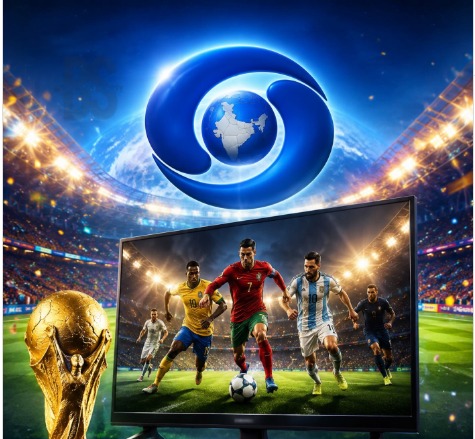
Beyond traditional cricket markets, the 2026 notification features major amendments targeting global football fans. Following close legal consultations between the Ministry and private television rights holders, specific landmark fixtures of the FIFA World Cup have been legally brought under the Prasar Bharati loop.
Public networks successfully broadcasted the opening match on June 12 and hold the mandatory free-to-air signals for all upcoming quarter-finals, semi-finals, and the final match. On domestic soil, the protection extends to the deep knockout matches of the historic Santosh Trophy alongside regional Asian Football Confederation (AFC) ties involving India.
For racquet sports, the regulatory expansion includes all active Davis Cup ties featuring the Indian contingent. It also secures the live broadcasting rights for all global Grand Slam singles finals, alongside any match from the quarter-final stage onward that features an Indian athlete across singles, doubles, or mixed doubles fields.
Economic Implications for Private Broadcasters and Consumers
The structural expansion of the 2026 mandatory sharing list rebalances the economic landscape for India’s top sports media networks. For rural and lower-income families utilizing the DD Free Dish terrestrial platform or standard All India Radio bands, the policy removes the expensive entry barrier of monthly digital pay-TV packages or streaming subscriptions.
Conversely, for commercial network corporations holding premium multi-million dollar bidding packages, the mandate alters standard operations:
Clean Feed Requirements: Private networks must deliver live signals to Prasar Bharati completely free of corporate commercials.
Ad Revenue Splits: Under the parent 2007 Act, advertising revenue generated during public re-transmissions is split under a strict statutory 75:25 ratio favoring the private content owner.
Terrestrial Exclusivity: To insulate private businesses from revenue loss, the law strictly confines Prasar Bharati’s distribution to terrestrial antennas and free state DTH boxes, preventing the free signals from flowing into private cable networks or commercial DTH boxes like Tata Play.
Official Sources Section
The adjusted regulations, legal categories, and specific tournament schedules detailed in this report are fully verified through statutory records maintained by public bodies:
Quote Section
Highlighting the public utility role of the updated signal sharing regulations, a legal officer from the Ministry of Information and Broadcasting observed:
"According to officials, the fundamental objective of the 2007 sharing act is to ensure that events of genuine historical significance are not locked behind expensive commercial paywalls. By systematically adding grassroots domestic tourneys alongside marquee icons like the FIFA World Cup, the government ensures comprehensive sports literacy and equal access for sports fans throughout rural India, without infringing on the core satellite subscription revenue models of private enterprises."
Why It Matters
The Centre's aggressive expansion of the sports broadcasting signal list marks a deep philosophical shift away from pure media commercialization. By treating high-tier international matches and grassroots youth championships as critical public goods rather than private properties, the policy bridges the digital viewing divide between urban and rural sports enthusiasts. Long-term, this free exposure acts as a major catalyst for corporate sponsorships and youth athletic recruitment across non-cricketing disciplines like hockey, football, and badminton.
Key Facts at a Glance
New Legislation: The Ministry of Information and Broadcasting issued a new Gazette notification widening the mandatory sports sharing pool.
Cricket Blanket Coverage: All official home and away bilateral matches played by Indian men's and women's cricket teams must be shared.
FIFA Integration: Key FIFA World Cup matches—including the opening clash, quarter-finals, semi-finals, and final—are now available on DD Sports.
Commercial Protections: Feeds are delivered advertisement-free, with a 75:25 revenue split applied strictly to public platform ad spots.
Grassroots Inclusion: Youth championships, including the Hockey India Sub-Junior National Championship, are included to boost domestic talent visibility.
FAQ Section
Q1: How can viewers in India watch these sports events for free?
The live feeds are transmitted completely free of cost across Doordarshan’s terrestrial channels, the DD Free Dish DTH platform, and All India Radio (Akashvani) audio frequencies.
Q2: Does this regulation apply to private internet streaming apps like Disney+ Hotstar or JioCinema?
No. The Sports Broadcasting Signals Act of 2007 applies specifically to traditional television and radio signals. Private digital streaming rights and mobile platforms remain under the exclusive domain of commercial rights holders.
Q3: Can standard cable TV subscribers view the free DD Sports feed during these matches?
Under existing cable regulations, private cable and commercial satellite DTH operators are required to carry alternative programming or block out the shared feed to safeguard the exclusive commercial rights of the pay-TV broadcaster.
Q4: How long do these new sports designations remain legally active?
Once a specific tournament category is formalized within the Gazette notification, it maintains its status as an event of national importance for a standard term of four years unless modified by a subsequent ministerial directive.
Source: The Tribune India Sports Bureau | Official Gazette Notification, Government of India | Prasar Bharati Operational Compliance Registry.