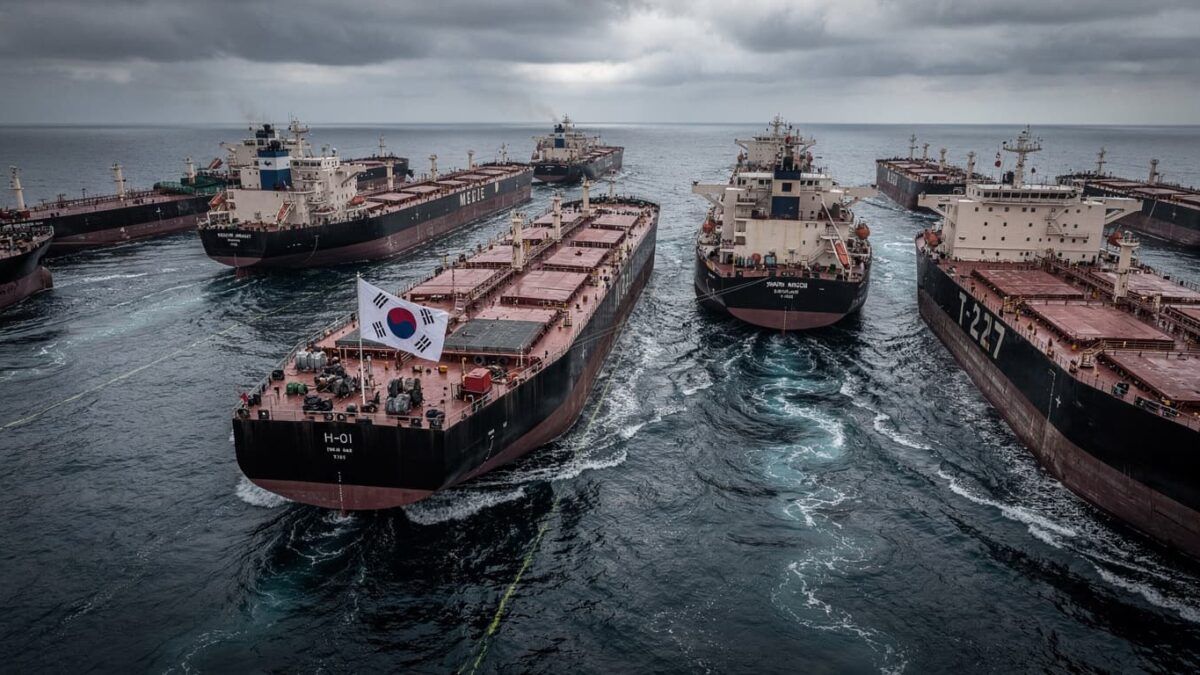
South Korea's crude oil imports fell 23% year-on-year to 9.7 million tons in May 2026, down from 12.6 million tons. The drop reflects a strategic move to lower reliance on volatile Middle Eastern routes, supported by new customs rules aimed at boosting alternative energy imports from the West.
SEOUL — South Korea has significantly scaled back its reliance on international energy markets as geopolitical shocks rearrange traditional trade routes. The East Asian economic powerhouse imported 9.7 million tons of crude oil in May 2026, marking a steep 23% decline compared to the 12.6 million tons recorded during the corresponding period last year.
According to statutory customs logs and global transit disclosures reviewed on Monday, June 15, 2026, the structural drop reflects a calculated domestic reaction to shipping chokepoint vulnerabilities and high ocean freight premiums. The sharp volume reduction is critically important today because it demonstrates how major manufacturing economies are aggressively altering their baseline energy inventories—choosing to draw down domestic stockpiles or adjust refinery throughput rather than buying high-risk shipments from regions caught in territorial crossfires.
Technical Allocation and Shifting Supply Matrix Metrics
The reduction in inward crude shipments coincides with an explicit government effort to move away from old energy dependencies.
According to transactional indicators verified by the Korea Customs Service, the drop in physical volume does not point to an internal industrial slowdown. Instead, Korean refiners have actively reconfigured their purchasing blocks to adapt to ongoing logistical constraints, moving away from vulnerable Persian Gulf providers and near-capacity terminals toward high-grade sweet crude producers in the Atlantic Basin.
Regulatory Special Cases Drive Market Diversification
To cushion the impact of falling import numbers, state authorities are deploying regulatory measures to fast-track non-traditional fuel deliveries.
Relaxing Tariffs and Expediting Alternative Feedstocks
As Middle East transport corridors face disruption, the government has revised complex import codes to maintain localized manufacturing stability.
According to policy outlines published by the Korea National Oil Corporation (KNOC), emergency administrative measures introduced this month include:
Relaxed Direct Transport Rules: The customs department has waived traditional documentation rules for U.S. crude transiting third-party countries, allowing them to instantly access Free Trade Agreement (FTA) preferential tax rates.
The Naphtha Fast-Track: Australian naphtha substitutes are now categorized under a tariff-exempt fast track, eliminating standard stockpiling obligations for local petrochemical firms.
Clearing Operational Bottlenecks: Active bilateral talks are underway with Malaysian clearing houses to cut the six-month verification delay on crude certificates of origin down to weeks.
Vessel Path Tracking: Customs officials are accepting automated satellite transponder logs and vessel geolocation datasets to verify original port loadings.
Evaluating Refiner Health and Strategic Reserves
While international crude prices fluctuate, domestic processors are utilizing strategic national stockpiles built during previous quarters of lower demand.
According to financial balance sheets monitored by the Ministry of Trade, Industry and Energy, South Korea’s top refiners—including SK Energy, GS Caltex, and S-Oil—have adjusted their daily refinery runs down by roughly 5% to 8%. Industry analysts observe that drawing down existing commercial reserves helps keep fuel costs stable, preventing an immediate spike in retail energy prices for domestic consumers.
Strategic Energy Resiliency
Government officials emphasize that lower import numbers do not pose a threat to immediate industrial productivity or national security.
"According to executive briefings held by the President's chief administrative office, South Korea has successfully secured a backup pool of 74.62 million barrels of crude oil through long-term diversified contracts. The structural move has successfully dropped the Middle East's total share of the country's crude import mix from nearly 70% down to 56% in under a year."
The administrative framework ensures that alternative oil shipments arriving from Gabon, Ecuador, and Kazakhstan bypass volatile maritime corridors entirely. To insulate the regional economy from future supply disruptions, the state plans to integrate an extra 16 million barrels of Western Hemisphere oil annually through the updated customs rules.
Why It Matters
For domestic manufacturing businesses, logistics firms, and local consumers, South Korea's managed reduction in crude imports ensures that everyday energy bills remain stable despite extreme overseas volatility. By shielding domestic refineries from high freight insurance costs through strategic national stockpiles and new tax breaks, the government prevents a sudden spike in fuel prices, protecting retail consumer spending power.
For global commodity traders, maritime carriers, and energy market investors, this volume contraction demonstrates a major pivot by one of the world's largest oil consumers. South Korea's success in replacing traditional Persian Gulf oil with Atlantic Basin alternatives sets a new template for energy independence, forcing global suppliers to adjust their long-term shipping strategies and pricing models.
Key Facts at a Glance
The Inflow Decrease: South Korea's crude oil imports for May 2026 slid to 9.7 million tons from 12.6 million tons a year ago.
Diversification Target: Middle Eastern oil reliance fell sharply to 56%, with the U.S. and Latin American suppliers stepping into the gap.
Customs Intervention: The Korea Customs Service has eliminated administrative hurdles, granting automatic tariff discounts on transited American oil.
Stockpile Buffer: Refiners are effectively drawing down on-land crude inventories to maintain maximum domestic production capacity without buying high-cost immediate imports.
Frequently Asked Questions (FAQ)
Why did South Korea's crude oil imports drop so significantly in May?
The 23% drop is driven by a deliberate strategy to reduce exposure to disrupted Middle Eastern shipping lanes, with refiners drawing down existing stockpiles and shifting to alternative suppliers.
Will the lower import figures lead to domestic fuel shortages or retail price hikes?
No, government and private energy boards have confirmed that existing reserves and alternative supply lines from the Americas and Africa are sufficient to handle demand without price shocks.
How are the new customs rules helping local oil refiners?
The updated regulations allow refiners to claim critical FTA tax exemptions on U.S. oil even if the cargo passes through third-party transit ports, bypassing old bureaucratic bottlenecks.
Official Sources Section: