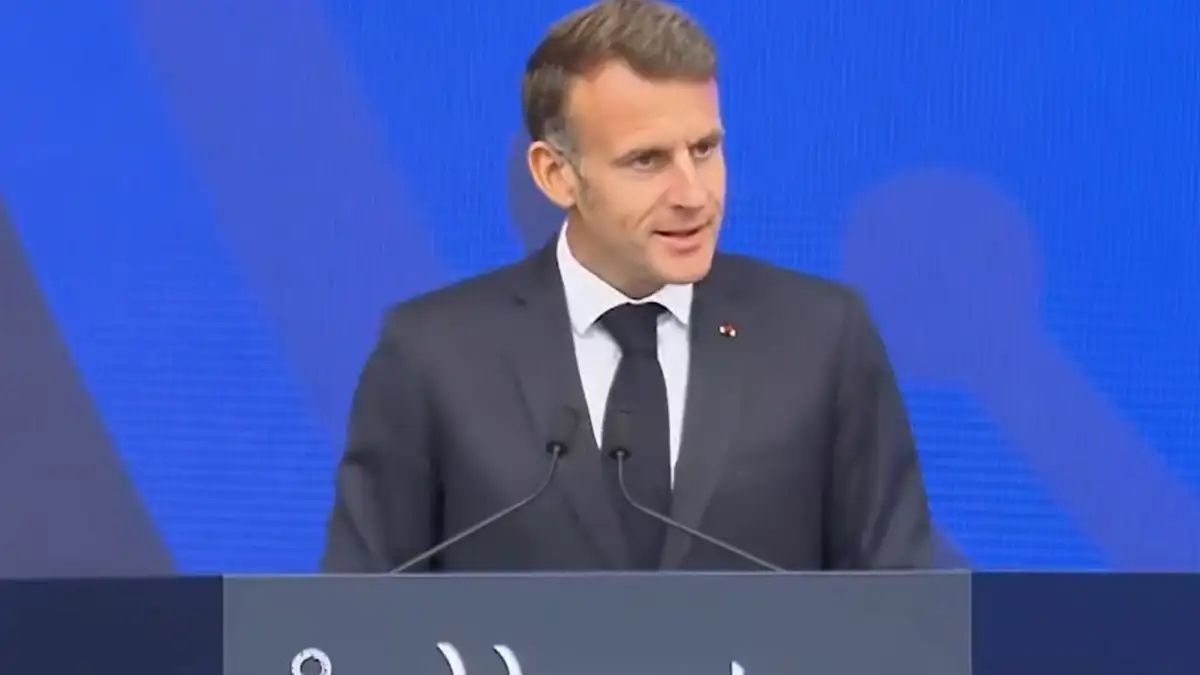
French President Emmanuel Macron praised India's Chandrayaan-3 mission as proof of its global innovation leadership at the Bharat Innovates 2026 summit in Nice. Jointly launched with PM Modi, the three-day deep-tech event connects 120 advanced Indian startups with international investors across critical computing and clean energy sectors.
NICE, France — In a major diplomatic gathering centered on high-technology cooperation, French President Emmanuel Macron formally positioned India at the absolute vanguard of international technological disruption. Speaking during the grand opening of the landmark three-day cross-border summit, Macron cited the historic Chandrayaan-3 lunar landing as the definitive global demonstration of India's rapidly expanding strength in innovation and industrial execution.
According to diplomatic communiqués released on June 14, 2026, by the Press Information Bureau (PIB), the opening event marks the first time the premier "Bharat Innovates" tech conclave has been hosted outside of Indian territory. Jointly inaugurated at the Palais des Expositions in Nice by President Macron and Indian Prime Minister Narendra Modi, the specialized DeepTech gathering serves as the key anchor for the ongoing India-France Year of Innovation.
The bilateral framework is highly significant today, as it marks a clear move away from historical, low-cost engineering outsourcing models. Instead, it formally cements a special global strategic partnership built on co-developing cutting-edge frontier technologies like artificial intelligence, quantum computing, and civil nuclear infrastructure.
The Industrial Blueprint of Bharat Innovates 2026
The large-scale tech exhibition establishes a massive bilateral framework, physically connecting hundreds of elite researchers with global venture capital networks.
According to programmatic registration briefs published by the Ministry of Education, the event floor hosts over 350 international institutional investors and venture capitalists. The structural design allows next-generation founders from across India to gain direct access to European commercial scaling corridors. This approach effectively converts raw academic intellectual property into highly competitive, real-world industrial products.
Overhauling the Global Narrative Around Indian Engineering Talent
During his opening speech, President Macron directly challenged outdated Western ideas that view India as merely a secondary operational processing hub for foreign corporations.
Moving From Support Contractors to Technological Leaders
The French President stressed that the incredible execution parameters achieved during the Indian Space Research Organisation's (ISRO) 2023 lunar landing completely reshaped international perceptions of the country's technical capabilities.
According to official audio logs distributed by regional networks, Macron’s address focused on several core structural shifts:
The Lunar Benchmark: The Chandrayaan-3 mission, executed at a record-low budget in record time, serves as a masterclass in modern engineering efficiency and scale.
The Massive Engineering Wave: India’s powerful demographic advantage now produces more than one million highly trained, professional engineers every single year—a talent output that surpasses Europe and the United States combined.
A Commitment to Open Models: Both democracies are actively resisting pressure from rival blocs to close off advanced artificial intelligence systems. They are choosing instead to support transparent, multilingual, and open-source cooperative AI models.
Expanding Nuclear Power Options: Bilateral working groups are rapidly scaling up joint development plans for low-carbon energy security, focusing on Small Modular Reactor (SMR) designs and civil nuclear deployment.
Deepening Alliances from Deep-Tech Solutions to Defense Systems
The expanding tech alignment matches a broader pattern of growing cooperation in critical economic security and defense programs.
"According to joint statements released by the Ministry of External Affairs (MEA), the strategic alliance between the two nations goes far beyond standard transactional commercial contracts. The relationship is uniquely driven by a deeply shared vision of technological self-reliance, directly impacting large-scale defense co-production initiatives, advanced aerospace engine design, and oceanographic climate observation satellite systems like TRISHNA."
Prime Minister Modi emphasized this unique bond during his address, stating that "India is no longer just a consumer of global solutions, but a major contributor to them." Modi challenged international investors to look beyond simple market valuations, urging them to back human-centric startups that build reliable, affordable tech designed to solve real-world problems for ordinary citizens worldwide.
Why It Matters
For global tech investors and venture capital firms, this federal endorsement opens up a direct, streamlined pathway to deploy capital into highly regulated deep-tech areas like quantum computing and biotechnology. It lowers traditional cross-border friction, creating a reliable framework for European funding to back Indian engineering talent at early stages.
For consumers and local technology industries, this partnership accelerates the real-world rollout of practical AI tools for smart agriculture, remote medical diagnostics, and clean energy storage solutions. By rejecting closed, monopolistic tech systems, the India-France alliance ensures that advanced digital platforms remain open, affordable, and accessible to developing economies across the global South.
Key Facts at a Glance
The Historic French Conclave: Prime Minister Modi and President Macron officially launched the Bharat Innovates 2026 summit in Nice, France, highlighting deep-tech growth.
The Space Benchmark: President Macron praised India's Chandrayaan-3 lunar mission as absolute proof of the country's elite innovation and industrial capabilities.
Massive Talent Volume: Official state reports show India produces over one million new qualified engineers every year, matching the combined output of Europe and the United States.
The Open AI Pledge: Both nations have pledged to resist closed tech cartels, promising to collaborate on open-source, multilingual artificial intelligence systems for the public good.
Frequently Asked Questions
Which specialized deep-tech sectors are being prioritized at the Nice summit?
The event focuses intensely on 13 critical pillars, including Quantum Computing, Semiconductor fabrication design, Advanced Materials, Green Hydrogen, and Next-Generation Biotechnology.
How does the India-France Year of Innovation affect young startup founders?
The year-long initiative provides small startups with structured access to global investment funds, collaborative university research programs, and clear intellectual property frameworks across both Europe and India.
What specific joint climate initiatives were highlighted during the event?
The leaders reviewed ongoing work on the International Solar Alliance and advanced climate-tracking satellites like TRISHNA, which are designed to monitor global environmental shifts and resource distribution.
Official Sources Section: