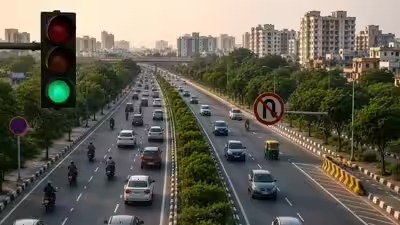
The Delhi government is advancing a plan to convert 25 busy road corridors into signal-free zones using a U-turn-based traffic management model. The initiative, supported by the Delhi Traffic Police and PWD, aims to reduce congestion and vehicle emissions by streamlining traffic flow across the capital by late 2026.
NEW DELHI — In a major effort to address the perennial issue of vehicular congestion, the Delhi government is planning to convert 25 additional busy road stretches into signal-free corridors. By replacing traditional traffic signals with a structured U-turn-based traffic management system, authorities aim to eliminate bottlenecks and allow for continuous vehicle movement throughout the national capital.
The proposal, which was cleared in principle following a technical evaluation on June 23, 2026, involves redesigning key intersections where current signal delays contribute to significant idling and peak-hour gridlock. According to the Delhi Traffic Police and officials from the Public Works Department (PWD), this model has already shown promise in pilot studies at locations such as Rajghat and parts of Najafgarh Road.
Redesigning Delhi’s Road Network
Rather than relying on expensive, large-scale infrastructure projects like new flyovers, which are often limited by land and structural constraints, the new plan focuses on reconfiguring existing road space. Under the proposed model, traffic signals at identified junctions will be removed. Motorists needing to change direction will instead use designated U-turn points positioned to steer traffic efficiently without requiring complete stoppages.
"The approach is designed to deliver faster congestion relief at a lower cost," officials stated. By eliminating the "start-stop" cycle at red lights, the initiative intends to improve average travel speeds, reduce fuel consumption, and lower vehicular emissions—a critical factor in Delhi's ongoing efforts to manage air quality.
The initiative follows a proposal submitted in mid-June by the Guru Hanuman Society of India, an NGO that studied traffic patterns and suggested the U-turn-based engineering intervention. The Delhi Traffic Police is currently partnering with technical experts to conduct feasibility studies on the selected 25 corridors.
Key Corridors Under Review
The list of proposed stretches covers several of the city's most high-traffic zones. Key routes identified for potential conversion include:
Rohtak Road: Punjabi Bagh to the Tikri-Bahadurgarh border.
Mathura Road: Ashram to the Badarpur border.
Outer Ring Road: Covering stretches across Nehru Place, IIT Flyover, Munirka, and R.K. Puram.
Mehrauli-Gurgaon (MG) Road: A critical link currently under study to potentially reduce travel time significantly.
Red Fort Circuit: Including Chhatta Rail Junction, Daryaganj, and Delhi Gate.
Official Sources
According to the Delhi Traffic Police, the identification of these corridors is based on detailed traffic volume surveys. Special Commissioner of Police (Traffic) Manish Kumar Agarwal stated that the police department is "committed to improving mobility through practical engineering interventions." He emphasized that the focus is on maximizing the efficiency of existing road infrastructure. The plan also aligns with recent directives from the Union Ministry of Environment, which has urged the city to expedite signal-free transitions to help mitigate road dust and vehicular pollution by the end of 2026.
Why It Matters
The practical implications of this plan are significant for daily commuters who often face hour-long delays on these corridors. By streamlining flow, the city expects a reduction in "travel fatigue" and improved productivity. However, the plan has also sparked debate regarding pedestrian safety. Some urban planning experts and residents have raised concerns that removing signals may prioritize vehicle speed over the needs of pedestrians, suggesting that foot overbridges or synchronized signal timing might be necessary to ensure safe crossing points remain accessible.
Key Facts at a Glance
Target: Conversion of 25 major intersections/corridors into signal-free zones.
Mechanism: Replacing traffic lights with back-to-back, U-turn-based traffic flow.
Expected Benefits: Reduced idling time, lower fuel consumption, and improved average travel speeds.
Stakeholders: Delhi Traffic Police, PWD, and technical inputs from the Central Road Research Institute (CRRI).
FAQ
Why is Delhi moving toward a signal-free model?
The model aims to reduce unnecessary stoppages, which are a primary cause of congestion and high fuel consumption/emissions during peak hours.
Will this affect pedestrian safety?
There are concerns regarding pedestrian movement. Authorities are being urged to balance traffic flow improvements with safe crossing infrastructure like foot overbridges.
Which roads are prioritized first?
Stretches like Rohtak Road, Outer Ring Road, and MG Road are among the top priorities due to their extremely high traffic density.
Source: Delhi Traffic Police, Public Works Department (PWD) Delhi, NDTV, The Times of India, Press Information Bureau (PIB)