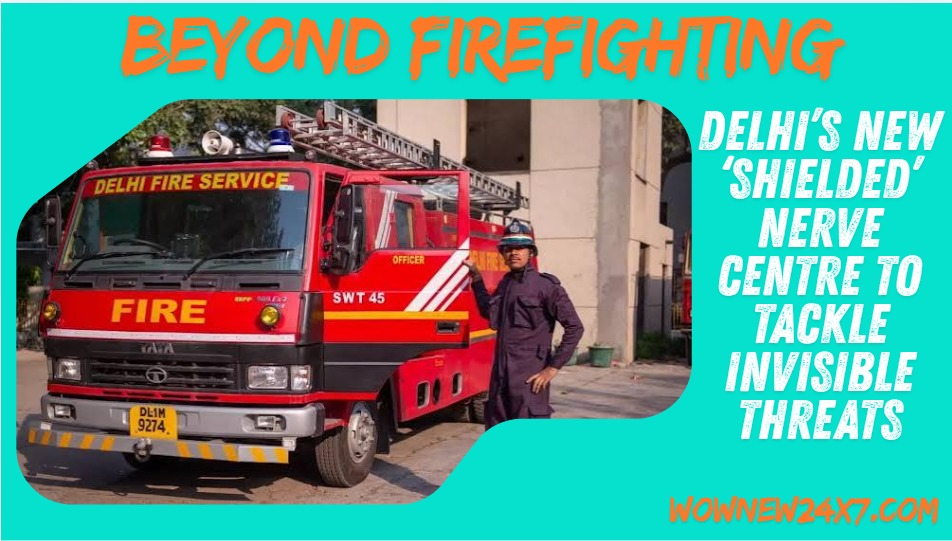
Delhi is moving ahead with plans to build an underground, radiation-shielded command centre for nuclear and chemical disasters. Integrated into the new Delhi Fire Services headquarters, the facility is a key part of a 25-year roadmap to upgrade the capital's emergency response, AI capabilities, and firefighting infrastructure.
NEW DELHI — In a major move to bolster national disaster resilience, Delhi is slated to construct its first underground Chemical, Biological, Radiological, and Nuclear (CBRN) command centre. The facility, which will be integrated into the new headquarters of the Delhi Fire Services (DFS), is designed to remain fully operational during catastrophic events, including radiological leaks, chemical disasters, or nuclear-related emergencies.
The project is a cornerstone of the Delhi Fire Services’ 25-year comprehensive action plan, aimed at modernizing the city’s emergency infrastructure to match its rapid urban expansion. Officials confirmed that a tender has been floated for the construction of the new headquarters and the specialized emergency-response facility, which is expected to be completed within five years.
Engineering Resilience Against High-Risk Threats
According to DFS officials, the command centre will be "plug-and-play" and specially engineered to provide a radiation-shielded environment for personnel. By placing the hub underground, the department aims to ensure that command and control structures remain intact and functional even in the event of large-scale contamination or structural crises.
Chief Fire Officer Abhilash Malik stated that the facility would serve as the nerve center for managing high-risk incidents. It will coordinate operations across the city's three existing disaster response centres located in Nehru Place, Laxmi Nagar, and Rohini, while also directing the DFS Search and Rescue Battalion.
"This will be the first such CBRN command centre in the national capital," Malik noted. "It is being designed in a way that radiation will not affect personnel inside, enabling effective command and coordination during critical situations."
A 25-Year Roadmap for Disaster Management
The CBRN command centre is just one component of a broader, long-term technological and infrastructure overhaul for the city. As Delhi’s population exceeds 20 million, the DFS has submitted a roadmap to enhance response times and technical capabilities:
Infrastructure Growth: The department is seeking to expand its network of fire stations from the current 71 to 196 by 2051.
Technological Integration: Plans are underway to establish a centralized command system equipped with Artificial Intelligence (AI), GPS, and GIS-based tracking within the next year.
Aerial Surveillance: The roadmap includes a phased rollout of drones, beginning with surveillance within two years and progressing to firefighting assistance within five years.
Manpower Expansion: To manage the increased load, the DFS has submitted a proposal to the government for the recruitment of 12,174 additional personnel, with a long-term goal of an operational strength of 48,000 staff members.
Why It Matters
For citizens, the establishment of a specialized CBRN centre provides a critical layer of safety in an era of complex urban hazards. Beyond standard firefighting, the facility ensures that the city has a dedicated, secure space to manage "low-probability, high-impact" events. This specialized focus on radiological and chemical protection acknowledges the evolving risks associated with modern industrial and urban environments, ensuring that inter-agency coordination is maintained even during the most dire scenarios.
Key Facts at a Glance
Facility Type: Underground, radiation-shielded CBRN (Chemical, Biological, Radiological, and Nuclear) command centre.
Location: Integrated into the new Delhi Fire Services headquarters at the current DFS site in Connaught Place.
Primary Objective: Maintain uninterrupted command and control during nuclear, chemical, or biological disasters.
Timeline: Construction and completion are targeted within a five-year window.
Inter-Agency Coordination: The center will link DFS assets across Nehru Place, Laxmi Nagar, and Rohini.
FAQ
Why is an underground command centre necessary?
An underground, shielded facility ensures that emergency responders can continue to coordinate life-saving operations during nuclear or radiological events when surface-level command centers might be compromised by radiation or structural damage.
What incidents will this center handle?
The center is specifically designed for "CBRN" incidents—Chemical, Biological, Radiological, and Nuclear threats—as well as other large-scale industrial and urban disasters.
When will the command centre be operational?
The construction is part of a five-year plan, with tenders currently being processed.
Will this affect day-to-day firefighting?
While the CBRN centre is for specialized disasters, it is part of a larger plan to modernize the entire DFS, including the use of AI and GPS to reduce response times for everyday fires.
Source: Delhi Fire Services (DFS), Press Trust of India (PTI), The Times of India, Hindustan Times