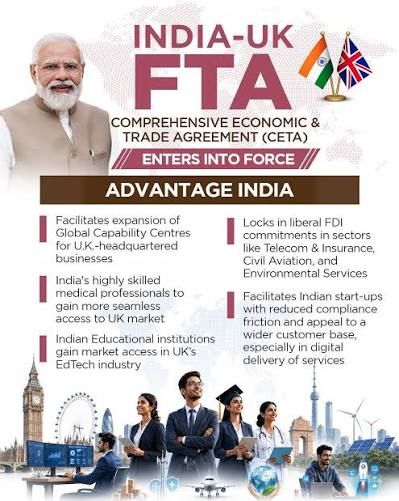
The upcoming India-UK Free Trade Agreement is expected to significantly boost India’s exports in electronics, digital services, and advanced manufacturing. By reducing trade barriers and aligning regulatory standards, the pact aims to integrate Indian technology into global value chains, fostering long-term economic growth and increasing bilateral trade competitiveness for 2026.
As negotiations near a decisive phase, industry leaders anticipate that the India-UK Free Trade Agreement will catalyze a major export boom.
NEW DELHI — The proposed India-UK Free Trade Agreement (FTA) is poised to fundamentally reshape trade relations, with industry leaders identifying electronics, digital services, and advanced manufacturing as the primary beneficiaries of the deal. As negotiators from both nations work to finalize the terms, stakeholders suggest that the agreement could provide a vital boost to India’s export competitiveness in the high-value technology sector.
The pact, which has been in the advanced stages of discussion throughout 2026, aims to remove tariff barriers and streamline regulatory frameworks. By aligning standards in digital trade and intellectual property, the FTA is expected to provide Indian tech firms with preferential access to the United Kingdom, one of the world's largest services markets.
A New Chapter for Tech and Manufacturing
The emphasis on advanced manufacturing under the India-UK Free Trade Agreement reflects a shift toward integrating Indian production hubs into global value chains. Industry bodies such as NASSCOM and the Confederation of Indian Industry (CII) have noted that the reduction of non-tariff barriers will be just as significant as the lowering of custom duties.
"According to officials," the deal includes specific provisions for professional mobility and data protection, which are essential for the expansion of digital services. By creating a predictable legal environment, the agreement is expected to encourage long-term capital flows, specifically in sectors like software development, cybersecurity, and cloud-based services.
Electronics: The Next Export Frontier
Electronics manufacturing in India has seen significant domestic growth under the 'Make in India' initiative, and the India-UK Free Trade Agreement provides the necessary market access to sustain this momentum. Exporters specializing in consumer electronics, semiconductors, and telecommunications equipment are looking to the UK as a gateway to broader European markets.
Furthermore, advanced manufacturing—ranging from precision engineering components to aerospace parts—is expected to benefit from the FTA’s focus on mutual recognition agreements (MRAs). These agreements would allow products tested in India to meet British certification standards, drastically reducing the time and cost associated with bringing new technology to market.
Why It Matters
For businesses, the India-UK Free Trade Agreement acts as a blueprint for diversification, allowing Indian firms to tap into the UK’s mature services economy. For the Indian government, the deal is a strategic move to achieve the export targets set for 2030, ensuring that the country’s manufacturing sector matures from low-cost assembly to high-end technological output. Investors view the pact as a litmus test for India’s ability to secure large-scale bilateral deals with developed economies, potentially paving the way for future agreements with other global trade blocs.
Key Facts at a Glance
Primary Sectors: Electronics, digital services, and advanced manufacturing.
Strategic Goal: Lowering tariff and non-tariff barriers to increase export competitiveness.
Key Stakeholders: NASSCOM, CII, and trade ministries from both India and the UK.
Outlook: Targeted at diversifying India’s export basket and enhancing bilateral services trade.
Frequently Asked Questions
How will the India-UK Free Trade Agreement affect digital services?
The FTA is expected to streamline regulations around data flows and professional services, making it easier for Indian IT firms to operate and provide digital solutions in the UK.
Will the FTA boost manufacturing exports?
Yes, by including mutual recognition agreements (MRAs), the agreement aims to lower compliance costs for Indian advanced manufacturing firms, making their products more competitive in the British market.
What is the timeline for the finalization of the FTA?
While official dates are subject to ongoing diplomatic negotiations, both nations have expressed a commitment to concluding a mutually beneficial agreement within the 2026 fiscal year.
Source: Ministry of Commerce and Industry, Confederation of Indian Industry (CII), NASSCOM, Department for Business and Trade (UK)