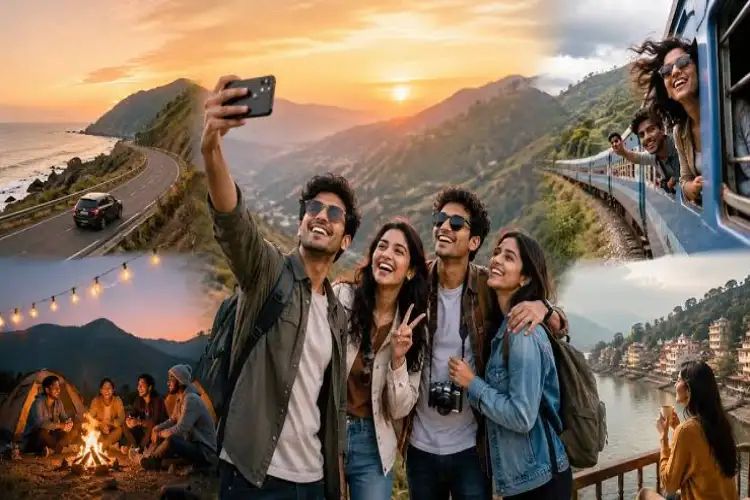
A new travel report reveals that India’s Gen Z has retired the traditional annual holiday in favor of spontaneous, short weekend trips. Driven by a desire for self-expression and stress relief, 87% prefer getaways under a week, prioritizing unique shared accommodations and slow travel over landmark-driven itineraries.
NEW DELHI — India’s Generation Z has quietly retired the corporate ritual of the singular annual holiday, shifting structural capital into frequent weekend trips and micro-travel windows. According to a specialized domestic consumer research report titled "Never the Same: The New Rules of Gen Z Travel in India" published on Saturday, June 20, 2026, an overwhelming 87 percent of travelers aged 18 to 29 now explicitly prefer short breaks lasting under a week. The comprehensive study, which surveyed 2,012 urban respondents across 11 major Indian cities, confirms that traditional long-form itineraries are being replaced by sudden, stress-responsive getaways. This development is highly important today because it forces an immediate operational overhaul across the country’s hospitality, aviation, and digital booking platforms, which historically relied on predictable, seasonal vacation calendars.
The Anti-Itinerary Shift: Spontaneity Replaces Meticulous Planning
For decades, the standard Indian family vacation was an annual, highly orchestrated summer or winter escape that required months of prior coordination. The latest consumer metrics demonstrate that Gen Z is completely dismantling this structural standard.
Data within the study shows that 70 percent of young consumers prefer taking three distinct short breaks throughout the year rather than allocating their entire time off to a single annual holiday. This behavior has labeled Gen Z the "Anti-Itinerary" generation. Instead of collecting tourist landmarks like trophies, 66 percent of respondents book their accommodation within mere days or weeks of departure. For these individuals, travel has transitioned from an anticipated annual milestone into a quick, defensive reaction against corporate burnout and workplace stress.
The Accommodation as the Destination: The Rise of Slow Stays
A distinct shift highlighted in the report is where young consumers spend their time and capital. Traditional sightseeing is taking a backseat to comfortable relaxation, with nearly two-thirds (66 percent) of young tourists traveling with the explicit intention of doing absolutely nothing.
This behavioral pivot has fundamentally altered properties from simple overnight utility rooms into the central focus of the entire vacation:
Time Allocation: Approximately 78 percent of Gen Z travelers spend at least half of their total trip time directly inside their chosen accommodation.
Property Requirements: Rather than looking at standard hotel checklists, travelers search for a "home wishlist" containing private balconies, regional architectural features, and immediate proximity to local neighborhood food markets.
Communal Stays: When traveling in large social circles, more than half choose to rent a single shared villa or home rather than booking separate, isolated hotel rooms.
This structural trend is verified by data from Airbnb India, which registered a notable 55 percent year-on-year increase in domestic group bookings among young users, signaling the fastest-growing category on the platform.
Commercial Impact on the Indian Tourism Infrastructure
The financial implications of this micro-travel revolution are reshaping the domestic aviation and leisure sectors. According to regional tourism data verified by the Ministry of Tourism, domestic weekend bookings for short getaways spanning two to six nights surged by nearly 80 percent compared to the previous fiscal period.
Rather than traveling to standard, commercialized holiday capitals, 90 percent of Gen Z actively seek out offbeat locations that have not gone viral on mainstream social channels. They opt instead for quiet nature retreats, local culinary tours, and slow-paced exploration. Consequently, boutique home-stays and regional car rentals in Tier-II and Tier-III peripheral belts are experiencing unprecedented off-season revenue growth, correcting historical wealth disparities across rural hospitality markets.
Official Sources Section
The consumer survey data, behavioral indices, group booking metrics, and regional travel performance metrics outlined across this journalism piece are compiled directly from the Never the Same travel report issued by the Airbnb India Press Room, public aviation booking statistics from the Directorate General of Civil Aviation, and local tourism statistics published by the Ministry of Tourism.
Quote Section
"Travel for Gen Z is as much an act of self-expression as it is exploration, making them highly intentional consumers," stated Amanpreet Bajaj, Airbnb’s Country Head for India and Southeast Asia, during a media release analysis. "According to officials, 92 percent of young travelers state it matters deeply that their choice of stay reflects their distinct personal taste rather than a generic popular option. Organizers stated that this generation is moving away from predictable tourist tracks, turning accommodation selection into the single most personal statement they make about who they are."
Why It Matters
The retirement of the traditional annual holiday has immediate, practical implications for both corporate work-life policies and the wider hospitality industry. To retain younger talent, businesses are increasingly forced to transition away from rigid, block-leave frameworks toward flexible weekend models that allow remote workers to blend work and leisure. For hospitality operators, survival no longer depends entirely on peak summer or winter vacation windows; instead, profitability requires maintaining a steady stream of unique, tech-enabled experiences tailored for spontaneous, short-duration domestic travelers throughout the calendar year.
Key Facts at a Glance
The Core Pivot: About 87 percent of Indian Gen Z travelers explicitly choose weekend trips and short breaks under a week over long traditional holidays.
The Spontaneity Metric: Rather than planning months in advance, 66 percent of young travelers finalize their bookings within just days or weeks of departure.
The Rest Preference: Nearly two-thirds of surveyed individuals travel primarily to slow down and relax, choosing properties over landmark sightseeing.
Group Dynamic Growth: Shared home bookings among young friends expanded by 55 percent year-on-year, reflecting a strong demand for communal spaces.
Anti-Viral Targeting: An overwhelming 90 percent of respondents actively avoid mainstream destinations, choosing lesser-known nature and food spots instead.
FAQ Section
Why is Gen Z choosing short weekend trips over a single long annual holiday?
Young professionals use short weekend trips as an immediate, flexible relief mechanism against workplace stress. It allows them to take frequent breaks throughout the year without exhausting their formal paid leave balance in one single go.
What features does Gen Z prioritize when selecting travel accommodation?
According to data, they look for unique "home wishlists" that include shared living areas, outdoor balconies or terraces, independent kitchens, and convenient pedestrian access to local markets and authentic neighborhood eateries.
How are travel operators adapting to the needs of the "anti-itinerary" generation?
Operators are removing strict booking penalties and rigid check-in protocols. They are increasingly offering last-minute digital reservations, flexible cancellation options, and curating properties that double as remote-work destinations with reliable high-speed internet.
Source: Survey data from the Airbnb India Press Room and domestic infrastructure statistics compiled by the national Ministry of Tourism.