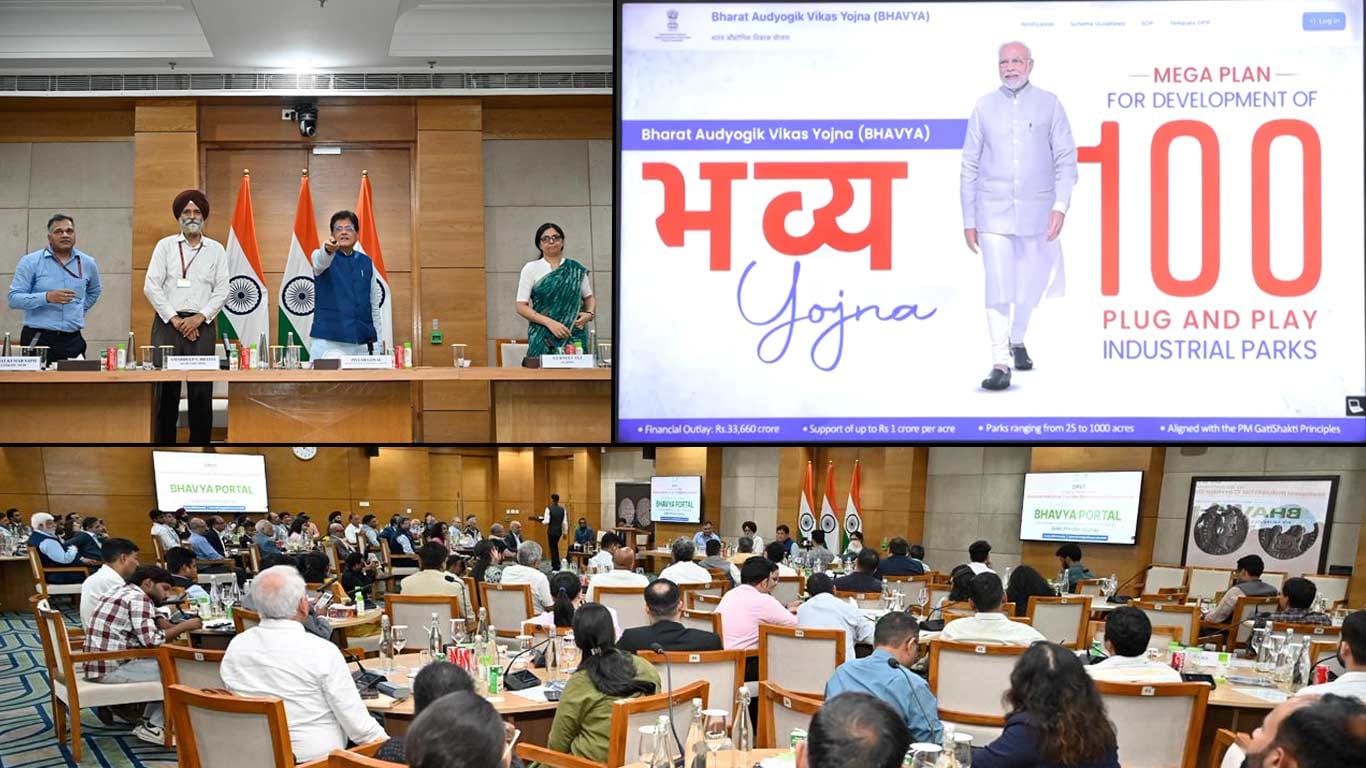
The DPIIT has launched the operational guidelines for the ₹33,660 crore BHAVYA scheme, aiming to establish 100 plug-and-play industrial parks across India by 2032. Focusing on Tier-2 and Tier-3 cities, the initiative will leverage public-private partnerships to deliver investment-ready manufacturing ecosystems with integrated worker housing and multimodal logistics connectivity.
BENGALURU — The Department for Promotion of Industry and Internal Trade (DPIIT) announced a comprehensive national roadmap on Friday, June 19, 2026, to establish 100 world-class, plug-and-play industrial parks across India over the next six years. Outlining the statutory architecture of the newly launched Bharat Audyogik Vikas Yojna (BHAVYA) scheme, senior officials confirmed that the central initiative will run through the financial year 2031-32 with a total budgetary outlay of ₹33,660 crore. The strategic master plan aims to fundamentally alter India's domestic manufacturing footprint by shifting investment focus toward Tier-2 and Tier-3 cities, while lowering structural barriers for international and domestic corporations.
Challenge-Based Selection and Public-Private Partnerships
The deployment of the BHAVYA scheme will follow a phased, highly competitive selection framework managed by the central government. Speaking at a high-level media briefing in Bengaluru, Ms. Gurneet Tej, Joint Secretary at the DPIIT, announced that the application window for the first phase of development would officially close on July 31, 2026, with the second round extending from August 1 to September 30, 2026.
In the initial phase, up to 50 individual industrial park proposals will be chosen through a challenge-based system. The central government has established clear space guidelines: projects in non-hilly states require a minimum contiguous land parcel of 100 to 500 acres, whereas hilly states, northeastern regions, smaller territories, and union territories with populations under one crore have a lower threshold of 25 acres. Additionally, up to 20 signature parks nationwide are scheduled to scale up to 1,000 acres to accommodate heavy manufacturing clusters.
The financial model relies heavily on public-private partnerships (PPPs) and coordinated state land banks. The Central Government has committed financial assistance of up to ₹1 crore per acre for industrial parks constructed on state-allocated government land. For projects led entirely by private developers, the financial assistance cap is set at ₹50 lakh per acre.
Infrastructure Readiness and Supply Chain Integration
The core objective of the BHAVYA scheme is to transition away from traditional raw land acquisition, which has historically caused severe project delays for factory operators. Instead, the focus is on creating fully integrated, investment-ready "plug-and-play" ecosystems where businesses can mount operations immediately.
According to the operational guidelines, the selected industrial sites will be strategically positioned near high-speed expressways, major railway corridors, and international airports. The designated Special Purpose Vehicles (SPVs) created under the Companies Act, 2013, will govern each park. These entities are mandated to build modern sub-surface utilities, common effluent treatment plants, shared quality-testing laboratories, renewable energy microgrids, and digital single-window clearance portals. Crucially, the parks must feature dedicated worker-support infrastructure, including on-site housing and skill development centers.
Official Sources Section
According to official administrative disclosures published by the Press Information Bureau, the operational guidelines for the BHAVYA scheme were formally approved and released by the Union Ministry of Commerce and Industry on May 23, 2026. Regulatory updates from the Department for Promotion of Industry and Internal Trade show that the National Industrial Corridor Development Corporation (NICDC) has been officially designated as the Project Management Agency to supervise the corporate compliance, fund disbursal milestones, and logistical execution of the SPVs over the six-year rollout.
Quote Section
"According to officials at the DPIIT press briefing, there will be no arbitrary state-wise caps on the number of industrial parks allowed under the program, ensuring that selection remains strictly merit-based. Organizers stated that regional workshops are already being executed alongside state agencies to fast-track regional project reports before the July deadline."
Why It Matters
The massive influx of capital into integrated industrial infrastructure has widespread microeconomic and macroeconomic implications for multiple sectors:
For Investors and Global Manufacturers: Pre-developed plug-and-play plots completely eliminate land-titling risks and local regulatory friction, vastly accelerating the time-to-market for foreign direct investments (FDI).
For Businesses and Supply Chains: Smaller manufacturing enterprises gain access to advanced testing labs, shared waste facilities, and multimodal logistics corridors that would otherwise be cost-prohibitive.
For Citizens and Local Workers: Spreading these parks across Tier-2 and Tier-3 cities will create millions of skilled manufacturing jobs outside major metropolitan hubs, supported by localized worker housing complexes.
Key Facts at a Glance
₹33,660 Crore Outlay: The BHAVYA scheme is a fully funded Central Sector initiative running from FY 2026-27 to FY 2031-32.
100 Industrial Parks: The policy aims to establish 100 state-of-the-art manufacturing hubs across India within six years.
Phase-1 Target: Up to 50 industrial parks will be selected in the first phase, with initial application deadlines set for July 31, 2026.
Land Requirements: Mandates a minimum of 100 contiguous acres in non-hilly states and 25 acres in hilly or northeastern regions.
Plug-and-Play Focus: Prioritizes pre-built factory sheds, underground utility lines, on-site worker housing, and integrated single-window clearances.
Frequently Asked Questions (FAQ)
What is the BHAVYA scheme launched by the DPIIT?
The Bharat Audyogik Vikas Yojna (BHAVYA) is a central sector scheme launched by the Ministry of Commerce and Industry to develop 100 world-class, infrastructure-ready, plug-and-play industrial parks across India over a six-year period.
What does "plug-and-play" infrastructure mean for these industrial parks?
Plug-and-play infrastructure means that the industrial parks come pre-equipped with roads, underground utilities, electricity, water management systems, common effluent treatment plants, and clear environmental clearances. This allows businesses to set up manufacturing operations immediately without dealing with construction and land acquisition delays.
Are private real estate developers allowed to participate in this scheme?
Yes. The BHAVYA scheme actively encourages Public-Private Partnerships (PPPs). Private sector developers can form project-specific Special Purpose Vehicles (SPVs). The central government offers financial assistance of up to ₹50 lakh per acre for parks developed under private sector leadership.
Source: Official scheme frameworks issued by the Department for Promotion of Industry and Internal Trade, national press release reports from the Press Information Bureau, and operational updates distributed by the Ministry of Commerce and Industry, Government of India.