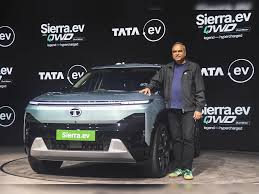
Tata Motors Managing Director Shailesh Chandra announced that electric vehicles are projected to secure a 10 percent share of India's car market by the end of FY27. Driven by high fuel prices and a shift to mainstream buyers, the domestic EV segment is pacing toward a million-unit annual market by FY31.
MUMBAI — Electric vehicles are projected to account for nearly 10 percent of India’s domestic passenger vehicle market by the conclusion of fiscal year 2027 (FY27), according to an industry update delivered by Tata Motors executive Shailesh Chandra on June 30, 2026. Speaking during a media briefing in Mumbai, Chandra, the Managing Director of Tata Motors Passenger Vehicles and Tata Passenger Electric Mobility, outlined a structural shift in consumer behavior that is transitioning the domestic automobile sector out of its early-adopter phase and directly into mainstream market integration. This development comes as escalating energy security concerns and a widening grid of public charging infrastructure fundamentally alter the baseline economics of alternative powertrains for Indian consumers.
Geopolitical Friction Emerges as a Market Catalyst
The accelerating pace of electric vehicle (EV) penetration within India's automobile landscape is increasingly tied to macroeconomic and geopolitical pressures. According to corporate statements provided during the briefing, persistent regional instability in West Asia has served as an unexpected force multiplier for local EV adoption since early 2026. Rising crude oil benchmarks and anxiety regarding the long-term domestic availability of traditional fossil fuels have collectively compressed consumer hesitation.
The market has fundamentally shifted from a manufacturer-driven "push" dynamic into a consumer-led "pull" phase. Total running expenditure has become the primary metric for modern urban buyers, particularly within the entry-level and mid-tier passenger vehicle segments. Data presented by Tata Motors reveals that EV adoption escalated from 2.5 percent in FY25 to 4.5 percent in FY26. For the first quarter of FY27, current field reports pin current penetration levels between 6.5 percent and 7 percent, establishing a reliable trajectory toward the 10 percent fiscal year-end target.
Portfolio Expansion Targets the Mid-SUV Segment
To capitalize on this structural transition, domestic automakers are shifting focus toward high-volume segments that align with the median transaction price of Indian consumers. The announcement coincided with the official launch of the Sierra.ev, a premium mid-size electric SUV priced competitively between ₹18.79 lakh and ₹24.79 lakh (ex-showroom). The mid-SUV category remains the mathematical center of gravity for the country's utility vehicle sector, sitting just above the broader national median car transaction price of approximately ₹12 lakh.
By introducing longer-range variants—featuring 63 kWh and 75 kWh battery configurations capable of sustaining up to 665 kilometers on a single charge—manufacturers aim to eliminate lingering highway range anxiety. Industry calculations project that India’s overall passenger vehicle market will expand from 4.7 million units to 6.4 million units annually over the next five years. Out of this incremental volume growth of 1.7 million units, electric powertrains are projected to claim roughly 800,000 vehicles, creating a million-unit annual EV market by FY31.
Supply Constraints and Production Rebalancing
Despite robust demand metrics, full volume optimization across the domestic automotive sector remains capped by localized component supply constraints. Tata Motors officials acknowledged that current consumer bookings for high-demand electric models continue to significantly outpace immediate factory output, heavily impacted by narrow part allocations from secondary tier-1 component suppliers.
To stabilize these volume discrepancies, automated production lines in major automotive manufacturing hubs are undergoing phased expansions. Present assembly capacities across the industry are tracking at roughly 60,000 to 65,000 passenger vehicles per month, with target allocations looking to lock in a baseline of 70,000 monthly units before the end of the ongoing fiscal cycle. A highly weighted proportion of this upcoming incremental capacity will be systematically reserved for electric assembly lines to fulfill surging order backlogs.
Official Sources Section
The operational updates, market forecasts, and corporate capex goals summarized in this economic report are based upon the following official frameworks:
Corporate Guidance: Financial presentations and strategic roadmaps issued during the Tata Motors media briefing in Mumbai.
Macro Industry Registration Metrics: Domestic sales and market share figures reconciled against monthly retail reports from the Society of Indian Automobile Manufacturers.
Quote Section
"According to officials at the manufacturing division, the domestic EV segment has permanently moved past the technological experiment phase. The combination of expanding public charging infrastructure, extended product warranties, and localized battery packaging has solidified consumer confidence that electric mobility is the long-term operational standard for urban commuting."
Why It Matters
The structural escalation of EV penetration to 10 percent of India’s total car market by FY27 has severe operational implications for energy infrastructure, corporate supply chains, and municipal urban planning. For institutional investors and financial markets, a million-unit annual EV trajectory by FY31 validates massive capital expenditure allocations toward localized lithium-ion cell manufacturing and ancillary electronic component setups. For municipal governance and commercial real estate developers, this rapid adoption curve necessitates an immediate acceleration in the installation of public fast-charging nodes across national highways and high-density commercial complexes to prevent grid congestion.
Key Facts at a Glance
Penetration Target: India's electric passenger vehicle segment is projected to reach approximately 9 to 10 percent market share by the close of FY27.
Macro Drivers: Rising traditional fuel prices stemming from prolonged West Asia tensions have accelerated consumer interest in alternative powertrains.
Volume Forecast: Total domestic EV volume is estimated to scale into a million-unit annual market by FY31, accounting for roughly 30 percent of manufacturer sales profiles.
Production Response: Assembly lines are expanding toward a stable target of 70,000 units monthly to mitigate lingering component supply constraints.
FAQ Section
1. What is driving the shift from a "push" to a "pull" EV market in India?
The transition is primarily driven by consumer focus on lower operational costs alongside macroeconomic factors. Volatile global fuel prices linked to West Asia geopolitical conflicts have prompted mainstream buyers to actively seek out electric alternatives to safeguard against traditional fuel inflation.
2. How much is the Indian passenger vehicle market expected to grow by FY31?
The total domestic passenger vehicle market is projected to expand from 4.7 million units to roughly 6.4 million units annually by fiscal year 2031, representing an incremental demand increase of 1.7 million vehicles over the five-year period.
3. What steps are being taken to address current EV delivery backlogs?
Automakers are implementing structured manufacturing upgrades to ramp up baseline passenger vehicle production from current levels of 60,000–65,000 units up to a stable 70,000 units per month, with a high priority placed on increasing alternative powertrain assembly allocations.
4. What percentage of sales do major domestic manufacturers expect from EVs by 2031?
Market leaders like Tata Motors are aligning their long-term corporate strategies to ensure that electric vehicles comprise more than 30 percent of their total domestic passenger vehicle sales volumes by FY31.
Source: Official automotive market analyses, capital allocation presentations, and executive transcripts compiled directly from media distribution desks at Tata Motors Passenger Vehicles and the Society of Indian Automobile Manufacturers.