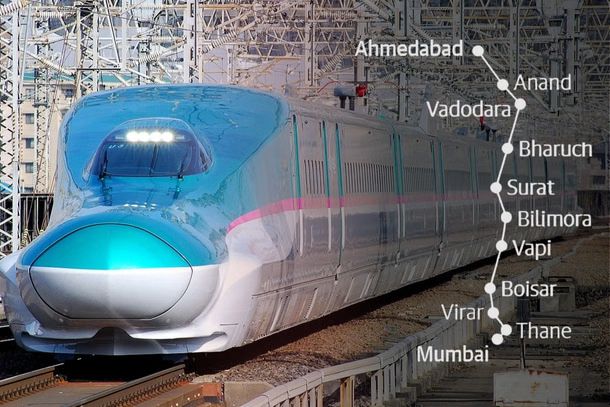
As construction advances on India's premier high-speed rail corridor between Mumbai and Ahmedabad, public interest centers on projected ticket pricing. According to official evaluations by the National High Speed Rail Corporation Limited, end-to-end fares are anticipated to range around Rs 3,000, offering a fast, cost-effective alternative to traditional flights and air-conditioned trains.
As civil construction reaches advanced milestones, transit authorities outline expected pricing structures designed to make high-speed rail accessible across demographics.
As infrastructure development accelerates across western India, public attention increasingly focuses on the operational economics of the Mumbai–Ahmedabad High-Speed Rail Corridor. Spearheaded by the National High Speed Rail Corporation Limited (NHSRCL), India's inaugural bullet train project is slated to open initial operational segments, connecting economic hubs at speeds reaching 320 km/h. With civil works covering elevated viaducts, river bridges, and station terminals progressing rapidly, commuters, businesses, and transit analysts are closely evaluating the projected fare architecture to understand how high-speed mobility will balance luxury comfort with everyday affordability.
Projected Fare Structure and Distance-Based Slabs
According to initial project disclosures and feasibility studies released by transit administrators, the ticketing framework for the high-speed rail corridor is designed to remain competitive with existing premium modes of transport. Rather than imposing prohibitive luxury pricing, the fare model scales progressively according to distance traveled.
Key structural highlights of the anticipated ticketing framework include:
End-to-End Travel Cost: The full-length journey between Mumbai and Ahmedabad is projected to cost approximately Rs 3,000 for standard seating classes.
Minimum Entry Fares: Short-distance commutes—such as transit between the Bandra-Kurla Complex (BKC) and Thane—are projected to start as low as Rs 250.
Business Class Provisions: Dedicated executive and business class coaches will feature higher tariff structures reflecting enhanced seating layouts and complimentary onboard hospitality.
Comparative Positioning: Projected standard fares are calibrated to run approximately 1.5 times higher than existing First-Class AC tickets on corresponding express routes, while undercutting door-to-door commercial flight expenses when factoring in airport transit times.
Economic and Commuter Impact
The introduction of high-speed rail transit carries substantial practical implications for business travelers, daily commuters, and regional investors. By reducing the travel time between Mumbai and Ahmedabad to under two hours, the corridor effectively integrates two major economic centers into a unified commuting zone. For citizens and corporate travelers, the service eliminates hours lost to highway congestion or airport security queues, fostering decentralized economic growth across the 12 designated stations spanning Maharashtra, Gujarat, and Dadra and Nagar Haveli.
Why It Matters
Establishing a high-speed transit network transforms regional demographics, promotes commercial collaboration, and reduces carbon footprints by shifting intercity traffic away from congested roadways and short-haul aviation. Transparent fare projections ensure that travelers can plan future mobility options effectively.
Key Facts at a Glance
Corridor Length: Approximately 508 kilometers between Mumbai and Ahmedabad.
Maximum Operating Speed: 320 kilometers per hour.
Projected End-to-End Fare: Around Rs 3,000 for standard seating.
Minimum Short-Distance Fare: Projected at Rs 250 for localized segments.
Total Stations: 12 transit hubs integrated along the route.
FAQ Section
What is the expected cost to travel from Mumbai to Ahmedabad on the bullet train?
Projected end-to-end fares for standard seating are estimated around Rs 3,000, with short-distance tickets starting as low as Rs 250.
How long will the bullet train journey take between the two cities?
The high-speed rail service is designed to cover the 508-kilometer distance in under two hours, operating at speeds up to 320 km/h.
How does the bullet train fare compare to airfares or existing trains?
The projected pricing is structured to remain competitive with First-Class AC train tickets while offering a faster, more convenient alternative to commercial flights when factoring in airport commutes.
Where can travelers find verified updates on project timelines and fare finalization?
Official construction updates, station maps, and fare announcements are accessible directly via the NHSRCL Official Website and the Ministry of Railways Portal.
Source: National High Speed Rail Corporation Limited (NHSRCL) Official Portal, Ministry of Railways, Government of India Releases, Press Information Bureau (PIB) Archives, The Hindu Business Bureau