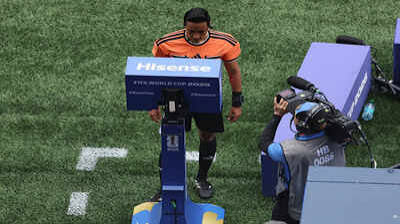
FIFA has introduced on-site VAR officials for all remaining 2026 World Cup matches to act as a technical backup for the centralized Dallas hub. This operational shift follows intense criticism of refereeing during the knockout rounds, aiming to prevent technology failures from further complicating the tournament's final stages.
In a significant shift for the final stages of the 2026 FIFA World Cup, the governing body has introduced a new layer of protection for its Video Assistant Referee (VAR) system. Starting with the quarter-final match between France and Morocco, FIFA has stationed a primary VAR official and a reserve VAR official inside every tournament venue.
This change marks a departure from the tournament's initial protocol, which relied exclusively on a centralized Video Operation Room at the International Broadcast Centre in Dallas, Texas. While the Dallas hub remains the primary center for VAR operations, the addition of on-site personnel serves as a critical fallback to ensure match continuity should any communication or technical link between the stadium and the central hub be disrupted.
Operational Reliability vs. Decision-Making
FIFA has clarified that this adjustment is an operational safeguard rather than a fundamental change to the laws of the game or the threshold for VAR interventions. The governing body maintains that the primary objective is to eliminate the risk of lengthy technical delays or a match proceeding without video assistance—a scenario FIFA regulations strictly prohibit.
By having officials physically present in the stadium, referees can continue the pitchside review process seamlessly even if the connection to the Dallas facility fails. FIFA officials emphasized that this move is intended to reinforce the reliability of the tournament's technological infrastructure as the competition nears its climax.
Context of Rising Scrutiny
The update follows a series of high-profile controversies during the knockout stages that placed immense pressure on tournament officials. Matches in the Round of 16, particularly Argentina’s 3-2 victory over Egypt, drew sharp criticism from team management. Egypt manager Hossam Hassan publicly questioned the integrity of the officiating, while England manager Thomas Tuchel expressed deep frustration with the consistency of decisions following his side’s victory over Mexico.
These incidents ignited widespread debate among supporters and media regarding the reliability of the centralized VAR model. While FIFA’s chief refereeing officer, Pierluigi Collina, has defended the integrity of the officials and rejected allegations of bias, the increased intensity of public and team criticism has forced the governing body to focus on ensuring that technological reliability does not become the next focal point of controversy.
Why It Matters
For players, coaches, and fans, the presence of on-site VAR officials is a measure intended to provide stability in the most high-stakes moments of the 2026 World Cup. As the tournament progresses toward the semi-finals and final, FIFA’s priority is to minimize interruptions and technical failures, ensuring that the focus remains on athletic performance rather than the administrative mechanics of the review process.
Key Facts at a Glance
Revised Protocol: Primary and reserve VAR officials are now stationed at every stadium for all remaining matches.
Primary Control: The central Video Operation Room in Dallas remains the main hub for VAR reviews.
Safeguard Purpose: The on-site team acts as an emergency backup to maintain VAR capabilities in the event of technical or communication failures with the Dallas hub.
Implementation: The new system was first utilized during the France vs. Morocco quarter-final.
FAQ
Does this mean the VAR decision-making process has changed?
No. FIFA stated that the protocol update is purely operational to improve reliability. The laws regarding VAR interventions and the threshold for overturning on-field decisions remain unchanged.
Why did FIFA make this change now?
While FIFA maintains the change is to strengthen operational security, it follows intense public and team criticism regarding officiating during the Round of 16, notably during the Argentina-Egypt match.
Can a match be suspended due to VAR failure?
No. FIFA regulations stipulate that a match cannot be suspended due to a technology failure, which is why the on-site backup team has been deployed to ensure the system remains functional under all circumstances.
Who is in charge of the review?
The Dallas hub remains the primary center of control; the on-site officials only step in if the connection to Dallas is lost.
Source: FIFA World Cup 2026 Official Updates, The Times of India, Hindustan Times