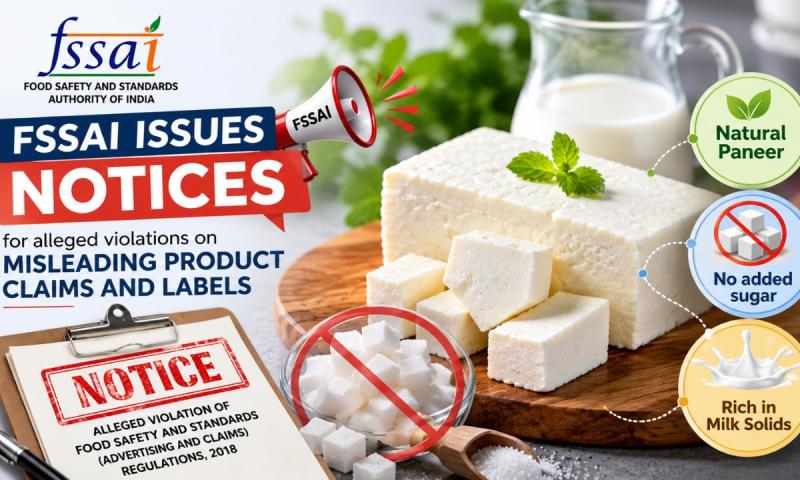
The Food Safety and Standards Authority of India (FSSAI) has issued a compliance notice to Heritage Foods Limited over its "Heritage Fresh Paneer" packaging. The regulator ruled that using words like "Fresh" and "Healthy" violates labeling standards and misleads consumers. The company has seven days to respond or face legal penalties.
NEW DELHI, India — The Food Safety and Standards Authority of India (FSSAI) has issued a formal notice to dairy manufacturer Heritage Foods Limited over allegedly misleading claims on its packaged paneer product. In a regulatory sweep announced on Monday, July 6, 2026, the apex food safety body stated that the brand’s "Heritage Fresh Paneer" label violates national food standards, potentially deceiving consumers about the actual characteristics of the packaged product.
The enforcement action is part of a broader, intensified campaign by the regulator to eliminate unsubstantiated marketing phrases from consumer food packaging across the country. Alongside Heritage Foods, two other food business operators (FBOs)—Dia Foods and Cipzer Nutraceuticals—were also served notices for separate labeling and compliance violations.
Non-Compliance with Labeling and Advertisement Rules
According to the official regulatory notice published by the Food Safety and Standards Authority of India (FSSAI), the commercial use of the term "Fresh Paneer" on the Heritage Foods product line fails to meet the strict legal conditions mandated under Schedule V of the Food Safety and Standards (Advertising and Claims) Regulations, 2018.
The regulator pointed out that using terms like "Fresh" on packaged, processed, or long-shelf-life dairy items can mislead the public into believing the food possesses unique physical attributes or immediate processing timelines that do not align with regulatory definitions.
Furthermore, the FSSAI raised formal objections to secondary branding elements on the product that utilized the word "Healthy." The statutory body clarified that under Regulation 8(3) of the 2018 framework, implying a product inherently promotes or enhances general health is forbidden unless backed by specific, prior regulatory clearances and robust scientific verification.
Seven-Day Deadline and Broad Enforcement Sweep
The Ministry of Health and Family Welfare, which oversees the food authority, confirmed that Heritage Foods has been given a strict seven-day window to respond to the notice. The company must explain why punitive legal action should not be pursued under the Food Safety and Standards Act, 2006.
The parallel notices issued during Monday's enforcement action highlight the variety of marketing practices currently under scrutiny:
Dia Foods: Cited for its "La Casa Vegan Hazelnut Chocolate Spread." The company allegedly marketed the item as "All Natural" and "100% Organic" without obtaining the required organic and vegan food endorsements under its FSSAI license. The regulator also referenced a recent advisory from May 28, 2026, which restricts unscientific uses of the absolute term "100%."
Cipzer Nutraceuticals: Flagged for its juice capsules displaying unauthorized "FSSAI Approved" tags, which falsely imply an official government product endorsement rather than standard business licensing.
Impact on Dairy Consumers and the Food Industry
The regulatory crackdown directly affects millions of daily consumers who rely on clear packaging to make dietary decisions. For investors and businesses in India's highly competitive FMCG and dairy sectors, the move signals that the central government is zeroing in on corporate compliance. Companies will likely need to audit their existing packaging designs and phase out generic buzzwords to avoid costly product recalls, supply chain disruptions, or formal penalties.
Official Sources Section
The regulatory actions, specific legal non-compliance details, and product tracking data detailed in this report are based entirely on official public statements and digital notices published on July 6, 2026, by the Food Safety and Standards Authority of India (FSSAI).
Quote Section
"FSSAI has issued notices to several food business operators (FBOs) for violating provisions of the FSS Act, 2006 regarding misleading claims and labelling violations," the food safety authority stated in an official announcement. "FBOs are directed to strictly comply with the established regulations and to take corrective measures."
Why It Matters
This enforcement action bridges the gap between creative corporate marketing and strict consumer protection law. By enforcing precise rules for standard adjectives like "fresh" and "healthy," the government ensures that large dairy cooperatives and independent food brands operate on a transparent, level playing field. Consumers gain higher confidence that the vocabulary used on grocery store shelves directly matches the scientific status of the ingredients inside.
Key Facts at a Glance
Targeted Product: "Heritage Fresh Paneer," manufactured and distributed by Heritage Foods Limited.
Core Violation: Unauthorized use of terms "Fresh" and "Healthy" in direct violation of Schedule V and Regulation 8(3) of India’s 2018 Advertising and Claims rules.
Ultimatum Issued: The manufacturer has been given seven days to submit a formal defense or face direct prosecution under the FSS Act, 2006.
Wider Sector Crackdown: Parallel regulatory interventions penalised competing brands for unauthorized "100% Organic", "Vegan", and "FSSAI Approved" labeling.
Frequently Asked Questions
Why is the word 'Fresh' restricted on packaged paneer?
Under FSSAI guidelines, specialized descriptive terms like "Fresh" are legally reserved for products that have not undergone processing, preservation, or extended storage. Packaged paneer that requires chemical or thermal preservation to maintain shelf life does not meet this standard.
What happens if Heritage Foods fails to comply within seven days?
If a food business operator fails to provide a valid explanation or correct its product labels within the seven-day window, the FSSAI can initiate financial penalties, suspend manufacturing licenses, or launch legal prosecution under the Food Safety and Standards Act.
Are these products unsafe to eat?
No. The notices issued by the FSSAI focus entirely on deceptive marketing, labeling inaccuracies, and advertising violations. The safety, hygiene, or chemical purity of the underlying food items has not been challenged in these specific notices.
Source: Food Safety and Standards Authority of India (FSSAI) Portal, Ministry of Health and Family Welfare.