The Ministry of Road Transport and Highways has proposed extending Pollution Under Control Certificate (PUCC) validity to three years for BS-VI vehicles under six years old. The draft rules reduce compliance frequency for cleaner cars while mandating stricter testing every three to six months for older emission standards.
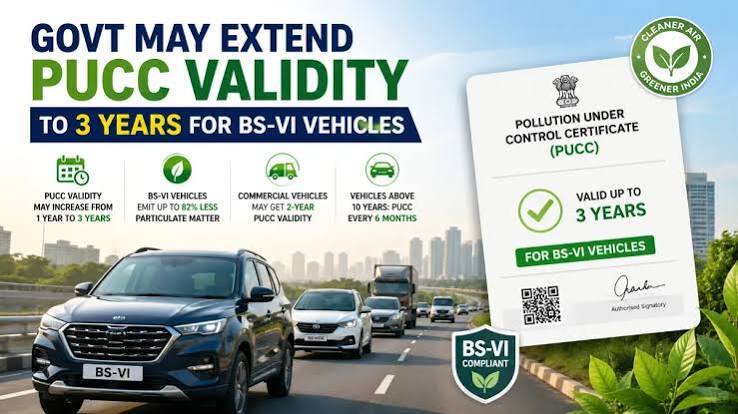
NEW DELHI — The Ministry of Road Transport and Highways (MoRTH) has issued a draft notification proposing to extend the validity of the Pollution Under Control Certificate (PUCC) for BS-VI-compliant private vehicles up to six years old from one year to three years.
The proposal, published as part of upcoming amendments to the Central Motor Vehicles Rules, aims to reward owners of cleaner, lower-emission vehicles with reduced compliance friction while systematically tightening inspection schedules for older, higher-polluting transport models.
Tiered Compliance Based on Vehicle Age and Emission Norms
According to official draft details released by MoRTH, the revised framework establishes a tiered inspection timeline linked directly to a vehicle's Bharat Stage (BS) emission standards and operational age:
BS-VI Private Vehicles (0–6 years old): Exemption from annual testing, requiring PUCC renewal only once every three years.
BS-VI Private Vehicles (6–10 years old): Mandatory annual PUCC renewal.
BS-VI Private Vehicles (Above 10 years old): Mandatory PUCC renewal every six months.
BS-VI Commercial Vehicles (0–6 years old): Validity extended to two years.
BS-IV Compliant Vehicles: Uniform mandatory renewal required every six months regardless of age.
Legacy Vehicles (BS-I, BS-II, BS-III): Stricter compliance mandates requiring testing and renewal every three months.
The Bharat Stage VI standards, enforced nationwide since April 1, 2020, mandate advanced tailpipe treatment tech like selective catalytic reduction (SCR) and diesel particulate filters (DPF). Government data shows BS-VI petrol and diesel engines emit substantially lower particulate matter (PM) and nitrogen oxides ($\text{NO}_x$) compared to older BS-IV platforms.
Regulatory Objectives and Environmental Justification
Government transportation officials noted that modern BS-VI engines maintain stable emission profiles over initial operating cycles due to onboard diagnostics (OBD-II) systems that alert drivers to component malfunctions in real time.
By extending validity periods for newer, cleaner vehicles, transport departments can redirect enforcement and testing resources toward monitoring high-emission commercial transport and legacy engines lacking modern exhaust filtration.
The proposal also integrates all PUCC issuance centers directly into the national VAHAN database to prevent fraudulent certification and ensure real-time enforcement during routine traffic checks or motor insurance renewals.
Official Sources Section
According to official draft notifications and announcements from the government:
Official Statements and Industry Insights
According to officials at the Ministry of Road Transport and Highways, the draft regulations reflect a data-driven approach to pollution control that balances environmental enforcement with consumer convenience.
"The goal of the revised PUCC framework is to ease the compliance burden on citizens who invest in cleaner, modern vehicle technologies like BS-VI, while simultaneously ensuring that older vehicles with higher pollution footprints are inspected regularly," transport department officials stated in published administrative summaries.
Why It Matters
For millions of private car and two-wheeler owners, the proposal drastically reduces routine trips to authorized testing kiosks—requiring only two PUCC renewals during the first six years of vehicle ownership instead of six.
For transport authorities and environmental agencies, the policy establishes a clear regulatory incentive for citizens to transition away from legacy BS-I, BS-II, and BS-III models toward modern low-emission powertrains or electric vehicles.
Key Facts at a Glance
BS-VI Private Vehicles: Proposed 3-year PUCC validity for vehicles up to 6 years old.
BS-VI Commercial Fleet: Proposed 2-year PUCC validity for new commercial transport.
Legacy Norms: BS-IV vehicles will require testing every 6 months; BS-I through BS-III require testing every 3 months.
Database Linkage: All PUCC records must sync directly with the central VAHAN portal to qualify for motor insurance renewals.
Frequently Asked Questions
Does the three-year PUCC rule apply to all cars immediately?
No. The proposal is currently in the draft notification stage issued by MoRTH. Once finalized and published in the official gazette, it will apply specifically to BS-VI-compliant vehicles up to six years old.
How often will BS-IV vehicles need pollution testing under the new rules?
Under the proposed rules, all BS-IV compliant vehicles must undergo pollution testing every six months, regardless of their age.
What happens if I drive without a valid PUCC?
Under Section 190(2) of the Motor Vehicles Act, driving without a valid PUCC attracts penalties of up to ₹10,000, potential license suspension, and invalidation of motor insurance coverage.
Source: Ministry of Road Transport and Highways (MoRTH) | Parivahan Sewa Official Portal