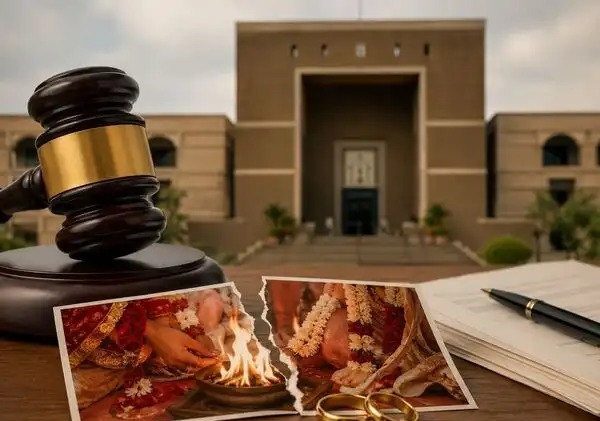
The Gujarat High Court ruled that a registered marriage certificate cannot validate a Hindu union if customary religious ceremonies are not performed. Emphasizing that registration serves strictly as proof of an already solemnized wedding under the Hindu Marriage Act, the court declared a disputed marriage invalid because foundational rituals were omitted.
AHMEDABAD, India — The Gujarat High Court has ruled that the registration of a Hindu marriage under Section 8 of the Hindu Marriage Act, 1955 serves only as proof of an already solemnized marriage and cannot confer legal status if essential customary rites and ceremonies are not performed. The judgment, delivered by a division bench on June 23, 2026, and made public on Monday, emphasizes that a marriage certificate alone does not establish the legal relationship of husband and wife under Hindu law if foundational rituals like saptapadi (the seven sacred steps around the fire) are absent.
This development is critically important today as it reinforces the strict statutory boundaries between civil documentation and personal religious laws in India. The decision directly impacts non-resident Indians (NRIs), young couples, and legal practitioners by clarifying that contractual or administrative registration cannot override the essential ceremonial prerequisites mandated by Section 7 of the Hindu Marriage Act.
Legal Supremacy of Customary Rites Over Certificates
The division bench, comprising Justice Ilesh J. Vora and Justice R.T. Vachhani, set aside a previous family court order that had refused to invalidate a marriage despite explicit admissions that no wedding rituals had occurred. The High Court held that registration is an evidentiary tool rather than a validation mechanism.
According to the judgment in Kaushal Pramodbhai Sonar v. Khushi Sanjay Shah, the bench observed that the purpose of Section 8 registration is strictly to provide proof of a marriage validly solemnized under Section 7. If no foundational marriage rites have occurred, any registration certificate issued by authorities holds no legal effect and fails to alter the marital status of the parties.
The ruling arose from an appeal by Kaushal Sonar, a UK-based professional who discovered an alleged marriage only after the defendant, an Ahmedabad resident, presented a marriage certificate to his parents. Sonar contended that his signatures were obtained fraudulently under professional duress at a firm owned by the woman's father, and that they had never lived together or performed any Hindu rites.
During the family court proceedings, the woman explicitly admitted in her written statement that no rites or rituals had taken place. However, the lower court insisted on a full trial, citing that a registered certificate raised a presumption of validity. The High Court criticized this stance, stating that forcing a long trial when the absence of a foundational fact is mutually admitted is an error of law.
Marriage is "Not Merely Song and Dance"
The bench expanded on the sociological and spiritual weight of the institution under Indian jurisprudence, asserting that a Hindu marriage is a samskara (sacrament) forming the bedrock of a new family unit.
The court stated that a marriage is not a commercial transaction or simply an occasion for "song and dance" or "wining and dining." Instead, it is a sacred event designed to create a lifelong, consensual, and dignified partnership. The bench highlighted that local and geographical variations in rituals do not dilute their legal necessity, as they are legally bound to purify and transform the spiritual being entering the union.
Official Sources Section
The legal findings and statutory interpretations detailed in this report are sourced directly from the final judgment issued by the Gujarat High Court under Neutral Citation 2026:GUJHC:38968-DB. The court explicitly relied upon Section 7 (Solemnization of a Hindu Marriage) and Section 8 (Registration of Hindu Marriages) of the Hindu Marriage Act, 1955. The bench also substantiated its interpretation by citing the landmark Supreme Court of India precedent Rathnamma & Ors. v. Sujathamma & Ors., which dictates that administrative registration does not validate an otherwise unsolemnized marriage.
Quote Section
The division bench of Justices Ilesh J. Vora and R.T. Vachhani explicitly detailed the limits of marriage documentation in their written order:
"The purpose of registration under Section 8 is only to provide evidence and proof of a marriage that has already been validly solemnized in accordance with Section 7 of the Act. Registration under Section 8 does not, by itself, make a marriage valid or legal if the essential ceremonies required under Section 7 have not been performed. If no such marriage has actually taken place, any registration made or certificate issued will have no legal effect."
Why It Matters
This judgment brings critical clarity to family law, closing loopholes where fraudulent or coercive marriage certificates are leveraged for extortion, immigration advantages, or property claims without actual marital consent or solemnization. For citizens and international non-residents (NRIs), it clarifies that signing civil registry forms without performing community-recognized rites offers zero legal protection or matrimonial rights under the Hindu Marriage Act.
Key Facts at a Glance
Evidentiary Limit: A marriage certificate under Section 8 is proof of a previous wedding; it cannot create a legal marriage out of thin air.
Statutory Commandment: Section 7 of the Hindu Marriage Act mandates customary rites, including saptapadi, to make a union complete and legally binding.
Admission Extinguishes Trial: When both parties formally admit that no religious rituals took place, courts must invalidate the union immediately rather than ordering a prolonged trial.
Case Outcome: The High Court declared the disputed cross-border marriage null and void ab initio (invalid from the beginning).
FAQ Section
Q1: Does this ruling mean all registered marriages in India need a religious ceremony?
A1: This ruling applies specifically to unions registered under the Hindu Marriage Act, 1955. Civil marriages conducted under the Special Marriage Act, 1954 do not require religious rites and are validated solely by civil solemnization before a marriage officer.
Q2: What happens if a marriage certificate is issued but no rituals were performed?
A2: According to the Gujarat High Court, such a certificate has no legal effect and does not establish the legal status of husband and wife. The affected party can legally approach competent authorities to have the registration and certificate canceled.
Q3: Is saptapadi mandatory for every Hindu marriage in India?
A3: Section 7 states that a marriage must follow the recognized customary rites and ceremonies of either party. Where saptapadi is an essential part of those customs, it is mandatory; where other distinct traditional rites govern the community, those specific rituals must be fulfilled.
Q4: Can a lower family court force a trial if one party holds a registered certificate?
A4: No. The High Court clarified that if there is a clear, unambiguous admission by the party holding the certificate that no marriage rituals were solemnized, the family court must pass a decree on that admission immediately.
Source: Gujarat High Court Official Portal, Ministry of Law and Justice, Government of India.