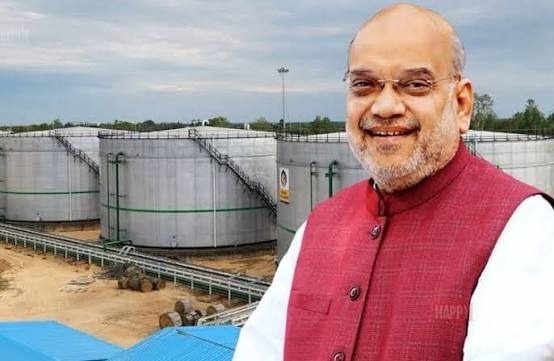
Union Home Minister Amit Shah will inaugurate BPCL’s ₹1,775 crore integrated 1G and 2G bio-ethanol refinery in Bargarh, Odisha, on July 4, 2026. The advanced 200 KLPD facility processes grains and rice straw into fuel, supporting the national E20 blending mandate and creating substantial new economic channels for local agricultural communities.
BARGARH, ODISHA — Union Minister for Home Affairs and Cooperation Amit Shah will pay a high-profile two-day visit to western Odisha on July 4 and 5, 2026, to officially inaugurate Bharat Petroleum Corporation Limited’s (BPCL) advanced integrated bio-ethanol refinery in Bargarh district. The launch of this mega environmental project represents a critical structural milestone for India's National Biofuels Policy, accelerating the domestic timeline to achieve its statutory target of 20 percent ethanol blending in petrol across national distribution grids.
Technical Prowess: Bridging First and Second Generation Refining
The state-of-the-art facility, constructed at Baulsingha village in Bargarh with an aggregate capital investment of ₹1,775 crore, is the first refinery in India designed to integrate both first-generation (1G) and second-generation (2G) bio-ethanol technologies at a single location. Developed under the financial parameters of the central government's Pradhan Mantri JI-VAN Yojana, the facility boasts a combined operational capacity of 200 kilolitres per day (KLPD).
The production architecture splits the output evenly between the two technologies:
1G Infrastructure (100 KLPD): Utilizes a grain-based processing framework to refine fuel-grade bioethanol directly from broken food grains and surplus starches.
2G Plant (100 KLPD): Employs sophisticated lignocellulosic conversion technology to extract high-yield ethanol strictly from agricultural residues, primarily utilizing regional rice straw.
BPCL has already successfully executed and dispatched early initial shipments from the grain-based 1G block over the past few months. The upcoming formal dedication by the Union Home Minister marks the official commissioning of the complex 2G block, signaling the complete operational readiness of the integrated bio-energy ecosystem.
Economic Dividends for Regional Farmers and Agriculture
The dual-feed strategy provides immediate practical and economic benefits to the agricultural communities of western Odisha, particularly across the rice-producing hubs of Bargarh and Sambalpur. Historically, the clearing of post-harvest crop residue has caused significant localized waste mismatches. By establishing a commercial value chain for rice straw, the refinery transforms a former agricultural waste product into an active raw material asset class.
According to a regional assessment provided by local lawmakers, the operational stabilization of the refinery will create an extensive rural collection infrastructure. This network will generate hundreds of direct corporate positions inside the processing facility alongside thousands of indirect logistical jobs across harvesting, processing, baling, and transport networks, adding vital income streams to the rural economy.
Aligning National Energy Security and Environmental Mandates
Beyond its localized industrial impact, the Bargarh bio-ethanol refinery is highly strategic to India's macro-energy goals. By refining domestic, plant-based fuel components, the state-owned oil marketing giant directly reduces the country's multi-billion-dollar crude oil import dependencies.
Furthermore, the technological absorption of rice straw acts as a vital environmental countermeasure. Providing an alternative industrial destination for crop residues prevents open stubble-burning practices, significantly lowering seasonal particulate matter emissions and greenhouse gas releases, while creating a high-protein animal feed byproduct to support regional animal husbandry sectors.
Official Sources Section
The operational launch specifics and the Union Minister’s detailed itinerary were validated using announcements shared by Bargarh Member of Parliament Pradeep Purohit and Odisha Revenue and Disaster Management Minister Suresh Pujari. Regulatory tracking criteria and investment parameters correspond directly to the program metrics administered under the Ministry of Petroleum and Natural Gas.
Quote Section
"According to officials managing the central infrastructure calendar, the complete activation of the integrated 1G and 2G bio-refinery provides robust proof of India's technical self-reliance in alternative energy, turning agricultural waste metrics into solid drivers of regional corporate investment and clean energy resilience."
Why It Matters
For energy markets, private vehicle consumers, and regional agricultural networks, the commercial completion of this refinery guarantees a stable, indigenous supply of fuel oxygenates. The steady volume addition from Bargarh ensures that oil marketing companies can maintain the E20 blending thresholds continuously without experiencing structural feedstock shortages or logistics bottlenecks.
Key Facts at a Glance
Project Value: Scaled at an aggregate execution expenditure of ₹1,775 crore under central schemes.
Production Capacity: Capped at 200 KLPD, balancing 100 KLPD of 1G and 100 KLPD of 2G technology.
Feedstock Source: Utilizes broken food grains alongside regional rice straw residue.
Inauguration Timing: Formally scheduled for July 4, 2026, during the Home Minister's multi-day state visit.
FAQ Section
What makes the Bargarh ethanol refinery unique in India?
It is the nation’s first facility to integrate both grain-based first-generation (1G) and lignocellulosic second-generation (2G) ethanol manufacturing processes at a single localized industrial site.
How does this refinery directly assist local farmers?
The facility creates a formal, paid marketplace for agricultural residues like rice straw, giving local farmers an alternate source of revenue while mitigating the need for open field stubble burning.
What scheme funded the development of this green project?
The advanced refinery project was developed and incentivized under the central government’s Pradhan Mantri JI-VAN Yojana, which supports commercial bio-ethanol ventures.
Source: Ministry of Petroleum and Natural Gas Official Portal, Bharat Petroleum Investor Disclosures