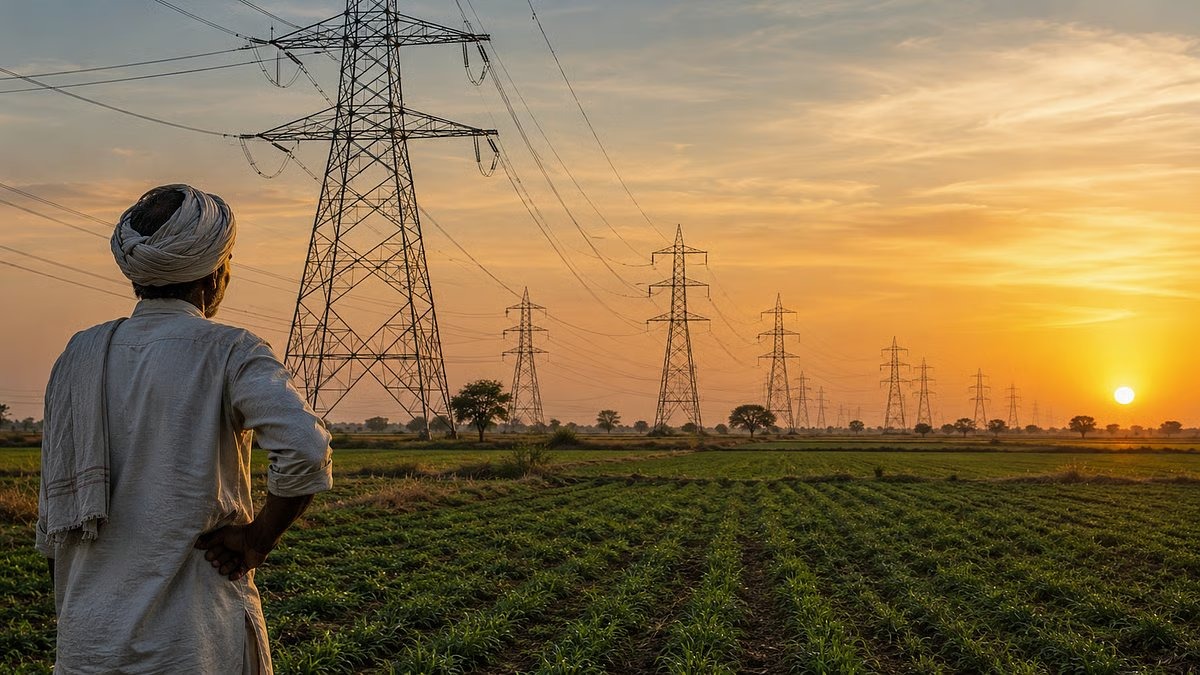
The Gujarat government has significantly increased compensation for farmers whose land is used for power transmission lines. Moving away from jantri-based rates, farmers will now receive twice the market value of their land, with full upfront payments and increased compensable tower-base areas, resolving months of agricultural protests across the state.
The state government has replaced jantri-based payouts with a market-linked model, ensuring fairer compensation for land used in transmission infrastructure.
GANDHINAGAR, Gujarat — In a major policy shift aimed at addressing widespread farmer agitation, the Gujarat government announced on Friday, July 3, 2026, a significant enhancement in compensation for agricultural land utilized for electricity transmission lines and power towers. The revised framework replaces the outdated "jantri" (official circle rate) system with a model linked to twice the prevailing market value of the land, providing a more transparent and lucrative payout structure for affected landowners.
The decision, spearheaded by Chief Minister Bhupendra Patel, follows months of protests by various farmers' organizations, including the Kisan Congress and Kisan Sangharsh Samiti, who had long argued that existing compensation rates failed to account for the loss of land productivity and the long-term impact of high-voltage transmission corridors.
Key Changes to the Compensation Framework
Under the new policy, the government has overhauled several aspects of how transmission infrastructure projects impact private farmland:
Market-Linked Valuation: Compensation for land affected by transmission lines will now be calculated at twice the prevailing market value, rather than the previous benchmark based on jantri rates.
Upfront Payments: The state has abolished the staggered three-installment payment system (previously distributed during foundation work, tower erection, and stringing). Landowners will now receive 100% of their compensation upfront before project work begins.
Expanded Tower Base Area: The compensable area for transmission towers has been increased to include an additional one-meter buffer on all four sides of the base. For example, for a 765 kV transmission line, the compensable area has been expanded from 625 square meters to 729 square meters.
Transparency through MRCs: The government will constitute a Market Rate Committee (MRC) in every district to determine fair land values. This committee will include the District Collector, representatives of affected landowners, an authorized valuer nominated by farmers, and representatives from the transmission service provider.
Impact on Ongoing Projects
The government confirmed that the revised policy is not restricted to future projects. Farmers whose compensation was fixed under previous rates but whose projects are still under execution will now be eligible for the benefits of this new framework.
For the Right of Way (RoW) corridor—the land path required for overhead lines—payments will be linked to the market value determined by the MRC. Farmers in rural areas will receive 30% of the assessed market value, while those in municipal council and municipal corporation areas will receive 45% and 60%, respectively.
Official Sources
According to an official government press release issued on July 3, 2026, the policy change was finalized after extensive consultations with farmers' organizations and cabinet-level reviews. Agriculture Minister Jitubhai Vaghani confirmed that the administration prioritized farmers' economic interests to ensure the smooth rollout of critical energy infrastructure.
Quote Section
"Responding to long-standing representations from farmer organisations, the state government has decided that compensation will now be calculated at twice the prevailing market value of the land instead of the jantri rate," stated an official government release.
Why It Matters
This policy pivot is a direct response to the increasing friction between renewable energy development and agricultural land rights in Gujarat. By ensuring fair, market-linked payouts, the government aims to mitigate the protests that had been delaying significant power projects. For farmers, this ensures a more equitable settlement for land lost to energy infrastructure, while for transmission companies, it provides a clearer path for project execution.
Key Facts at a Glance
Valuation Shift: Compensation has moved from 200% of jantri rates to twice the prevailing market value.
Total Upfront Payouts: The three-stage installment system has been scrapped in favor of a 100% upfront payment policy.
Increased Compensable Area: Tower base calculations now include a one-meter buffer on all four sides.
Inclusive Valuation: Market Rate Committees (MRCs) will include representatives nominated by the farmers to ensure transparency.
FAQ
Who is eligible for the new compensation rates?
The new policy applies to all future projects and existing transmission projects that are still under execution.
How will the market value of the land be determined?
The Market Rate Committee (MRC), comprising government officials, transmission company representatives, and farmer-nominated valuers, will assess the prevailing market value for each project area.
What happens to farmers already compensated under old rules?
The government has explicitly stated that farmers whose transmission projects are still under execution are eligible for the benefits of the new compensation policy.
Source: Gujarat Government Press Release, The Times of India, Economic Times