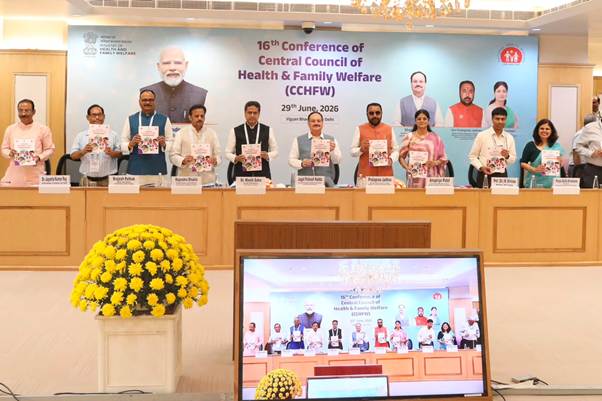
The Union Health Ministry has launched the SUMAN Roadmap 2030, a comprehensive National Strategy for Safe Motherhood and Newborn Care. Unveiled by Health Minister J.P. Nadda, the data-driven framework targets 130 high-focus districts to eliminate preventable maternal deaths and reduce the national Maternal Mortality Ratio to below 70 by 2030.
NEW DELHI — The Union Ministry of Health and Family Welfare officially launched its comprehensive National Strategy for Safe Motherhood and Newborn Care on June 29, 2026. Unveiled by Union Health Minister Jagat Prakash Nadda during the 16th Conference of the Central Council of Health and Family Welfare (CCHFW) in New Delhi, the initiative is formally designated as the "SUMAN Roadmap 2030." This strategic development represents a major public health milestone designed to accelerate India’s progress toward achieving the United Nations Sustainable Development Goals (SDGs) for maternal and child health over the next four years.
Targeted Interventions Across High-Burden Districts
The new National Strategy for Safe Motherhood and Newborn Care moves away from a uniform public health model, opting instead for a highly customized, data-driven approach. According to statements released by the health ministry, the initiative introduces targeted, time-bound medical and systemic interventions across 130 specific districts located within 13 high-focus states.
These states include Assam, Bihar, Chhattisgarh, Haryana, Jharkhand, Karnataka, Madhya Pradesh, Odisha, Punjab, Rajasthan, Uttar Pradesh, Uttarakhand, and West Bengal. By funneling specialized financial, clinical, and infrastructure assets directly into these historically underserved zones, the government aims to dramatically narrow regional disparities in healthcare access and quality.
Life-Cycle Healthcare and the RMNCHA+N Framework
Administrators confirmed that the operational design of the strategy is strictly anchored within the pre-existing Reproductive, Maternal, Newborn, Child and Adolescent Health plus Nutrition (RMNCHA+N) framework. The SUMAN Roadmap 2030 implements a continuous life-cycle approach to female reproductive healthcare, integrating clinical and community interventions across four distinct stages:
Pre-Pregnancy Care: Institutionalizing preventive measures, including regular folic acid supplementation for women planning families.
Antenatal and Perinatal Support: Expanding intensive nutritional tracking to combat maternal anemia and undernutrition.
Intrapartum Care: Introducing artificial intelligence (AI)-enabled labor rooms and digital monitoring utilities.
Postnatal Continuity: Securing mandatory minimum institutional stays post-delivery alongside structured infant care.
The strategy places a heavy operational focus on the multi-stage tracking and clinical management of high-risk pregnancies, ensuring that complications are flagged well before labor begins.
Community Integration and Infrastructural Upgrades
To bridge the gap between rural households and urban medical centers, the National Strategy for Safe Motherhood and Newborn Care heavily utilizes community-level engagement. The health ministry announced the creation of "SUMAN Panchayats," which will leverage local governance to drive accountability and promote positive health practices.
Additionally, Accredited Social Health Activists (ASHAs) will conduct bi-weekly home visits during the final months of pregnancy to screen for clinical danger signs. On the infrastructure front, the roadmap establishes dedicated Birth Waiting Homes, Maternal and Child Health Wings, and Obstetric High Dependency Units (HDUs). It also mandates the wider deployment of Non-Pneumatic Anti-Shock Garments (NASG) to effectively manage obstetric hemorrhage during emergency transit.
Official Sources Section
The institutional directives, statistical metrics, and implementation targets detailed in this report are sourced directly from official government releases, including:
The official press statements published by the Press Information Bureau (PIB) under the Ministry of Health and Family Welfare, Government of India.
Opening declarations and policy documentation presented at the 16th Conference of the Central Council of Health and Family Welfare.
Statutory operational briefs compiled by the Maternal Health Division of the Indian Government.
Quote Section
"India's vision of a Viksit Bharat by 2047 cannot be realized without a healthy population, making health one of the core pillars of national development," stated Union Health Minister Jagat Prakash Nadda during the policy rollout.
"According to officials from the Ministry of Health and Family Welfare, the newly launched roadmap adopts a person-centric, comprehensive life-cycle approach, ensuring convergence with child health, adolescent health, family planning, and national nutrition programs."
Why It Matters
For citizens, rural communities, and healthcare providers, this strategy establishes a formal, legally backed service guarantee. By eliminating out-of-pocket expenses for emergency obstetric transport, critical drugs, and neonatal diagnostics under the expanded Surakshit Matritva Aashwasan (SUMAN) initiative, the policy removes the financial dread historically associated with institutional childbirth. For corporate healthcare investors and public health agencies, the deployment of AI-enabled labor rooms and centralized digital tracking via the JANANI Portal opens major pathways for public-private medical tech integration.
Key Facts at a Glance
Primary Objective: The strategy aims to lower the national Maternal Mortality Ratio (MMR) to below 70 per 100,000 live births by the year 2030.
Geographic Target: Immediate operational deployments will focus heavily on 130 high-burden districts spread across 13 selected states.
Digital Infrastructure: Implementation includes the mandatory launch of the JANANI Portal for real-time beneficiary tracking and a centralized SUMAN Call Centre for grievance redressal.
Historical Baseline: Official ministry figures show India's MMR has successfully declined from 130 to 87 per 100,000 live births since 2014.
FAQ Section
Q1: What is the primary goal of the SUMAN Roadmap 2030? A1: The primary goal is to establish a comprehensive framework that reduces the national Maternal Mortality Ratio (MMR) to under 70 per 100,000 live births, drives down infant mortality, and ensures universal access to dignified, high-quality maternal and newborn healthcare.
Q2: Which states are classified under the "high-focus" category? A2: The strategy isolates 130 districts across 13 states: Assam, Bihar, Chhattisgarh, Haryana, Jharkhand, Karnataka, Madhya Pradesh, Odisha, Punjab, Rajasthan, Uttar Pradesh, Uttarakhand, and West Bengal.
Q3: How does the strategy utilize technology in rural labor rooms? A3: The roadmap outlines the digitalization of delivery infrastructure through AI-enabled labor rooms and enhanced tracking tools integrated directly into the government's centralized JANANI Portal.
Q4: What specific community-level programs are being introduced? A4: The government is introducing "SUMAN Panchayats" to foster local administrative accountability, bi-weekly third-trimester home visits by ASHA workers, and social awareness platforms like the "Mothers' Picnic."
Source: Ministry of Health and Family Welfare, Government of India; Press Information Bureau (PIB) Delhi.